NEWSnews
GDZX Assists Inner Mongolia Clients in Accurate Cable Fault Location and Repair
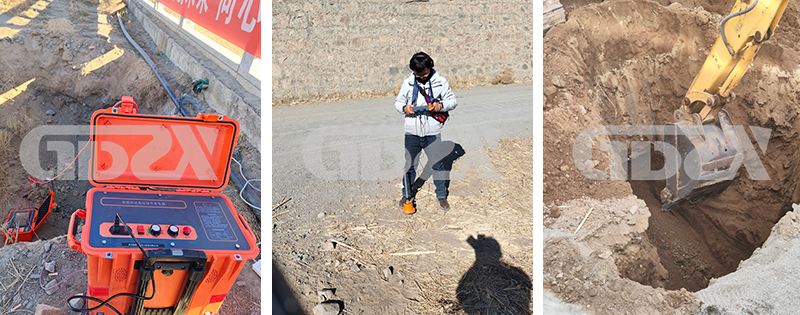
From March 13 to 22, 2026, GDZX was invited by the customer to Inner Mongolia to locate and troubleshoot cable faults.The equipment used during the test included:ZX-Z10 Automatic Analysis Cable Fault Tester,ZX-A301 Cable Fault Locator,ZX-32B02 Cable Test High-Voltage Signal Generator,ZXPDF-3000EW Overhead Line Fault Locator,ZXPD4001 Underground Pipeline Detector, and other instruments.Both the equipment and technical services received unanimous praise from tcustomer.Customer recognition is our driving force for progress.GDZX will continue to provide reliable technical support to customers as always.
Cable Fault Location
Photovoltaic area cables
Since the path is unknown, a path detector is first used to locate the route. A transmitter injects a high-frequency signal into the cable, and a receiver then detects the same-frequency signal emitted underground to identify the cable path.
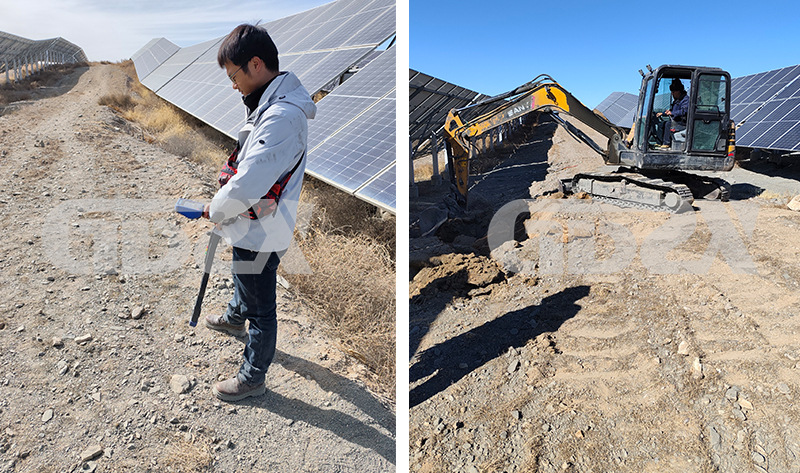
After the cable is exposed by excavator and manual excavation, the cable identification function of the path detector is used to identify the cable. The principle is to record and calibrate the injected signal cable and phase at the transmitting end via a coupling clamp, then perform identification at the excavated cable location.
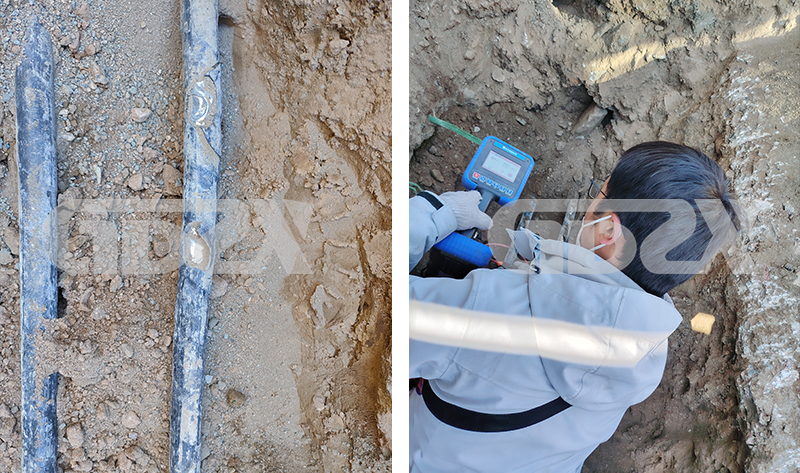
Secondary confirmation is performed using an overhead line tester. The principle is to inject a fixed-frequency square-wave signal into the cable via a transmitter, and then verify the signal with a receiver.
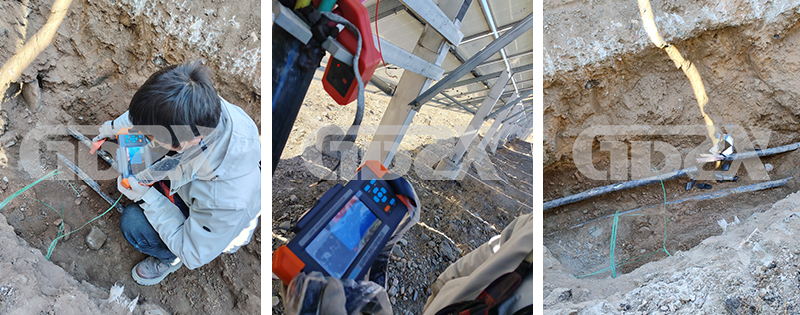
Once the cable is identified, it will be cut off and repaired.
cable for living quarters
The excavator digs open the cable joint, and the cable fault tester is then used to measure the low-resistance fault distance. The principle is based on time domain analysis: by calculating the time it takes for the signal to reflect back, the cable length is determined using a fixed wave velocity.
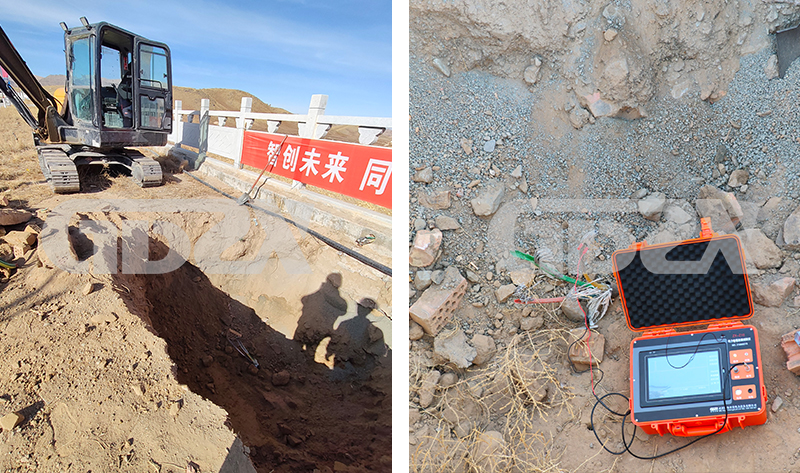
Then, combined with an integrated high-voltage power source, impulse voltage is applied to the cable to measure the high-resistance fault distance.
Since the cable path is known, the fault point can be located directly using a fault locator. The principle is to amplify the acoustic signal generated by the underground fault point via an earphone, and compare it with the electrical signal of the cable; the point with the strongest correlation is the fault point. Measurement is carried out near the high-resistance fault distance measured by the main cable fault tester.
After locating the fault point, the excavator is used to dig it out.