


NEWSnews
Technical Analysis and Application of ZXR-2A Transformer WindingResistanceTester
Introduction
In the power transmission and distribution system, the power transformer is the core energy conversion equipment, and the DC resistance test of its winding is a key mandatory test in the factory test, installation handover test, and in-service preventive test of the equipment. This test can effectively detect major equipment hidden dangers such as welding defects of winding conductors, inter-turn insulation damage, poor contact of tap changers, broken strands of leads, and loose windings, which is a core technical means to ensure the safe and stable operation of transformers.
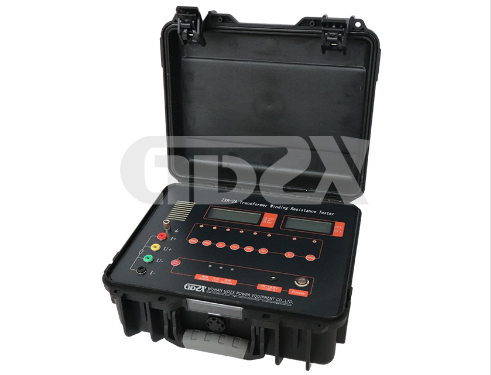
As classic test equipment, the traditional DC single/double bridge has inherent defects such as low test efficiency, long core saturation time under large inductive load, difficult reading in strong light environment, and weak on-site anti-interference ability, which can no longer meet the efficient and high-precision on-site test requirements of modern power engineering. This paper systematically analyzes the technical principle, core performance advantages and engineering application key points of the ZXR-2A transformer winding resistance tester, so as to provide technical reference for power test technicians in equipment selection and on-site application.
1. Core Technical Principle and Architecture of the Instrument
The ZXR-2A winding resistance tester adopts a high-precision closed-loop measurement and control architecture, which is mainly composed of a high-power switching power supply module, multi-range high-precision constant current source module, four-terminal measurement and sampling unit, data processing and dual-screen display unit, AC/DC dual power management module, and automatic arc suppression protection unit.
The instrument abandons the balance measurement principle of the traditional bridge, and adopts the constant current source voltage application - four-terminal sampling measurement method: by injecting high-precision and stable DC current into the measured winding, synchronously collecting the millivolt level voltage drop signal at both ends of the winding, and directly calculating and displaying the DC resistance value in real time after high-precision AD conversion and digital filtering processing, which fundamentally solves the pain points of the traditional bridge such as repeated balance adjustment, cumbersome measurement process and large human error. At the same time, the instrument has built-in advanced high-frequency switching power supply technology, which can realize wide-range adaptive high-current output. For transformer windings with large inductance characteristics, it can quickly compensate for current inertia, accelerate core magnetic saturation, and fundamentally reduce the test waiting time.
2. Core Technical Features and Engineering Application Advantages
2.1 Ultra-fast Test Capability, Adapted to On-site Operation Requirements of Large-Capacity Transformers
The winding of large-capacity power transformers in the power system presents the load characteristics of large inductance and low resistance. When testing with a traditional bridge, affected by the core excitation characteristics, the winding charging stabilization time can be as long as tens of minutes, and the full-range test of multi-range taps will take an extremely long power outage operation window, resulting in extremely low test efficiency.
Through the high-power switching power supply and high-current constant current output design, the maximum constant current output of the ZXR-2A tester can reach 2A, which can realize fast current compensation for large inductive loads during the test, greatly accelerate the core saturation process, and compress the charging stabilization time to 1% of that of the traditional single/double bridge, with the test efficiency increased by hundreds of times. This feature greatly shortens the operation time of on-site tests, especially adapts to the full-range test scenario of multi-range on-load tap changers of large-capacity main transformers in substations, and can significantly reduce the time cost of equipment power outage operation.
2.2 High-precision Measurement and Strong Anti-interference Design, Ensuring the Reliability of Test Data
The instrument adopts the industry-proven four-terminal measurement technology, which completely eliminates the influence of test lead resistance and terminal contact resistance on the measurement results, and lays a hardware foundation for high-precision measurement. At the same time, the built-in full-range closed-loop constant current source system can maintain high stability of the output current under different load characteristics, avoiding current fluctuations caused by the inductance change of the measured winding, and ensuring the measurement accuracy from the source.
The measurement accuracy of the whole instrument reaches 0.5 grade, and the minimum resolution can reach 1μΩ, which can accurately detect the abnormal change of winding resistance at micro-ohm level, and provide reliable data support for early defect diagnosis of equipment. For the complex operation environment of strong electromagnetic interference in the substation site, the instrument optimizes the hardware anti-interference architecture and software digital filtering algorithm, has excellent anti-induced electromotive force interference ability, and can maintain the stability and repeatability of test data in the environment adjacent to live equipment. The core components adopt imported high-stability industrial-grade devices, which further improve the repeatability of measurement data and long-term operation reliability, and solve the industry pain point of large dispersion of test data in multiple tests of traditional instruments.
2.3 Wide-range Adaptive Coverage, Adapted to Test Requirements of All Types of Power Equipment
The resistance measurement range of the instrument covers 1μΩ ~ 2kΩ, with 6 automatically switching measurement ranges (1mΩ ~ 20mΩ, 20mΩ ~ 200mΩ, 0.2Ω ~ 2Ω, 2Ω ~ 20Ω, 20Ω ~ 200Ω, 200Ω ~ 2kΩ). It can fully adapt to the DC resistance test requirements of all types and all voltage levels of transformer windings from 10kV distribution transformers to 500kV and above large-capacity main transformers, from low-voltage windings to high-voltage windings. It can also cover the DC resistance test scenarios of inductive equipment such as reactors and mutual inductors, realizing multi-purpose with one machine and greatly reducing the number of on-site test equipment to be carried.
For different ranges, the instrument has a built-in automatically matched constant current source output strategy: 2A high current output for 1μΩ ~ 2Ω range, 0.2A for 2Ω ~ 20Ω range, 0.02A for 20Ω ~ 200Ω range, and 0.002A for 200Ω ~ 2000Ω range, to achieve the optimal test accuracy and stabilization speed in the full range, and avoid the accuracy loss of single current output in the high resistance range.
2.4 High Adaptability Design, Meeting the Requirements of Complex On-site Operations
For operation scenarios with limited power supply conditions such as substation sites and field infrastructure sites, the instrument has a built-in 12V rechargeable battery pack, supports AC 220V AC and DC 11V ~ 14V DC dual power supply mode, and the whole machine power consumption is ≤15W, which can work stably for a long time in the scenario without external AC power supply. At the same time, the instrument adopts a compact portable design, with the whole machine volume of only 335×275×175mm and weight of only 2.8kg, which can be carried and operated by a single person, greatly improving the flexibility of on-site operation.
In terms of human-computer interaction and safety protection, the instrument adopts a 4 and a half digit LCD main display screen to display the measurement results, and a 3 and a half digit secondary display screen to synchronously display the ambient temperature or test current value, which completely solves the pain point of difficult reading of the traditional LED display screen in outdoor strong light environment, and can realize clear reading in full light environment. At the same time, the instrument has a built-in fully automatic arc suppression protection function, which can automatically realize the safe discharge of inductive loads after the test is completed, eliminate the risk of high-voltage arc generated by inductive load power off in traditional tests, ensure the safety of test personnel and equipment, and simplify the test operation process.
3. Key Points and Precautions for On-site Application Technology
To ensure the test accuracy and operation safety, technicians shall follow the following core technical specifications when using the instrument on site:
Test Wiring Specification: When wiring with the four-terminal test method, the current test line should be connected to the outer side of the measured winding terminal, the voltage test line should be connected to the inner side of the measured winding terminal, and the voltage test line should be in direct and reliable contact with the winding terminal to avoid mixed connection or cross connection with the current line, so as to eliminate the influence of lead resistance on the measurement results from the wiring link.
Tap Changer Test Specification: When conducting full-range test of the on-load tap changer, before switching each tap, you must wait for the instrument to complete the automatic arc suppression and discharge process before performing the tap switching operation. It is strictly forbidden to switch the tap changer with load to avoid equipment damage and potential safety hazards.
Safe Operation Specification: Before the test, ensure that the measured transformer is completely powered off, all windings are fully discharged to the ground, and reliably disconnected from other operating equipment and capacitive components; after the test is completed, you must wait for the instrument to complete the automatic arc suppression and discharge and confirm that there is no residual charge before removing the test wiring to avoid the electric shock risk caused by the residual charge of the inductive load.
Environmental Adaptation Requirements: The standard applicable environment of the instrument is temperature 0℃ ~ 40℃, relative humidity ≤85%RH. Under extreme working conditions beyond the environmental range, necessary temperature control and moisture-proof measures should be taken to ensure the measurement accuracy and equipment operation safety.
4. Conclusion
The ZXR-2A transformer winding resistance tester completely solves the inherent defects of the traditional single/double bridge through advanced switching power supply technology, high-precision closed-loop constant current source technology and four-terminal measurement technology. It has the core advantages of fast test speed, high measurement accuracy, wide range coverage, strong anti-interference ability, good portability and perfect safety protection, which can fully meet the full-scene winding DC resistance test requirements of the power industry such as transformer factory, handover and preventive tests.
The popularization and application of this instrument can greatly improve the efficiency and data reliability of power test work, provide solid technical support for condition-based maintenance, early defect diagnosis and safe and stable operation of power transformer equipment, and is an ideal upgraded equipment to replace the traditional bridge in the field of modern power test.
GDZX is a manufacturer of power detection equipment, offering a diverse range of products with comprehensive models and providing professional technical support. Contact us at +86-27-6552607 or +86-17396104357.Website: http://en.gdzxdl.com/


