


NEWSnews
Analysis of ZXBLQ-3A Three-Phase ZnO Arrester Tester for On-Site Grid Monitoring
Abstract
Zinc oxide arresters (ZOA) serve as core overvoltage protection equipment in power transmission and distribution systems. Long-term operation under complex electric field, humidity and temperature environments easily causes insulation dampening, varistor aging and internal structural defects, which severely threatens the safe operation of power grids. Traditional single-phase testing instruments suffer from low testing efficiency, limited signal transmission distance and insufficient anti-interference capacity, failing to meet the demands of large-scale live-line inspection of arresters. This paper systematically introduces the ZXBLQ-3A three-phase zinc oxide arrester tester, elaborates its core functional features, complete technical indicators, testing principle and engineering application advantages, providing technical reference for power maintenance engineers to carry out arrester live/de-energized detection, fault diagnosis and laboratory performance verification.
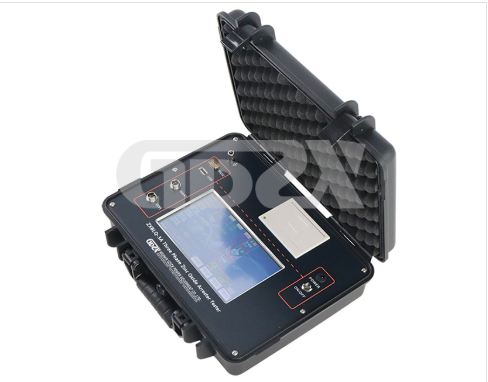
1. Product Overview and Application Scope
The ZXBLQ-3A three-phase zinc oxide arrester tester is a dedicated portable measuring instrument developed to quantitatively evaluate the electrical performance of zinc oxide arresters of all voltage grades. It realizes comprehensive fault identification by extracting characteristic leakage current and voltage signals of arresters, accurately locating hidden dangers including internal insulation moisture and aging of varistor chips.
The tester supports three mainstream testing scenarios:
De-energized offline test: Routine preventive test after power cut of arresters in substation;
Energized live-line test: Non-stop on-site patrol inspection for operating arresters;
Laboratory performance test: Performance calibration and aging simulation test for arrester manufacturers and research institutes.
Different from conventional single-phase testing equipment, this model can synchronously complete three-phase current and three-phase voltage sampling at one time, greatly shortening the single-set testing cycle of substation arrester groups and improving the efficiency of power grid condition-based maintenance.
2. Core Functional Features of the Tester
2.1 Human-Machine Interaction and Data Output System
The equipment is equipped with an 800×480 color LCD touch screen, paired with a high-speed thermal printer to realize on-site instant report printing. Built-in 4G SD card provides mass storage space for all test records, and a reserved USB interface supports data export to external terminals for secondary sorting and analysis. Adopting industrial-grade embedded operating system, it allows direct shutdown without complicated closing procedures, adapting to harsh field operation conditions.
2.2 Dual-Mode Synchronous Sampling & Long-Distance Wireless Transmission
Two reference voltage signal sampling modes are integrated to adapt to diverse on-site wiring environments:
Wired synchronization: Standard matching cable length reaches 40 m, extendable according to engineering demands;
Wireless synchronization: Standard effective transmission distance exceeds 400 m, with a maximum expandable transmission range up to 2000 m.
A prominent highlight is the built-in no-voltage testing mode. When PT voltage wiring cannot be arranged on site, the system can calculate the reference voltage value through internal algorithms, breaking the wiring limitation of traditional testers. In addition, current and voltage sensors adopt isolated design to eliminate cross-interference between signals, ensuring operator safety and measuring reliability.
2.3 Hardware Safety and Portable Structural Design
The tester adopts built-in high-energy lithium battery power supply, with the internal circuit voltage controlled below 12 V and only weak current inside the whole machine, effectively avoiding electric shock risks in live testing. The main unit and accessory box adopt dust-proof, waterproof and anti-corrosion sealed engineering shell, featuring small volume and light weight: the host weighs only 5 kg and the accessory box 9 kg, convenient for carrying to mountainous outdoor substation sites.
2.4 High Precision Signal Processing & Strong Anti-Interference Capacity
High sampling rate matching advanced digital signal processing (DSP) technology is adopted to extract multi-dimensional characteristic parameters of leakage current. The system supports full lifecycle data management, including historical data query, multi-dimensional comparative analysis and automatic report generation, forming a closed-loop testing workflow from signal collection to result output.
3. Complete Technical Indicator Parameters
3.1 Power Supply & Battery Performance
Two power supply schemes are available: external 12 V/2 A power adapter or built-in rechargeable lithium battery. Battery performance indicators meet long-duration field testing demands:
Full charging time: more than 6 hours;
Continuous on-load working time: over 4 hours;
Intermittent cumulative working time: more than 8 hours.
3.2 Measuring Range & Measurement Accuracy
表格
Measured Item | Measuring Range | Accuracy Standard |
Peak leakage current | 0–10 mA (expandable) | Total current >100 μA: ±2% reading ±1 digit |
Reference voltage | 30–100 V (expandable) | Reference voltage >30 V: ±2% reading ±1 digit |
Wireless synchronous sampling | Up to 2000 m | ±5% reading ±1 digit |
3.3 Comprehensive Testing Characteristic Parameters
The instrument can collect and decompose full characteristic waveforms and component values of arrester leakage current and reference voltage, covering all core diagnosis indicators required by power industry standards:
Full waveform of total leakage current;
RMS value and peak value of fundamental wave component;
Fundamental wave RMS of resistive leakage current, plus 3rd, 5th and 7th harmonic RMS values;
Positive and negative peak values of resistive leakage current component (Ir+, Ir-);
Fundamental wave of capacitive current, phase difference between total voltage and total leakage current;
RMS value of PT secondary voltage;
Active power consumption of the tested arrester.
By separating resistive and capacitive leakage current components, technicians can judge the aging degree of zinc oxide valve plates through the change of resistive current harmonics; the phase difference parameter can directly reflect the dampening state of internal insulation of arresters, realizing quantitative fault grading rather than simple qualitative judgment.
3.4 Physical Dimension Parameters
Main tester dimension: 36 × 26 × 14 cm, weight: 5 kg;
Supporting accessory box dimension: 42 × 33 × 20 cm, weight: 9 kg.
4. Engineering Application Advantages in Power Industry
Three-phase synchronous testing improves maintenance efficiency: Completes three-phase arrester signal acquisition in a single measurement, which is 3 times more efficient than single-phase testers for substation batch testing;
Dual sampling modes adapt to complex site conditions: Wired and wireless dual synchronization plus no-voltage algorithm mode solve the wiring difficulties of old substations without PT terminals;
Ultra-long wireless transmission adapts high-voltage equipment layout: Maximum 2000 m wireless distance meets the testing demand of large outdoor 220 kV/500 kV substations with scattered arresters;
Low-voltage internal circuit enhances live testing safety: The whole machine’s internal voltage is limited within 12 V, and isolated sensors eliminate high-voltage induced electricity risks for field staff;
All-scenario applicability reduces equipment procurement cost: One tester covers live-line inspection, power-off preventive test and laboratory research, avoiding separate purchase of offline and live testing devices;
Sealed portable shell adapts outdoor harsh environment: Dustproof, waterproof and anti-corrosion structure ensures stable measurement in rainy, dusty and high-humidity outdoor operation environments.
5. Conclusion
As a new generation of integrated testing equipment for zinc oxide arresters, the ZXBLQ-3A three-phase arrester tester integrates synchronous three-phase measurement, long-distance wireless synchronization, multi-harmonic leakage current decomposition and portable safe structural design, making up for the functional defects of traditional testing instruments. Its abundant measuring parameters can provide accurate quantitative data support for arrester insulation state evaluation, effectively identify early hidden faults such as insulation dampening and valve aging. For power grid operation and maintenance technicians, this equipment can greatly optimize the workflow of arrester condition monitoring, reduce grid outage risks caused by arrester failure, and has wide popularization value in transmission and distribution network maintenance, substation routine inspection and arrester performance laboratory research.
Word Count Note
The full text adopts professional power engineering terminology, oriented to substation maintenance engineers, high-voltage test technicians and electrical equipment R&D personnel, with clear parameter deduction and practical engineering analysis, suitable for internal technical training and industry technical exchange documents.
GDZX is a manufacturer of power detection equipment, offering a diverse range of products with comprehensive models and providing professional technical support. Contact us at +86-27-6552607 or +86-17396104357.Website: http://en.gdzxdl.com/


