


NEWSnews
Insulation Resistance Testers: Procurement Essentials & Key Parameters
1. Get This Straight Before Buying: A Higher Test Voltage Is Not Always Better
This is the most frequent misconception I encounter in procurement consulting, bar none.
When many procurement staff receive an equipment requirement sheet, their first reaction is to look for a "5000 V high-voltage megohmmeter" — assuming that a higher voltage means more professional, wider coverage, and stronger functionality. That logic may hold for other equipment, but with an insulation resistance tester it directly leads to paying too much, buying the wrong unit, or even causing a safety incident on site.
The root cause is this: the test voltage applied by an insulation resistance tester is a DC high voltage applied directly across the insulation of the equipment under test.
If a DC test voltage of 2500 V is applied to a low-voltage motor rated at 380 V, at best it accelerates insulation aging; at worst it directly breaks down an insulation layer that could have remained in service. This is no exaggeration — DL/T 596 (Preventive Test Regulations for Electric Power Equipment; please refer to the currently valid version) specifies the insulation resistance test voltages for various types of equipment precisely for this reason.
The test voltage should be selected to match the rated insulation level of the equipment under test, not "the higher the better."
Another common misconception is "looking only at the maximum test voltage and ignoring the measurement range." A megohmmeter nominally rated at 5000 V is inadequate for testing the main insulation of large power transformers (whose normal values are often in the range of hundreds of gigaohms or higher) if its actual upper range limit is only 100 GΩ. High voltage and high range must be satisfied simultaneously to be meaningful.
The reverse situation also occurs: a team doing routine maintenance on low-voltage electrical equipment buys a high-spec 5000 V/10 TΩ unit, yet 90% of its field work involves testing 380 V motors — the high-voltage ranges are never used, a pure waste of budget.
The correct procurement approach is: start from the objects to be tested, determine the required test voltage ranges and measurement range, and then select the equipment. The following sections expand on this one by one.
2. What It Is and What Problem It Solves in the Procurement Chain
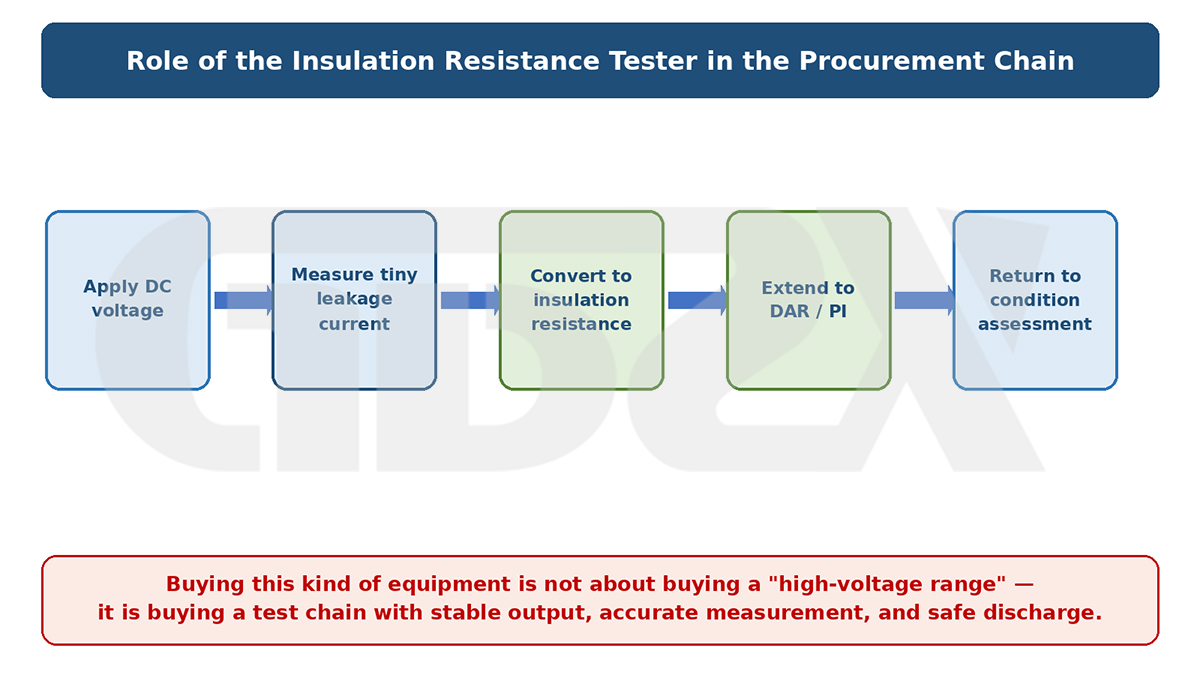
Figure: Position of the insulation resistance tester in the procurement chain
2.1 The Nature of the Insulation Resistance Tester
The working principle of an insulation resistance tester (commonly called a "megohmmeter" or "shake-meter"; modern products are fully electronic) is: it generates a stable DC high voltage internally and applies it across the two ends of the insulation of the equipment under test (generally the "line" terminal and the "earth" terminal), while precisely measuring the extremely small leakage current flowing through the insulation; the insulation resistance value is then calculated according to Ohm's law:
Insulation resistance R = applied voltage U ÷ measured current I
This measurement looks simple but actually places extremely high demands on the instrument: the applied DC high voltage must be stable (the larger the capacitance of the test object, the higher the requirement for voltage-holding capability); the leakage current being measured is extremely small (on the order of nA or even pA), requiring high input impedance and strong interference immunity; and the results must be repeatable and traceable to support longitudinal historical comparison.
2.2 Position in the Procurement Chain
Insulation resistance testing is a fundamental testing method in the whole-life-cycle management of electrical equipment, spanning factory acceptance, installation and commissioning, operation and maintenance, major-overhaul inspection, decommissioning assessment, and other stages.
• Factory acceptance stage: the manufacturer performs factory insulation tests on finished equipment to ensure insulation quality complies with product standards;
• Installation and commissioning stage: before newly installed equipment is energized, the construction unit performs commissioning tests on the insulation of each part to confirm that the installation process has not damaged the insulation;
• Operation and maintenance stage: power supply companies, power plants, and factory maintenance personnel periodically perform preventive tests on operating equipment, judging the degree of insulation deterioration from longitudinal trends in insulation resistance;
• Post-fault inspection: after equipment malfunctions or trips, quickly check whether an insulation fault exists.
Only by clarifying these scenarios can you assess "at which node my team mainly works," and thereby determine the real requirements for the instrument.
3. Insulation Resistance, DAR, and PI — How to Tell Real Requirements Apart When Procuring
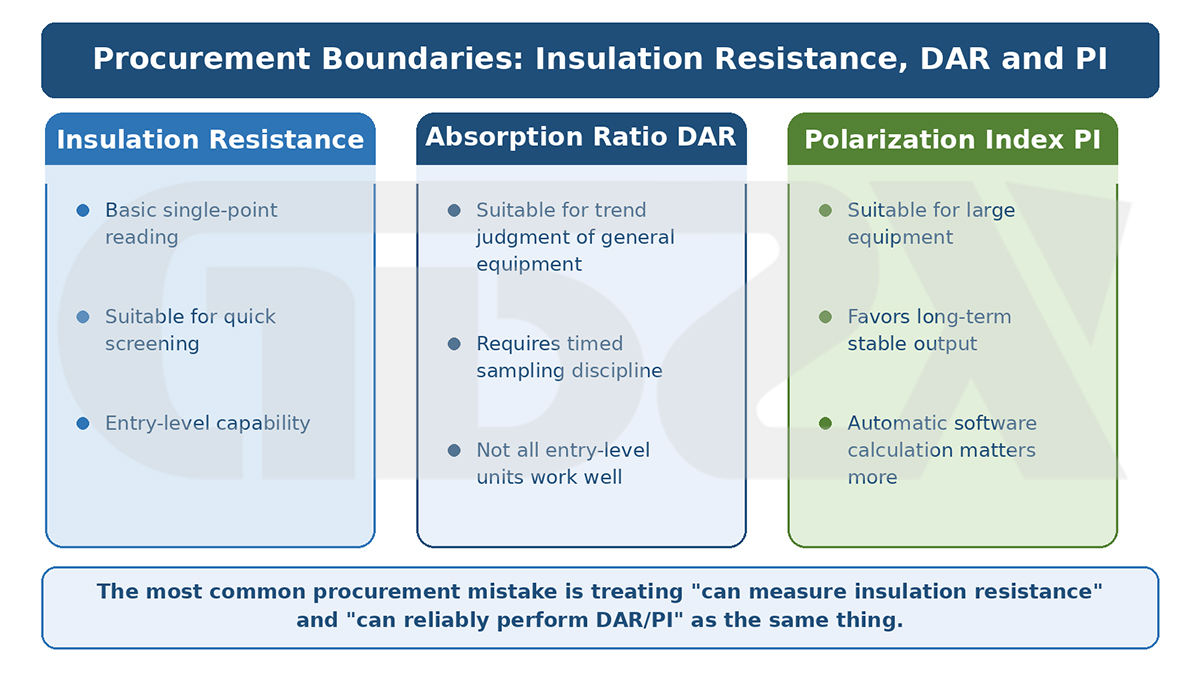
Figure: Procurement boundaries of insulation resistance, DAR, and PI
This is the part of a procurement list most easily handled vaguely. Many purchasers treat the "DAR function" and the "PI function" as optional accessories, but whether these two functions are genuinely needed determines whether you are buying a basic or a professional-grade unit, with a price difference that can exceed a factor of two.
3.1 Insulation Resistance (Single-Point Value)
Insulation resistance is the most basic measurement parameter, reflecting the DC resistance of the equipment's insulation under a specified test voltage and given temperature and humidity conditions. The reading after 60 seconds of applied voltage (R₆₀) is usually taken as the insulation resistance measurement result.
Applicable scenarios: routine maintenance inspections, quick checks after equipment installation, and confirmation of insulation health of low-voltage lines and electrical installations.
Procurement advice: for applications involving only basic insulation resistance measurement, a basic megohmmeter fully meets the need — do not pay for functions you will not use.
3.2 Dielectric Absorption Ratio (DAR)
The dielectric absorption ratio is defined, at the same test voltage, as the ratio of the insulation resistance after 60 seconds of applied voltage to that after 15 seconds:
Absorption ratio K = R₆₀ ÷ R₁₅
The absorption ratio reflects the polarization process of the insulation. For dry, clean insulation, polarization is full, R₆₀ is far greater than R₁₅, and the absorption ratio is high (usually K ≥ 1.3; specific acceptance criteria are subject to the currently valid standards and the equipment's technical conditions). For damp or contaminated insulation, the polarization process is suppressed, R₆₀ and R₁₅ differ little, and the absorption ratio is low.
The value of the absorption ratio lies in overcoming the limitation that a single-point insulation resistance value is strongly affected by temperature, allowing more reliable judgment of whether the insulation is damp. Insulation resistance values measured on two units at the same temperature can be compared directly, but values measured at different temperatures must be corrected before comparison; the absorption ratio is comparatively less affected by temperature and offers better longitudinal comparability.
Applicable scenarios: periodic preventive testing of transformers, large motors, high-voltage cables, and similar equipment, as well as pre-return-to-service inspection after prolonged outages. DL/T 596 (please verify the current version) explicitly requires absorption ratio measurements in the commissioning and preventive testing of many classes of equipment.
Procurement advice: for any periodic testing involving transformers, medium and large motors, high-voltage cables, and other large-capacity equipment, the DAR function is a must-have, not an option.
3.3 Polarization Index (PI)
The polarization index is defined as the ratio of the insulation resistance after 10 minutes of applied voltage to that after 1 minute:
Polarization index PI = R₁₀ₘᵢₙ ÷ R₁ₘᵢₙ
Compared with the absorption ratio (60 s/15 s), the PI measurement takes longer and reflects the comprehensive absorption characteristics of the insulation during a longer polarization process, making it more sensitive to insulation aging and degradation. IEEE Std 43 (Recommended Practice for Testing Insulation Resistance of Electric Machinery) contains specific acceptance criteria for PI (PI ≥ 2.0 is commonly used as a reference pass value; specifics are subject to the equipment's technical conditions and currently valid standards), but note that the scope and criteria of different standards may vary.
Applicable scenarios: comprehensive assessment of large generator stator windings and large transformer insulation systems, and any situation requiring a high degree of confidence in judging insulation aging.
Procurement advice:
• For organizations performing insulation testing on generators, large main transformers, and long cables (several kilometers or longer), the PI function is worth having;
• For teams maintaining only distribution equipment below 10 kV or low-voltage equipment, the DAR is sufficient and the PI function offers mediocre value for money;
• When both are needed, confirm that the purchased unit supports automatic timing and automatic calculation and display of DAR and PI values, rather than requiring manual recording of readings at two time points followed by hand calculation.
3.4 The Necessity of Temperature Correction
Insulation resistance is strongly temperature-dependent. As a rule of thumb, for every 10 °C rise in insulation temperature, the insulation resistance roughly halves (the "10 °C halving" rule). Therefore, insulation resistance values measured at different temperatures cannot be compared directly; they must be converted to a common reference temperature (usually 20 °C) to be comparable.
Conversion formula (using an oil-immersed transformer as an example; specific coefficients are subject to the applicable standard):
R₂₀ = R_t × K_t
where K_t is the temperature correction coefficient, which varies with the measured temperature t and the equipment type; determine it from the temperature correction coefficient table in the corresponding equipment standard.
Impact on procurement: if preventive test results need to be compared longitudinally with historical data, the unit should support temperature input and automatic temperature correction; if only a pass/fail judgment for the current test is needed, temperature correction can be treated as an optional consideration. High-end units usually include a temperature sensor interface and perform the correction automatically — one legitimate reason for their higher price.


