


NEWSnews
Insulation Resistance Tester: Procurement, Pitfalls & Manufacturer Evaluation
7. Recommended Approaches for Common Procurement Scenarios
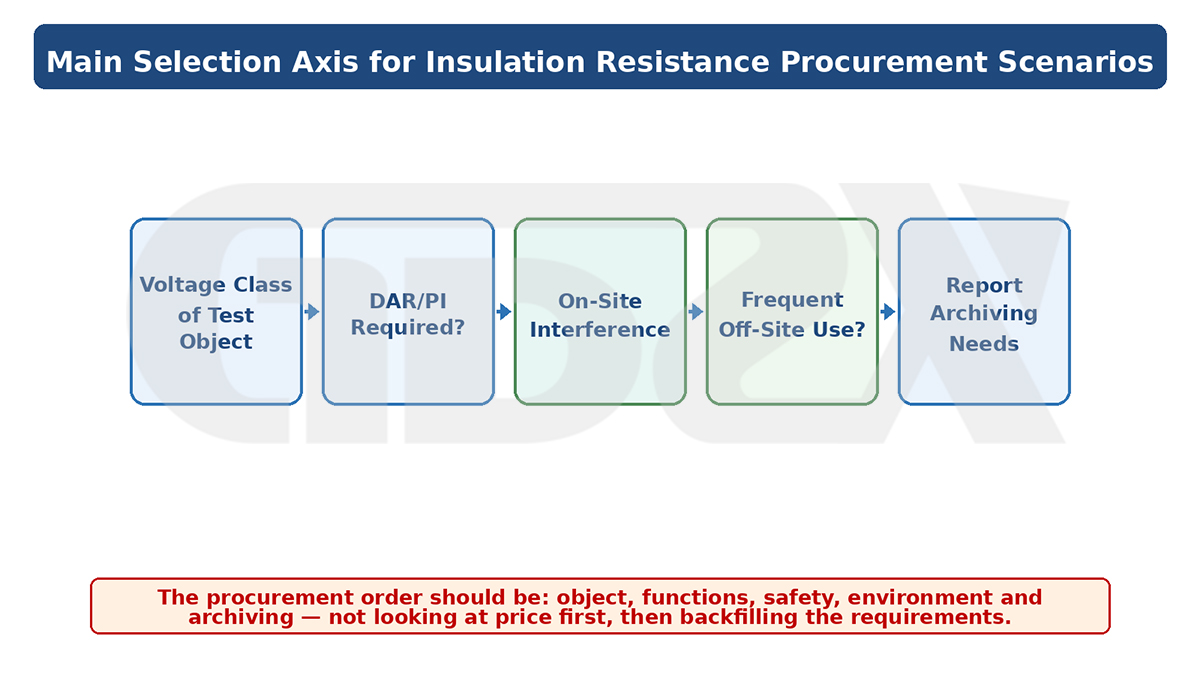
Figure: Main selection axis for insulation resistance procurement scenarios
Scenario 1: O&M team of a 10 kV substation needing a set of insulation testing equipment
Business profile: periodic preventive testing of 10 kV transformers, cables, switchgear and instrument transformers, as well as maintenance of the 380 V station service power system.
Recommended configuration:
Main equipment: portable megohmmeter
- Test voltage: 500 V / 1000 V / 2500 V, three ranges (a top range of 2500 V is sufficient for 10 kV equipment)
- Measuring range: ≥ 1 TΩ (required for 10 kV cables and similar objects)
- Functions: automatic calculation of the dielectric absorption ratio (DAR) and polarization index (PI), R-t curve recording, data storage and export
- Short-circuit current: ≥ 2 mA
- Automatic discharge: required
- G (guard) terminal: required
Auxiliary configuration: 2 handheld megohmmeters (for quick checks of low-voltage lines and equipment)
- Test voltage: 500 V / 1000 V
- No DAR/PI function required
Procurement tip: many teams simply ask for a "5000 V" instrument. In fact, the 2500 V range is sufficient for the vast majority of insulation test objects in a 10 kV substation; the 5000 V range mainly targets equipment at 35 kV and above. Spending the extra budget on a wider measuring range and better data management is more cost-effective.
Scenario 2: Maintenance of a 110 kV substation involving comprehensive insulation testing of the main transformer
Business profile: insulation resistance testing and absorption ratio measurement of the 110 kV main transformer, possibly involving 10–15 minute polarization index measurements.
Recommended configuration:
Main equipment: high-spec portable or laboratory-grade megohmmeter
- Test voltage: 5000 V range (required)
- Measuring range: ≥ 5 TΩ (the normal insulation resistance of a 110 kV main transformer can reach this order of magnitude)
- Functions: automatic calculation of PI (polarization index, 10 min/1 min), complete R-t curve recording
- Short-circuit current: ≥ 3 mA
- Temperature input and automatic temperature correction
- Data storage and export
Special note: insulation testing of 110 kV transformers places high demands on the measuring range. Some portable instruments have an actual range of only 1–2 TΩ at the 5000 V setting and will show an overflow for new main transformers (whose insulation resistance is usually higher), making the true value unobtainable. Before procurement, be sure to verify the accurate measuring range at the 5000 V setting.
Scenario 3: Factory maintenance team focused on routine maintenance of motors and switchboards
Business profile: test objects are mainly 380 V low-voltage motors, occasionally 10 kV high-voltage motors; testing mainly serves quick pass/fail judgment, and no historical records need to be kept.
Recommended configuration:
Main equipment: mid-range portable or high-end handheld type
- Test voltage: 500 V / 1000 V / 2500 V
- Measuring range: ≥ 100 GΩ (higher ranges are not needed for low-voltage motors)
- Functions: automatic calculation of the dielectric absorption ratio (DAR) (needed for high-voltage motors)
- Short-circuit current: ≥ 1 mA
- Multiple sets of test leads (adapting to different equipment terminals)
Value-for-money advice: factory maintenance scenarios do not need an ultra-high measuring range; it is more valuable to spend the budget on lead quality (the insulation performance of high-voltage test leads directly affects measurement accuracy) and on the ingress protection rating (factory environments are dirty; the IP rating should be no lower than IP54).
Scenario 4: Electrical engineering contractors performing commissioning acceptance of newly installed equipment
Business profile: commissioning tests before newly installed equipment is energized, involving diverse equipment types (low-voltage cables, high-voltage cables, switchgear, distribution transformers, etc.) and complex site conditions; the equipment must be durable and portable.
Recommended configuration:
Main equipment: mid-range portable type (covering the 500 V / 2500 V ranges)
- Measuring range: ≥ 500 GΩ (covering most commissioning test objects)
- Functions: automatic absorption ratio calculation, result printing or storage export (needed for issuing commissioning test reports)
- Ingress protection rating: IP54 or above
- Battery life: supports at least 4 hours of uninterrupted operation on a full charge
- Supplied with multiple lead adapter kits
Special note: commissioning test reports require data records and supporting evidence; choose a product that can export PDF reports or connect to a Bluetooth printer to reduce the risk of manual transcription errors.
8. The Most Common Procurement Pitfalls
Pitfall 1: Comparing only the maximum test voltage while ignoring the measuring range
When facing a 110 kV transformer, an instrument with a 5000 V maximum test voltage but only a 100 GΩ range is completely inadequate, while one with a 2500 V maximum test voltage but a 5 TΩ range may actually be more suitable (confirm at the same time that the test voltage meets the requirement). Test voltage and measuring range must always be evaluated together.
Pitfall 2: Trusting the nominal range without checking the accurate range
The "maximum range of 200 TΩ" stated in many product datasheets is the display range under certain specific conditions; the actual measurement error at that order of magnitude may exceed 50%. Require the manufacturer to provide the accurate range for each voltage setting (usually given as stated error limits), for example: "at the 5000 V setting, the measurement error within 1 GΩ–10 TΩ is ≤ 5%".
Pitfall 3: Ignoring short-circuit current, causing distorted measurements on large-capacitance test objects
You bought a high-spec "5000 V / 10 TΩ" instrument, only to find that when testing a 110 kV main transformer the voltage sags severely and the readings drift. The root cause is often a short-circuit current that is too small: the instrument cannot stably charge a large-capacitance test object. For large-capacitance objects, short-circuit current is the key.
Pitfall 4: Not requiring automatic discharge and leaving a safety hazard
"Manual discharge will do" — this is a very dangerous idea. Manual discharge depends on the operator performing it correctly and is easily neglected under intensive work. Automatic discharge is the last line of defense for personal safety and should be a non-negotiable basic requirement.
Pitfall 5: Treating the absorption ratio function as an optional accessory
For organizations that perform preventive tests, the absorption ratio is a test item required by the regulations, not a nice-to-have feature. If you buy an instrument without automatic absorption ratio calculation, you must either record readings at two time points manually, calculate the ratio by hand and copy it down — increasing the error rate — or skip the test altogether, which violates the regulations and may be found during inspections.
Pitfall 6: Ignoring the quality of test leads
Paying more for the megohmmeter body while saving on the leads is the worst value-for-money decision. The insulation quality and connection reliability of high-voltage test leads directly affect measurement results. The insulation resistance of poor-quality leads may be even lower than that of the test object, causing significantly low readings and misjudgment of equipment insulation faults. Require the manufacturer to supply high-voltage test leads with verified insulation capability, or purchase high-voltage leads from a professional brand separately.
Pitfall 7: Not verifying the ingress protection rating and environmental adaptability
Outdoor substation testing requires equipment that tolerates high temperature, high humidity and dust; cable testing in tunnels requires waterproof equipment. An insufficient IP rating, an operating temperature range that is too narrow, no derating specification for high altitude... these are easily overlooked in datasheets, but in real use they cause equipment damage or inaccurate measurements.
9. How to Review Manufacturer Documentation, Verification Certificates and After-Sales Commitments
9.1 Metrological Verification and Calibration Certificates
An insulation resistance tester is a measuring instrument; it shall be verified or calibrated in accordance with JJG 622 Verification Regulation of Insulation Resistance Meters (Megohmmeters) (the currently effective version prevails), and shall have the corresponding verification/calibration certificates.
Key review points:
• Whether the items tested on the certificate cover all the voltage settings and range intervals you need;
• Whether the body issuing the verification/calibration certificate is properly accredited (this can be checked on the official website of the metrology institute under the State Administration for Market Regulation);
• Whether the verification date is still valid (the verification interval is usually 1 year; a shorter calibration interval is recommended for frequently used instruments);
• Whether the verification conclusion is "Pass", and whether the uncertainty data meets your measurement accuracy requirements.
9.2 Product Type Test Reports
Require the manufacturer to provide the complete product type test report and verify the following:
• Whether the report was issued by an accredited third-party body (not the manufacturer's own testing);
• Whether the report covers all key specifications of this equipment model;
• Whether the safety performance indicators (output voltage error, insulation withstand, short-circuit protection) meet the requirements of the relevant standards.
9.3 Substantive Verification of After-Sales Service Commitments
After-sales clauses in contracts are often "templated" wording; ask the following substantive questions:
• Repair response time: after a problem occurs, how quickly does the manufacturer respond, and how quickly can a backup unit be provided?
• Annual calibration service: is on-site calibration provided, or must the unit be sent to the factory? What is the turnaround time for factory calibration?
• Calibration costs: are they included in the after-sales service fee, or charged separately?
• Software updates: are updates of the device software (including the host PC software) free of charge, and what is the update cycle?
• Spare parts lead time: supply lead time and price of core wear parts (such as test leads and batteries).
9.4 On-Site Demonstration or Prototype Verification
For equipment with a large procurement value, it is strongly recommended to require the manufacturer to provide a demo unit before signing the contract, to conduct an on-site demonstration at the actual workplace, to test equipment with known insulation status, and to compare the results with measurements from other calibrated instruments. This is the most effective way to identify consistency issues between the sample unit and volume production.


