


NEWSnews
Insulation Resistance Tester: Specifications, Voltage Calculations & BuyingGuide
10. Specification Selection and Test Voltage Calculation Examples
Example 1: Insulation Testing of a 10 kV High-Voltage Asynchronous Motor
Equipment Parameters:
Rated voltage: 10 kV Rated capacity: 500 kW Test requirements: Measure insulation resistance and absorption ratio
Step 1: Determine the Test Voltage
In accordance with the provisions of DL/T 596 (please refer to the currently effective version) on the test voltage for insulation resistance measurement of 10 kV motor windings, 2500 V is typically selected.
Step 2: Determine Range Requirements
At 20 °C, the normal insulation resistance of a high-voltage motor should generally far exceed the minimum acceptance limit. Based on typical estimated values for this type of motor (subject to the equipment technical specifications), select an instrument with a range upper limit ≥ 100 GΩ.
Step 3: Functional Requirements
Measuring the absorption ratio (R₆₀/R₁₅) is required; the instrument must support automatic timing and automatic absorption ratio calculation.
Step 4: Selection Conclusion
Minimum requirements: - Test voltage: including a 2500 V range - Range: ≥ 100 GΩ (500 GΩ or above recommended, to leave margin) - Function: automatic absorption ratio calculation - Others: automatic discharge, G terminal
Recommended type: portable megohmmeter (mid-range configuration or above).
Example 2: Comprehensive Insulation Evaluation of a 110 kV Main Transformer Winding
Equipment Parameters:
Rated voltage: 110/35/10 kV (three-winding transformer) Rated capacity: 50 MVA Test requirements: Measure insulation resistance, absorption ratio, and polarization index Reference temperature: 20 °C, measured temperature 35 °C, temperature correction required
Step 1: Determine the Test Voltage
For the 110 kV transformer high-voltage winding, the test voltage is typically 5000 V (subject to the currently effective version of DL/T 596 and the equipment technical specifications).
Step 2: Determine Range Requirements
The normal insulation resistance of a large transformer can reach from several hundred GΩ up to the TΩ level; a range of no less than 5 TΩ is recommended.
Step 3: Functional Requirements
• Polarization index (R₁₀ₘᵢₙ/R₁ₘᵢₙ): the instrument must support 10-minute continuous measurement and automatic calculation;
• Temperature correction: the measured temperature is 35 °C and must be converted to 20 °C.
If the instrument supports temperature input and automatic correction, the corrected R₂₀ is obtained directly; otherwise, it must be calculated manually using the correction factor table:
R₂₀ = R₃₅ × K_t (K_t is obtained from the temperature correction factor table for the corresponding equipment type, subject to the applicable standards)
Step 4: Selection Conclusion
Minimum requirements: - Test voltage: 5000 V range (mandatory) - Accurate range: ≥ 5 TΩ (the accurate range at the 5000 V setting, not the display range) - Short-circuit current: ≥ 3 mA (large-capacity transformers have a large equivalent capacitance) - Function: automatic PI (10 min/1 min) calculation and R-t curve recording - Temperature correction: temperature input and automatic correction supported (strongly recommended) - Data export: test report export function - Automatic discharge: mandatory
Recommended type: portable high-configuration or laboratory type (determined by budget and the availability of AC power on site).
Example 3: Quick Insulation Check of a 380 V Low-Voltage Cable
Object: a 380 V power cable in the factory, approximately 150 m in total length, for periodic maintenance inspection.
Step 1: Test voltage — for a 380 V low-voltage cable, use the 500 V range. Step 2: Range requirements — the estimated normal insulation resistance of a 150 m cable (estimated from the cross-sectional area and insulation material, generally in the range of several hundred MΩ to several GΩ) is well within a 10 GΩ range. Step 3: Functional requirements — quick pass/fail judgment only; no absorption ratio or polarization index needed. Conclusion: - A handheld megohmmeter (500 V range, range ≥ 10 GΩ) fully meets the requirements - No portable or laboratory high-configuration instrument is needed - The budget can be used for high-quality test clips and leads
11. Conclusion: How Purchasers Should Actually Make Decisions
This section summarizes the core logic of this document and provides purchasers with a clear decision framework:
Step 1: Start from the objects to be tested, not from the parameters
First, list clearly all equipment types and rated voltages that need to be tested in your organization, and look up the required test voltage setting and range requirements for each type of equipment. This is the starting point of all selection; bypassing this step and going straight to product specifications will inevitably lead to pitfalls.
Step 2: Compare the function list with the actual needs
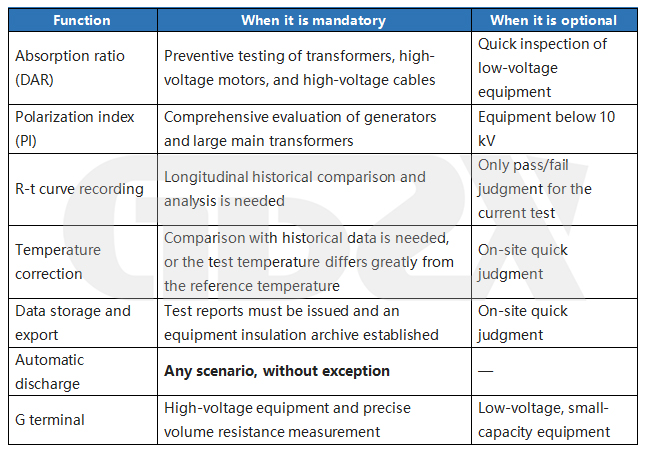
Step 3: Three parameters must be satisfied simultaneously
• Test voltage settings: covering the requirements of all objects to be tested
• Accurate range (not the display range): covering the upper limit of the normal insulation resistance of the objects to be tested
• Short-circuit current: meeting the stable charging demand of the largest-capacity object to be tested
If any of the three is missing, the instrument is not suitable for that test scenario.
Step 4: Safety is a red line, not a bonus item
Automatic discharge, overvoltage protection, and insulation test lead specifications — these are not "high-end configurations" but basic safety requirements. Products that fail to meet the basic safety requirements should not enter the procurement candidate list, no matter how low the price is.
Step 5: Justifiable sources of price differences
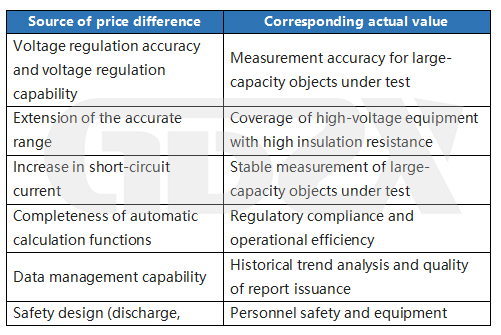
A low-priced instrument does not necessarily save money; it may mean an inflated range, insufficient voltage regulation capability, or substandard safety design, and the ultimate cost is untrustworthy measurement data or an on-site safety accident.
The Final Word
The core value of an insulation resistance tester lies not in how high a voltage it can output, but in its ability to give a trustworthy insulation resistance value precisely and repeatably under actual field conditions — a value that will be used to judge whether the equipment can continue to operate safely.
Trust in an instrument's measurement results must be built on the basis that its accuracy, range, voltage regulation capability, metrological traceability system, and field adaptability all meet the requirements. This is the essence of the procurement decision, and also the most essential judgment this document aims to convey.
Reference Standards and Regulations
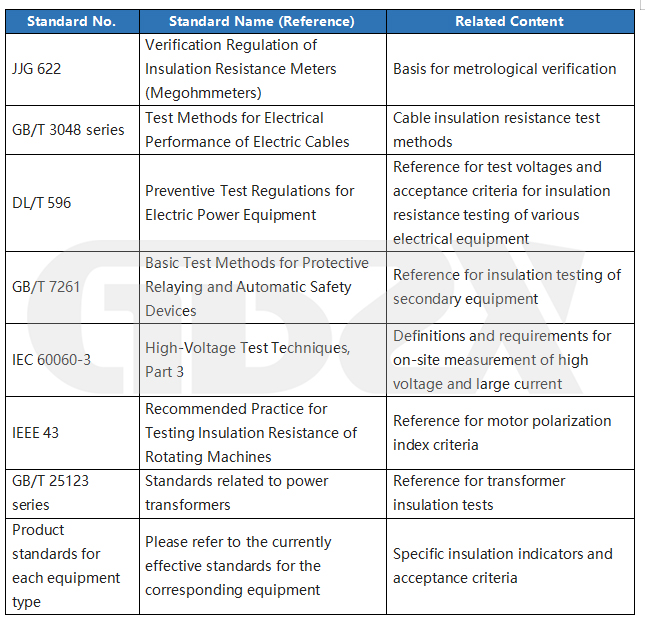
⚠️ Important note: The standard numbers above are listed based on current common industry references and may already have newer versions or replacement standards. All test methods and acceptance criteria must be implemented in accordance with the currently effective standards and the corresponding equipment technical specifications; this document is for procurement decision-making reference only.
*This document is of a technical advisory nature. For the test voltage selection and acceptance criteria of specific equipment, please refer to the currently effective standards, regulations, and equipment manufacturer technical documents.*


