NEWSnews
High-Voltage Switchgear Tester: Procurement Requirements & Type Adaptation
I. Clarify Before Purchasing: A High-Voltage Switchgear Characteristic Tester Is Not “Good Enough If It Measures Time”
The Essence of This Instrument Is Not a “Timer”
When procurement staff first encounter a high-voltage switchgear characteristic tester, an intuitive assumption often arises: “Isn't it just for measuring opening/closing time?” This is not wrong, but it is seriously incomplete. If only time were needed, a stopwatch costing a few thousand yuan plus two auxiliary contacts would suffice — there would be no reason to spend tens or hundreds of thousands on a dedicated instrument.
The real value of a high-voltage switchgear characteristic tester is that it is currently the only dedicated device capable of synchronously acquiring five categories of parameters during the actual operation of a circuit breaker: opening/closing time, contact travel, moving-contact speed, three-phase synchronism differences, and contact bounce. These five categories together form a complete quantitative assessment of the “internal health” of the breaker's mechanical mechanism.
A simple analogy: if a circuit breaker were an athlete, an insulation resistance test would be like taking its temperature, a loop resistance test like measuring blood pressure, and a mechanical characteristic test like a full sports-functional assessment — it checks not only whether all indicators are normal while standing still, but also whether muscles, joints and coordination stay within acceptable limits during starting, sprinting and sudden stops. Static measurement alone can never reveal a “cannot run” problem.
The Starting Point of a Procurement Decision: What Data Do Your Test Tasks Actually Require
Before starting the procurement process, procurement staff must work with the test team and the equipment management department to clarify one core question: Which parameters do our test tasks actually need to measure?
The answer directly determines what configuration you should buy. If your organization only needs opening/closing time and three-phase synchronism, a basic instrument without sensors is sufficient. But if your test tasks involve travel, contact gap, over-travel, opening speed at contact separation, closing speed at contact touch, and bounce — and commissioning tests (GB 50150-2016) and preventive tests (DL/T 596-2021) require these in many cases — then a displacement sensor is a mandatory configuration, not an “optional accessory”.
A procurement lesson that recurs repeatedly in practice: some organizations list sensors as “to be purchased later” to save budget, only to find after delivery that core parameters cannot be measured; they then have to repeat the procurement process to buy sensors, spending more money and delaying the test schedule.
How Standards Constrain Procurement: You Cannot Simply Buy Whatever You Want
Purchasing a high-voltage switchgear characteristic tester is not a free choice; it is constrained by explicit standard requirements:
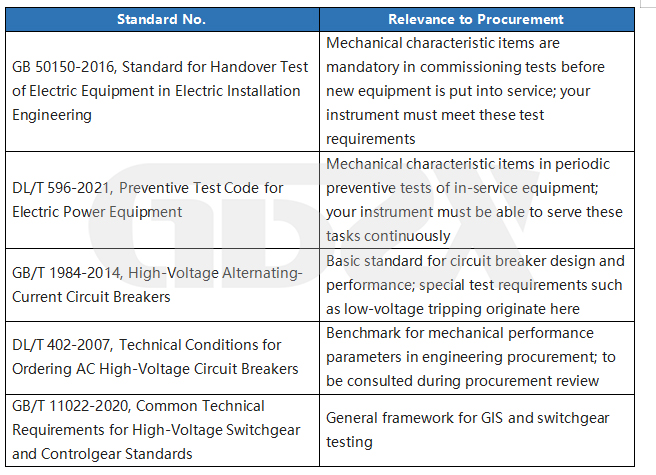
The core requirements of these standards boil down to one sentence: for organizations undertaking commissioning tests, preventive tests and post-overhaul tests of circuit breakers, the high-voltage switchgear characteristic tester is basic standard equipment, not an optional device that is “nice to have”.
Special reminder: the specific acceptance criteria mentioned in the above standards (permissible ranges of opening/closing time, speed limits, etc.) must be based on the technical conditions and factory test report of the circuit breaker manufacturer. There is no universally applicable fixed threshold. This point must be agreed with test personnel at the procurement stage, so that unreasonable “generic acceptance values” are not written into tender specifications.
II. What Problem Does It Actually Solve in the Procurement Chain
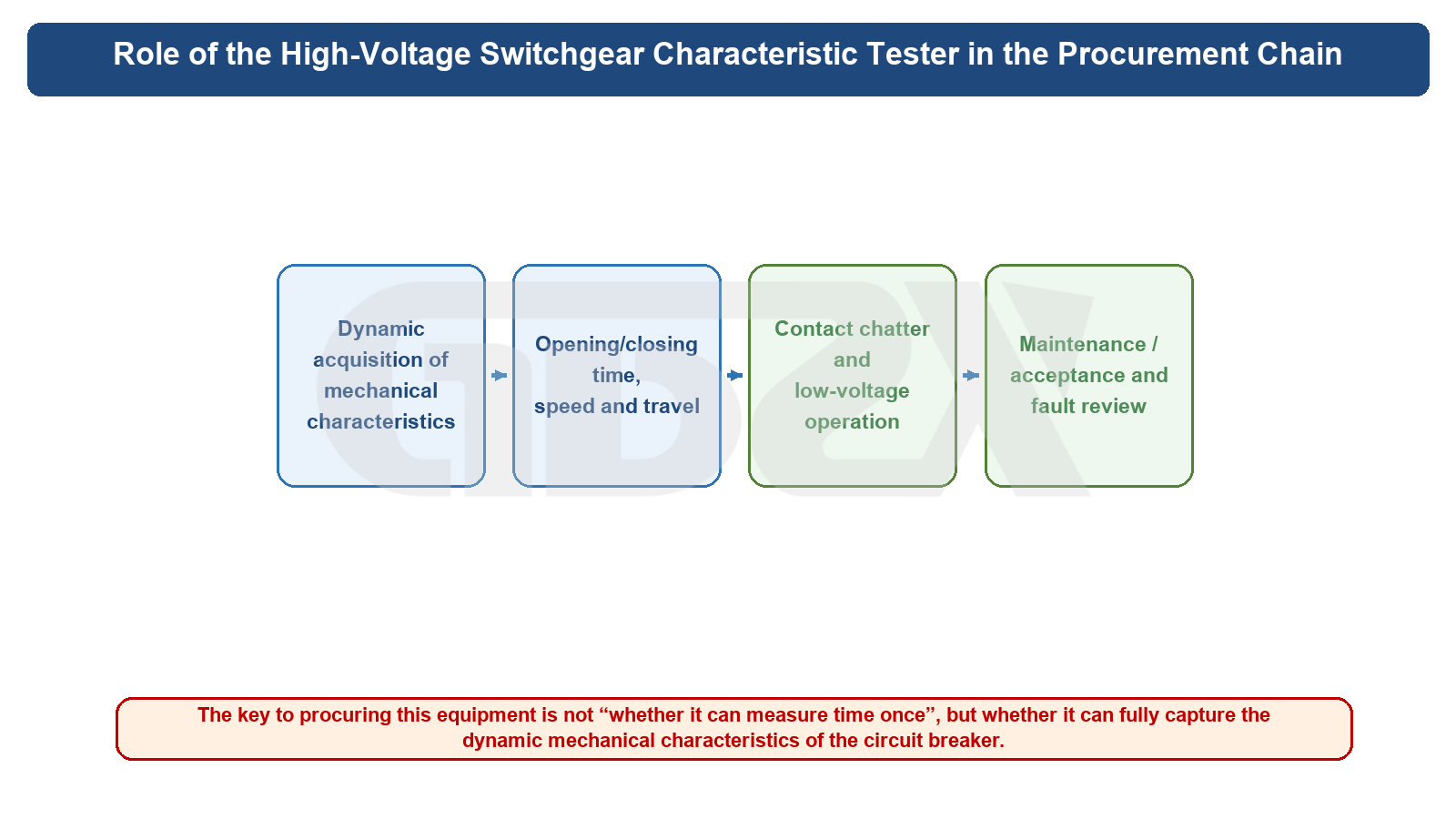
Diagram: Role of the High-Voltage Switchgear Characteristic Tester in the Procurement Chain
Division of Four Types of Test Equipment: The High-Voltage Switchgear Characteristic Tester Fills the “Dynamic Testing” Gap
A complete condition assessment of a circuit breaker normally requires four types of test equipment working together. Procurement staff need to understand the division of labour among them in order to make a sound purchasing plan:
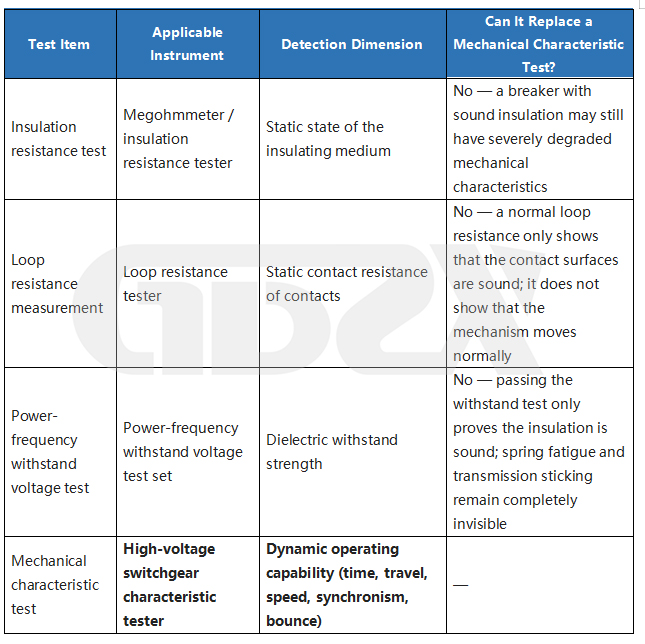
The absence of any one of these four types creates a blind spot in the testing system. In practice the most easily overlooked is the mechanical characteristic test — the first three are relatively simple to perform and give intuitive results (a normal resistance value means normal), whereas mechanical characteristic tests involve complex wiring and a threshold for data interpretation, so they are easily “simplified away”. Yet it is precisely these “hard-to-measure” dynamic parameters that are the only means of detecting early-stage mechanical defects.
What Can Mechanical Characteristic Tests Detect That Other Tests Cannot?
Based on current field maintenance and testing practice, the following three types of defects can be detected only by mechanical characteristic tests:
Fatigue of the spring-charged mechanism. After spring force decays, opening/closing speed drops and operating time lengthens, yet the appearance is normal and both insulation and loop resistance remain normal. Without a mechanical characteristic test, such a defect surfaces only as “failure to operate” during live operation — by then the consequences are far more serious than the purchase cost of an instrument.
Excessive three-phase non-simultaneity. Excessive differences in the operating times of the three-phase contacts cause the arc in one phase to persist too long during short-circuit interruption, damaging the contacts. This problem is completely invisible in static measurements and can only be found when three-phase operating data are acquired synchronously.
Abnormal contact bounce. Excessive closing bounce indicates contact wear or failure of the buffering mechanism; every separation during bounce strikes an arc and accelerates erosion. Bounce data can only be obtained during the closing operation by high-speed sampling (≥10 kHz).
Procurement Implication: Not “Nice to Have” but “Essential to the System”
If your organization undertakes commissioning tests, preventive tests or post-overhaul tests of circuit breakers, the high-voltage switchgear characteristic tester is basic equipment that must be purchased. The budget discussion should not be “whether to buy” but “what configuration to buy”.
III. Why Procurement Requirements Differ Completely Across Switchgear Types
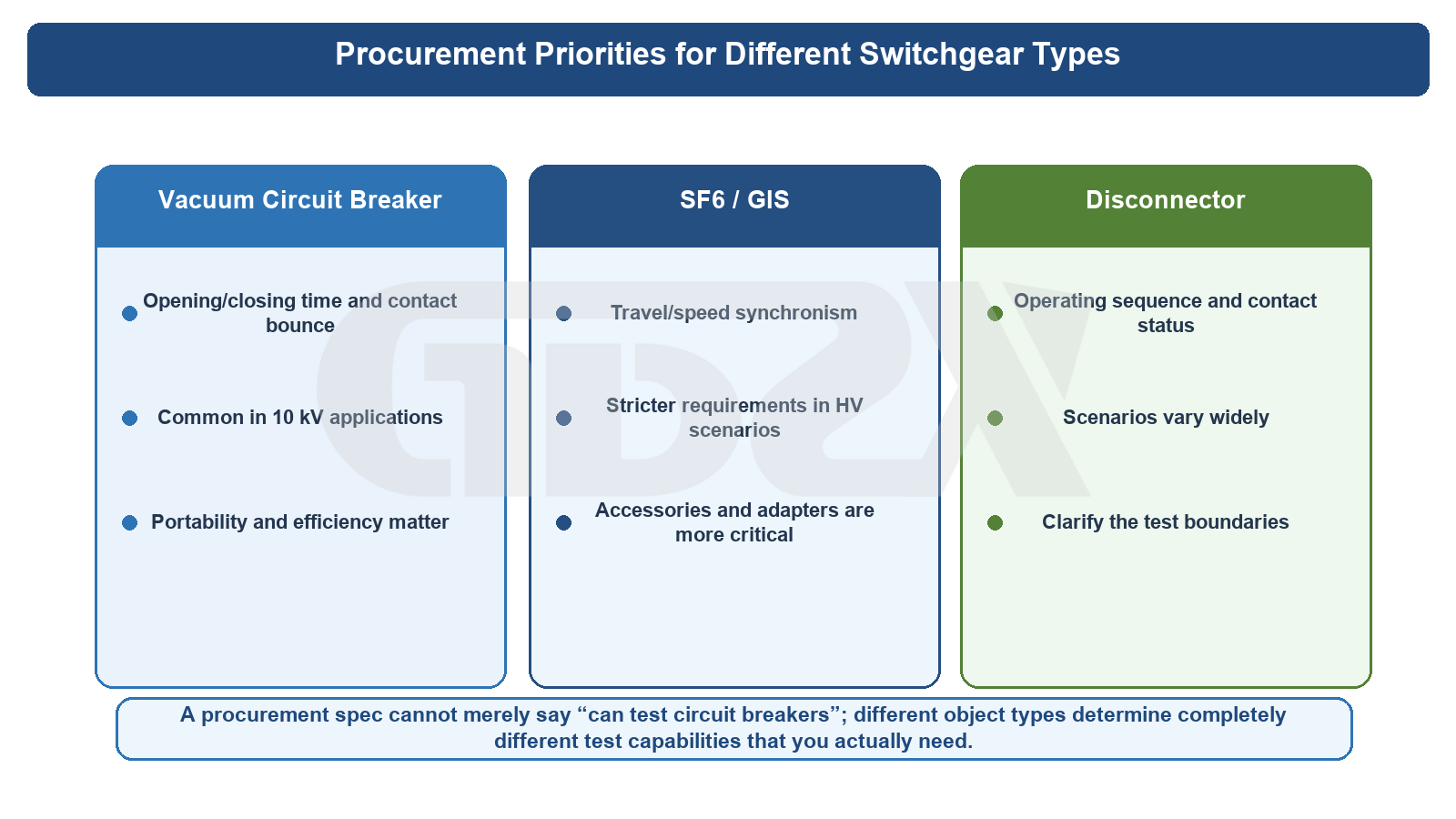
Diagram: Procurement Priorities for Different Switchgear Types
Procurement Cannot Rest on “Can Test Circuit Breakers” — the Type of Your Circuit Breaker Determines the Instrument You Need
This is the first cognitive trap procurement staff most easily fall into: assuming a high-voltage switchgear characteristic tester is universal equipment and one unit can test all circuit breakers. Technically the measuring principle is indeed universal; in practice, however, different switchgear types differ greatly in number of breaks, travel range, sensor mounting method, control circuit interface and special test requirements, which directly determines the instrument configuration you need.
Vacuum Circuit Breakers (Mainly 10 kV)
The 10 kV vacuum circuit breaker is the most numerous breaker type domestically and the main test object for most distribution maintenance teams. Its characteristics determine the fundamentals of procurement requirements:
• The operating mechanism is usually a spring-charged mechanism (some are permanent-magnet mechanisms), with relatively short travel (typically 10–20 mm)
• Opening/closing speeds are relatively high (opening speed at contact separation is typically in the range of 0.6–1.2 m/s), placing higher demands on sensor accuracy and sampling rate
• One break per phase, three breaks in total for three phases
• Secondary control interfaces are relatively standardized, and wiring methods of major domestic manufacturers follow certain patterns
• Contact wear is reflected indirectly through travel changes (reduced over-travel) and requires comparison with historical data
Procurement implication: for organizations mainly dealing with vacuum circuit breakers, a standard instrument with two or three sensor channels already meets more than 90% of routine needs. A sensor range of 150 mm is sufficient. The key is whether the sensor sampling frequency is high enough (≥20 kHz recommended), because vacuum circuit breakers have short travel and high speed, and an insufficient sampling rate distorts the speed curve.
SF₆ Circuit Breakers (110 kV and Above)
The mechanical structure of an SF₆ circuit breaker is far more complex than that of a vacuum circuit breaker, and procurement requirements escalate accordingly:
• Longer transmission chain and larger travel (typically 150–300 mm), requiring a displacement sensor with a range of 300 mm or more
• Some equipment of 110 kV and above uses a double-break structure per phase, giving six breaks in total for three phases — this is the direct origin of the “six-break model” requirement
• Gas-pressure blocking is an important precondition: when SF₆ gas pressure is insufficient, the blocking relay cuts off the opening/closing circuits, so the instrument must be able to handle the blocking logic
• Both phase-separated operation and three-phase linked operation exist, so test methods differ
• Higher power demand on the energy-storage power supply
Procurement implication: organizations dealing with SF₆ circuit breakers need at least a six-break model, and the sensors must have a 300 mm range. A built-in energy-storage power module is almost mandatory in this scenario — an external one is not only inconvenient but also prone to problems under poor field conditions.
GIS Equipment
The particularities of GIS equipment place higher demands on the instrument:
• The operating mechanism sits in an external mechanism box and the contacts are sealed inside the SF₆ gas chamber, so sensors cannot directly contact the moving contacts
• Sensors must be mounted on the transmission linkage or output shaft of the operating mechanism for indirect measurement, followed by conversion according to the transmission ratio — this requires test personnel to understand the GIS mechanism transmission ratio
• One GIS bay usually contains several circuit breakers and several groups of disconnectors, so the test workload is large
• At 220 kV and above, a four-break-per-phase structure may appear, giving 12 breaks in total for three phases — this is the reason the “twelve-break high-end model” exists
• The aviation connectors of the mechanism boxes of some large imported GIS units differ from domestic standards, so universal adapter cables may not fit
Procurement implication: organizations undertaking GIS substation test tasks are the real target users of twelve-break high-end instruments. Wiring compatibility must also be a key concern — especially the ability to adapt to imported GIS equipment. Crocodile-clip wiring is actually more flexible than aviation connectors in this scenario; having both methods available is recommended.
Disconnectors
Mechanical characteristic testing of disconnectors has different priorities from that of circuit breakers: it mainly measures full-travel time, three-phase closing non-simultaneity, and whether the operating mechanism is sticking. Operating speed is far lower than that of a circuit breaker, so the requirement on sensor accuracy is relatively low, but the travel is usually longer. If your test tasks include disconnectors, confirm that the sensor range and control output capability of the instrument can cover them.
Quick Reference Table of Procurement Requirements