


NEWSnews
High-Voltage Switchgear Tester: Core Parameters, Models & Price Differences
IV. Core Parameters That Must Be Understood When Purchasing
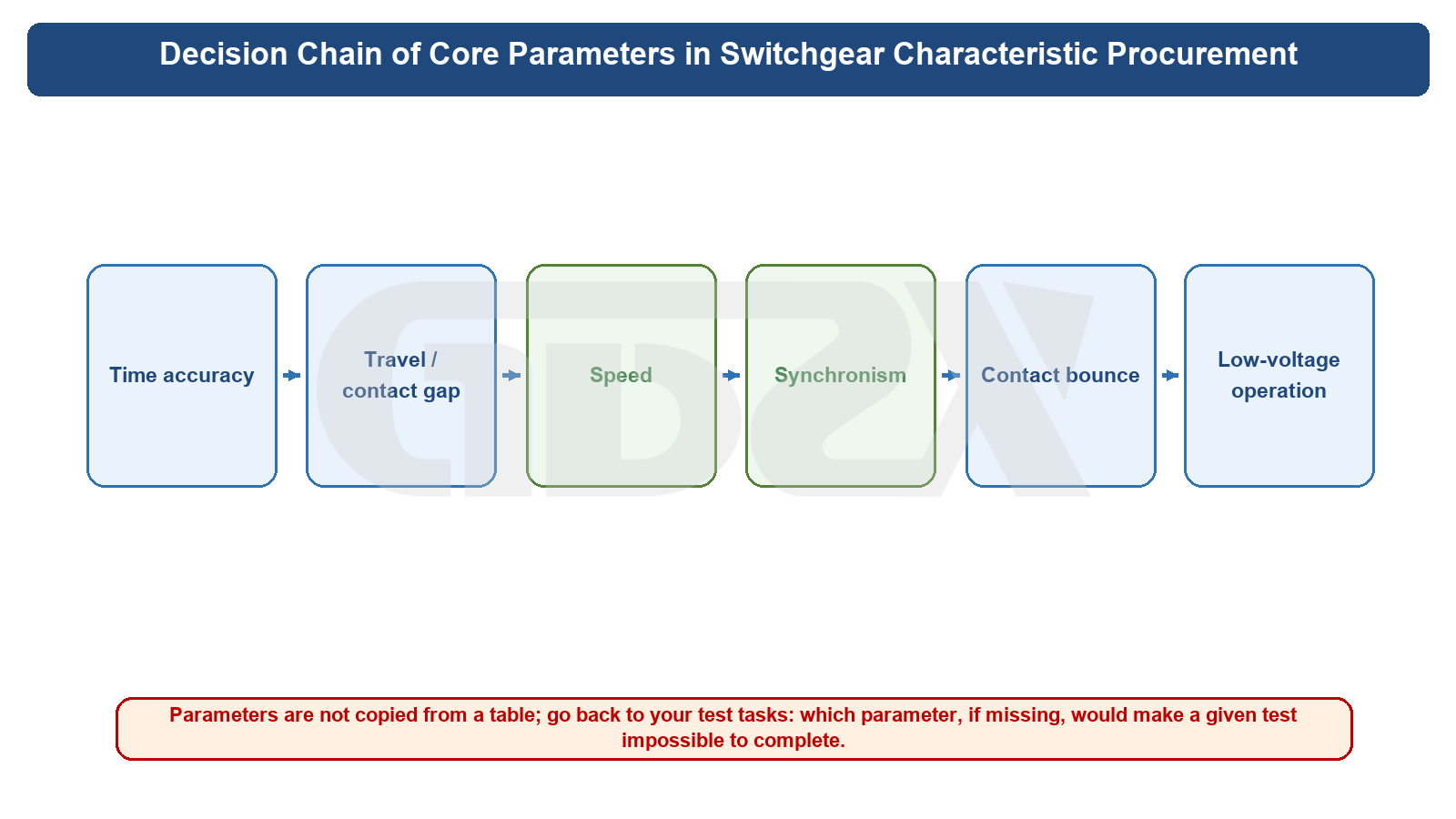
Diagram: Decision Chain of Core Parameters in Switchgear Characteristic Procurement
Procurement Is Not Copying a Parameter Table — the Key Is Knowing What Each Parameter Means for Your Tests
Tender documents often list dozens of technical parameters, but only a few core parameters truly affect the procurement outcome. Procurement staff need not understand the measuring principle of every parameter as a test engineer does, but they must know: what this parameter measures, what happens if it is missing, and how its accuracy affects the test conclusion.
4.1 Opening/Closing Time
This is the most basic measurement parameter of a high-voltage switchgear characteristic tester. Opening time is the interval from the control pulse to contact separation; closing time is the interval from the control pulse to contact touch. Time accuracy is usually better than 0.1 ms, with a resolution of 0.01 ms.
Procurement perspective: measurement accuracy for this parameter is now highly homogeneous across mainstream products and is not a selection differentiator. What really matters is whether the instrument can accurately capture the state transitions of auxiliary contacts (52a/52b) — if auxiliary contact signals are acquired inaccurately, the time data are not credible.
Key reminder on acceptance criteria: the acceptable range of opening/closing times must be based on the technical conditions of the circuit breaker manufacturer. Permissible ranges differ greatly between manufacturers, models and voltage levels. Do not write a fixed acceptance value such as “opening time ≤ X ms” into the tender document — that is an indicator of the device under test, not of the instrument.
4.2 Travel, Contact Gap and Over-travel
These three parameters are easily confused by procurement staff, yet the distinction directly affects your judgement about the sensor configuration:
Travel (Stroke): the total displacement of the moving contact from the closed to the open position. It reflects the complete operating distance of the transmission chain.
Contact gap (Contact Gap): the clear distance between the stationary and moving contacts after opening. It determines the dielectric withstand capability in the open state — insufficient gap risks insulation breakdown.
Over-travel (Over-travel): the additional amount by which the moving contact continues to press in after the contacts touch during closing. It ensures contact area and pressure. A reduction in over-travel normally indicates contact wear.
Procurement perspective: all three parameters are extracted from the travel-time curve. Without a sensor there is no travel curve and none of the three parameters can be calculated. So the issue is clear: if your test tasks require travel measurement (which most do), the sensor is a must-buy item, not an option.
4.3 Speed (Opening Speed at Contact Separation, Closing Speed at Contact Touch)
Opening and closing contact speeds are calculated from the slope of the travel-time curve (numerical differentiation). Insufficient opening speed means the arc gap opens too slowly; excessively low closing speed increases the pre-strike arc distance. The acceptable speed range is specified by the manufacturer's technical conditions, in m/s.
Procurement perspective: the quality of speed calculation depends on two factors — sensor accuracy and sampling frequency. The higher the sampling frequency, the smoother the speed curve and the closer it is to the true value. For 10 kV vacuum circuit breakers with short travel and high speed, a sampling frequency of ≥20 kHz is recommended; for SF₆ circuit breakers, 10 kHz is normally sufficient.
An easily overlooked detail: different instrument manufacturers use different sampling window widths for speed calculation (typically ±1 ms or ±2 ms), which causes slight differences in the speed readings of the same breaker on different instruments. If your organization has several instruments whose data must be cross-compared, purchasing from the same manufacturer is recommended to reduce comparison bias.
4.4 Three-Phase Synchronism
The maximum difference among the operating times of the A, B and C phase contacts is the three-phase non-simultaneity value. This parameter is critical — excessive non-simultaneity causes the arc in one phase to persist too long during short-circuit interruption, damaging the contacts.
Procurement perspective: three-phase synchronism measurement requires the instrument to acquire three auxiliary contact signals synchronously. The key word is “synchronous” — if the instrument has only one input, the three phases must be measured in three separate operations; between operations the equipment temperature and energy-storage state may differ slightly, so the three-phase data are not strictly comparable. For genuinely credible three-phase synchronism data, the instrument needs at least 3 auxiliary contact input channels with synchronous acquisition.
4.5 Contact Bounce
During closing, the contacts rebound because the kinetic energy has not been dissipated; every separation during bounce strikes an arc and accelerates contact erosion. Excessive bounce is a clear sign of contact wear or failure of the buffering mechanism.
Procurement perspective: the quality of bounce detection depends entirely on the sampling rate. A low sampling rate (e.g. 1 kHz) may miss brief bounce events, producing “false-negative” results with too few bounces and too short a bounce time. This is the most common measurement defect of low-end instruments on the bounce parameter. If your test tasks involve bounce judgement, confirm that the auxiliary contact sampling rate of the instrument is ≥10 kHz.
4.6 Low-Voltage Operation (Low-Voltage Trip and Close)
The low-voltage tripping test verifies whether a circuit breaker operates reliably below the rated control voltage. Refer to the general requirements of GB/T 1984-2014 (the minimum reliable operating voltage is normally no higher than 65% of the rated value and the maximum non-operating voltage normally no lower than 30%; the manufacturer's technical conditions prevail).
Procurement perspective: the low-voltage tripping test requires the instrument's control output voltage to be continuously adjustable and stable. Cheap instruments have poor voltage adjustment accuracy and large voltage drop under load, so the voltage actually reaching the coil differs from the displayed value and the critical voltage of low-voltage tripping is misjudged. At procurement, ask the manufacturer to provide the voltage accuracy specification of the control output at full load.
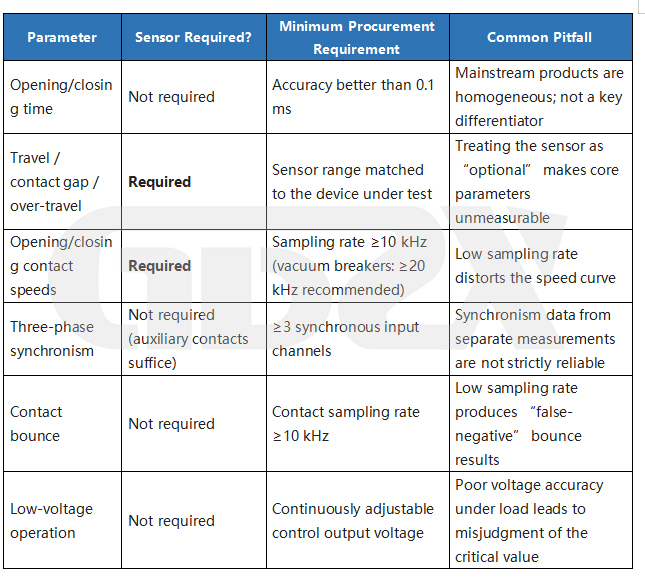
Quick Reference Table of Core Parameters for Procurement
V. Who Are Single-Break, Multi-Break, Basic and High-End Models For?
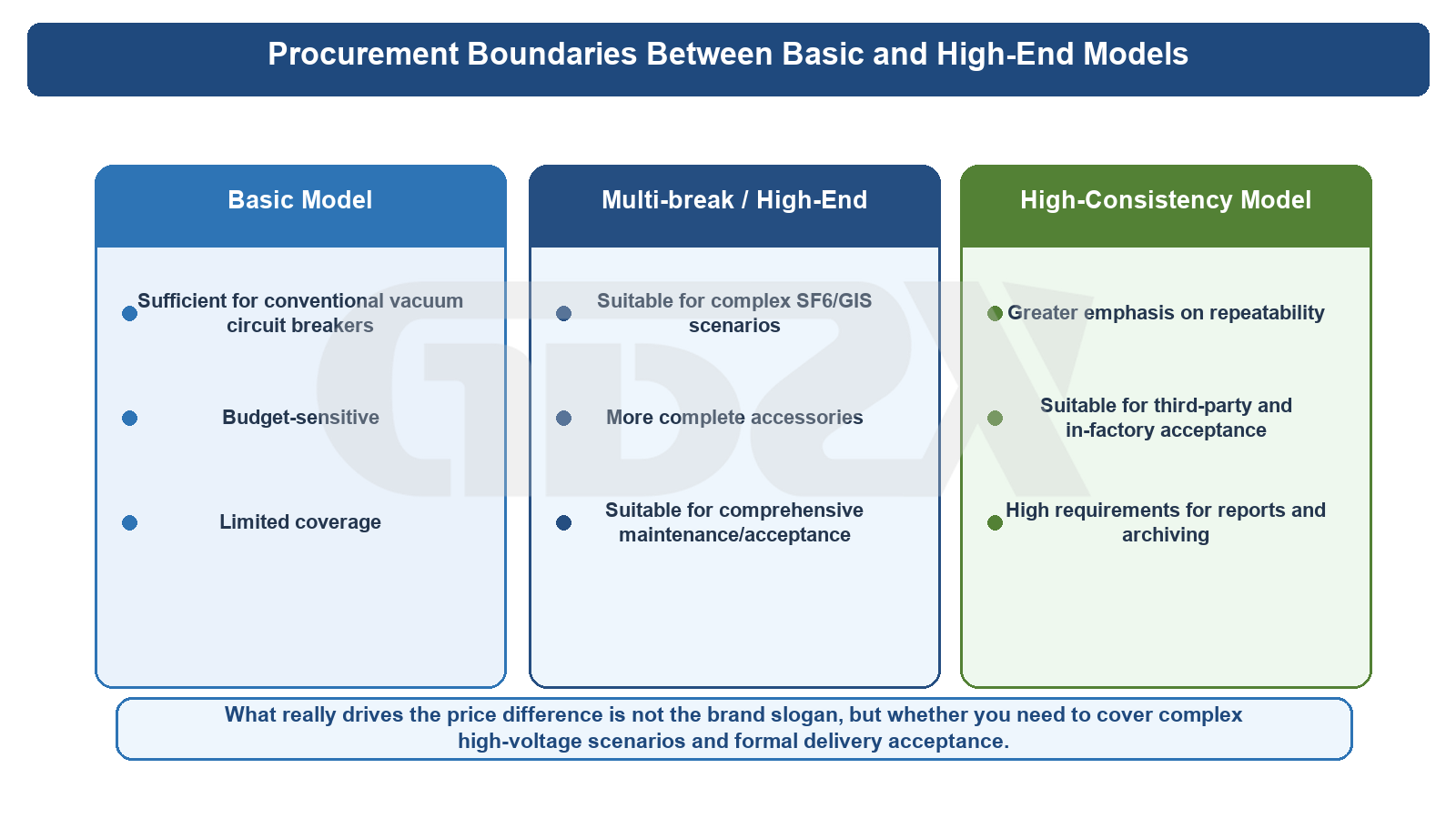
Diagram: Procurement Boundaries Between Basic and High-End Models
Procurement Cannot Look Only at the Number of Breaks — the Essential Difference Behind It
Many procurement staff take the number of breaks simply as “how many breaks can be measured at once”, but adding breaks brings not only efficiency gains; more importantly, it fundamentally changes data synchronism and test completeness.
Why Is “Synchronous Acquisition” More Valuable Than “Separate Measurements”?
This is the most fundamental gap between basic and multi-break models, and deserves close understanding by procurement staff.
When measuring three-phase travel with a basic (single-break) instrument, you need three separate operations: mount the sensor on phase A for one data set, remove it and mount it on phase B for another, then remove it again and mount it on phase C for a third. Between these operations the breaker's energy-storage state, DC control voltage and ambient temperature may change slightly, compromising the comparability of the three data sets.
More critically, calculating three-phase non-simultaneity requires that the three-phase data come from the same operation. Data measured in three separate operations cannot, strictly speaking, yield the true three-phase simultaneity — you only obtain “the time of phase A in operation 1”, “the time of phase B in operation 2” and “the time of phase C in operation 3”, and the differences among them are not the three-phase synchronism.
If your test report must state a conclusion on three-phase synchronism, multi-break synchronous acquisition is a hard requirement, not “nice to have”.
The Real Value Boundary of Basic Models
Having described the benefits of multi-break models, fairness also requires saying this: a basic instrument is not “low-grade goods”; it has a clear value position of its own. For organizations mainly dealing with 10 kV distribution network breakers, a basic instrument already fully covers single-phase opening/closing time, travel, speed and bounce measurements, with good portability and a low price threshold. Where vacuum circuit breakers dominate the test tasks and SF₆ multi-break equipment is not involved, the basic model offers the best value for money.
Purchase recommendation: set the upper model limit by the break count of the most complex on-site equipment, choose the main model by the most common test scenario, and decide on redundant channels according to budget. There is no need to configure the highest-grade equipment for occasional high-specification tasks — an organization performing 220 kV tests only once or twice a year can consider renting a twelve-break instrument rather than buying one that sits idle for long periods.
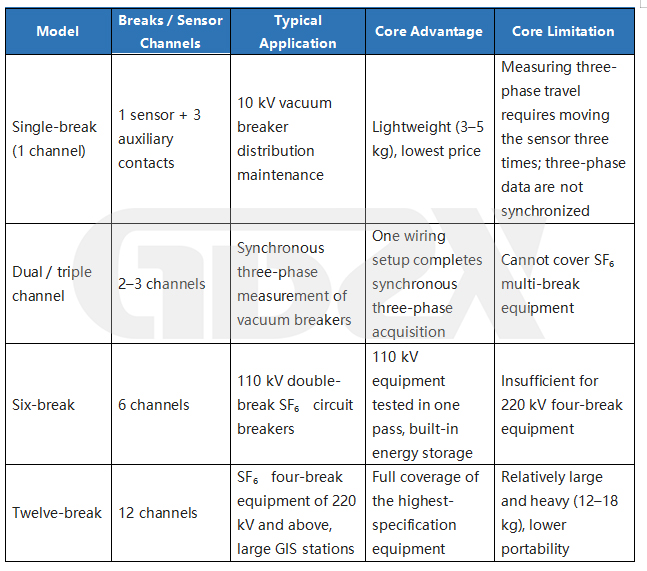
Comparison of Typical Specifications (Referring to Mainstream Domestic Commercial Models)
The parameters below are compiled from typical configurations of comparable domestic high-voltage switchgear characteristic testers, for horizontal comparison during procurement. The manufacturer's actual technical specification sheet prevails.
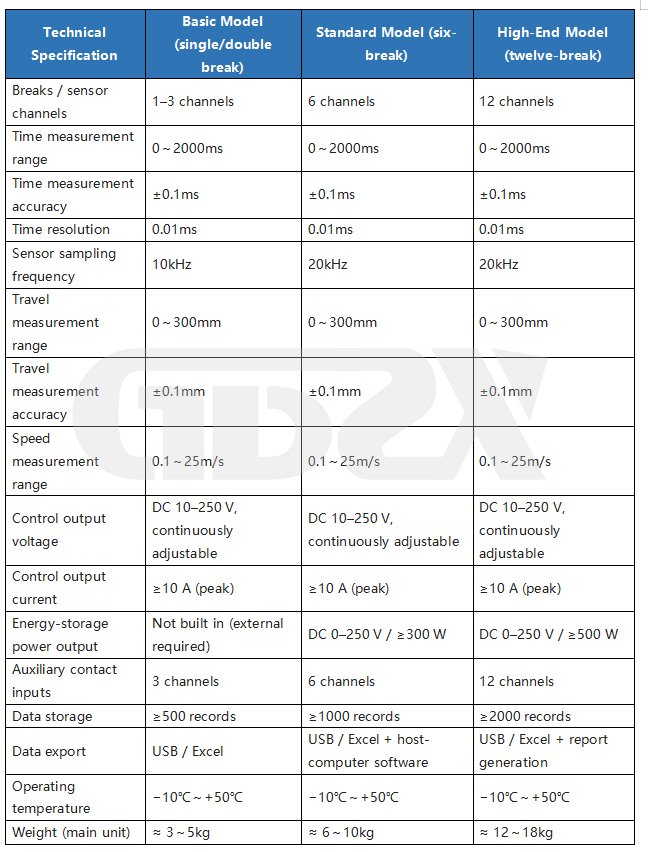
Note: the above parameters represent typical levels of comparable products and do not refer to any specific model of a single manufacturer. Procurement should be based on the manufacturer's official technical specification sheet and factory verification report.
VI. What Really Drives the Price Difference Is Not the Brand Slogan but These Capabilities
Low Price Does Not Mean Low Cost — Thinking in Terms of Total Procurement Cost
Market prices of high-voltage switchgear characteristic testers range from a few thousand to several hundred thousand yuan, a wide spread. The first reaction of many procurement staff is “find the cheapest”, yet judging from industry procurement and delivery reality in 2026, cases of “buying a cheap instrument and ending up spending more” are not uncommon. The purchase price is only the first outlay; the true total cost includes:
• The purchase price of the instrument itself
• The cost of matching accessories such as sensors and adapter cables (cheap instruments often come with incomplete accessories that must be bought separately)
• Training costs for field personnel (instruments with hard-to-use software and complex operation significantly increase training time)
• Loss of test efficiency (extra time and manpower for a single-break instrument to measure three phases)
• Labour cost of organizing data reports (instruments that cannot generate reports automatically require manual entry and formatting)
• Calibration fees (annual metrological calibration service)
• Repair and spare parts costs (sensors are the most common consumable)
• Software upgrade fees (whether provided free of charge or billed separately)
An instrument priced 30% lower but requiring sensors to be purchased separately, lacking report software and doubling the annual calibration fee may cost more over three years than an “all-inclusive” instrument priced 30% higher.
Six Core Capabilities That Drive the Price Difference
Based on current manufacturer evaluation and equipment comparison practice, the factors that truly widen the price gap concentrate on the following six:
1. Number of Breaks and Sensor Channels
This is the most direct price driver. Each additional break means a multiplied increase in sensor input channels, control output channels and data acquisition units. From single-break to twelve-break, hardware cost does not grow linearly but in steps.
2. Sensor Accuracy and Sampling Rate
A high-precision ADC (analog-to-digital converter) and high-sampling-rate sensors directly affect the quality of the travel curve, which in turn determines the accuracy of derived parameters such as travel, speed and bounce. Low-end instruments cut costs here by lowering the sampling rate — the result is a “jagged” speed curve and missed bounce events: data appear to exist but their quality is unreliable.
3. Built-in Energy-Storage Power Module
Basic instruments usually have no built-in energy-storage power supply, so an external DC source is needed on site to charge the spring mechanism. High-end models have a built-in independent energy-storage module with power covering 300 W–500 W and above, capable of directly driving the charging motors of various spring operating mechanisms. This module is not cheap, but it greatly improves field convenience.
4. Software Analysis and Report Generation
This is the most underestimated source of price difference. Low-end instruments offer only basic waveform viewing and data export (usually CSV or a proprietary format), so test personnel must manually organize data, calculate deviations and write reports. High-end models provide host-computer analysis software supporting multi-curve overlay comparison, historical trend analysis, automatic calculation of parameter deviations, and one-click generation of test reports in standard formats (PDF or Word).
Direct procurement impact: a standardized test report is needed for commissioning acceptance, preventive test archiving and tender technical documents. If the instrument cannot generate reports automatically, test personnel must format them manually every time, and the time cost far exceeds the price difference of the software function.
5. Voltage Accuracy and Adjustment Range of the Control Output
A low-voltage tripping test requires gradually reducing the control voltage from the rated value down to the critical value. High-quality instruments offer fine voltage adjustment and small voltage drop under full load, so the critical voltage can be located precisely. Low-price instruments usually perform poorly here — coarse adjustment steps and large load-dependent voltage drop — which limits the reference value of low-voltage operation test results.
6. Brand After-Sales and Service System
The sensor is the most fragile part of the instrument system — on-site impacts, pulling and improper mounting all cause damage. The delivery speed and price of spare sensors directly determine how quickly the instrument returns to service after a failure. Established manufacturers have clear advantages in calibration certificate traceability, spare parts supply and technical support response. For example, manufacturers such as Guodian Zhongxing, which have worked deeply in power test equipment for many years, can normally ship spare sensors within 48 hours and provide immediate telephone response to technical questions — a very practical safeguard for urgent test tasks.


