


NEWSnews
High-Voltage Switch Characteristic Tester: Standards & Test Necessity
I. Relevant Standards and Regulations
1.1 Primary Referenced Standards
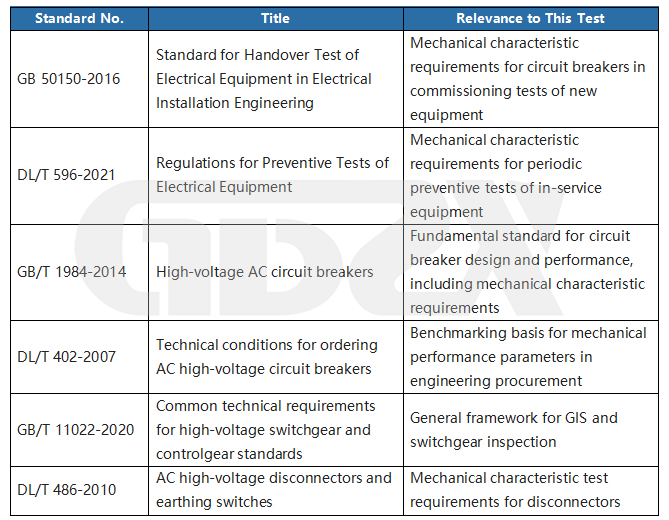
Important Note: All standards shall be subject to the currently effective versions and applied in conjunction with the technical specifications and type-test reports provided by the manufacturer. The standard references in this document are for guidance only and cannot replace the formal basis for engineering execution.
1.2 Comparison of Applicable Standards and Requirements for Three Test Scenarios
The same circuit breaker faces different test requirements at different stages of its life cycle, and the basis for execution differs accordingly.
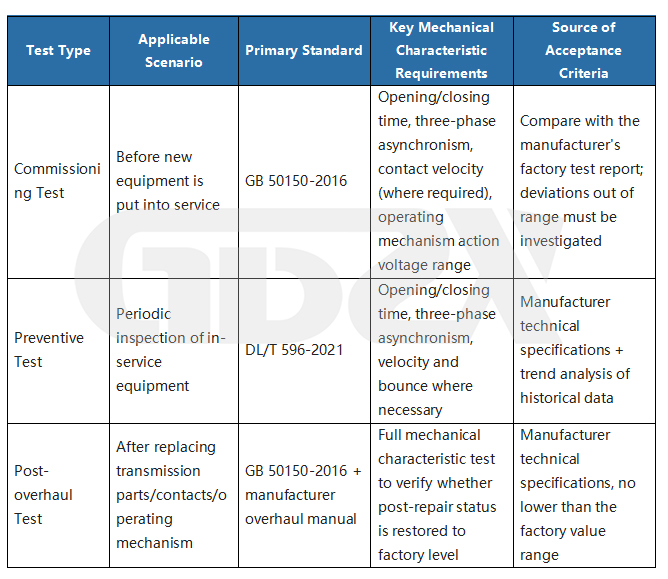
1.3 About Test Qualifications
Performing high-voltage equipment tests requires the appropriate special-operation certificate (Electrician In-Network Work Permit or Special Equipment Operator Certificate). "Working without a certificate or independently operating high-voltage equipment" is strictly prohibited; non-compliant operation not only poses personal safety risks, but the test results also lack legal validity. When participating in high-voltage equipment tests, the relevant requirements of the electrical safety work regulations shall also be observed, including fulfilling work-ticket procedures, setting up safety barriers, installing grounding wires, and ensuring the work supervisor is present to provide oversight.
II. What Is a High-Voltage Switch Characteristic Tester
The high-voltage switch characteristic tester is a specialized test instrument designed to measure the mechanical operating characteristics of switching devices such as high-voltage circuit breakers and disconnectors. At the instant the circuit breaker executes an opening or closing command, it synchronously acquires parameters including operating time, contact travel, moving-contact velocity, three-phase asynchronism, and bounce. Once a problem occurs in the breaker's mechanical mechanism — spring fatigue, transmission-component wear, or poor control-circuit contact — there are often no visible abnormalities in appearance, yet the operating-characteristic data will show deviations first. The value of this instrument lies precisely in quantifying and revealing this "invisible" mechanical state.
In appearance, mainstream products are typically portable or suitcase-type. The main unit panel integrates an LCD display (or a knob-plus-button interface), opening/closing control output terminals, energy-storage power output terminals, sensor input ports (single or multiple channels), auxiliary-contact input terminals, and a data interface. Standard accessories include opening/closing control cables (aviation plugs or crocodile clips), a linear displacement sensor, sensor mounting brackets, and an operation manual. By the number of breaks/sensor channels, the product lineup typically ranges from a basic single-break model to a comprehensive twelve-break model, corresponding to field-test needs of different scales.
III. Why Mechanical Characteristic Testing Cannot Be Omitted
A comprehensive circuit breaker inspection generally covers five categories of tests: insulation resistance, loop resistance, power-frequency withstand voltage, SF₆ gas, and mechanical characteristics. The first four verify insulation level, contact resistance, insulation strength, and the arc-extinguishing medium, respectively, but all arestaticmeasurements and cannot reflect the mechanism state during the breaker's actual operation. The mechanical characteristic test fills precisely this gap — verifying whether the mechanism can complete the opening/closing action within the specified time, at the correct speed, and with proper synchronism. GB 50150-2016 lists it as a mandatory commissioning test, and DL/T 596-2021 includes it as a periodic preventive test item.
In field engineering practice, the following three types of defects can be detected only by the mechanical characteristic test:
Spring energy-storage mechanism fatigue: When spring force decays, opening/closing speed decreases and operating time lengthens, yet appearance is normal and insulation and loop resistance are both normal. Without the mechanical characteristic test, such defects surface only during live operation in the form of "failure to operate."
Excessive three-phase asynchronism: An excessive difference in the operating times of the three-phase contacts causes the arc in one phase to persist too long during short-circuit interruption, damaging the contacts. Neither loop-resistance nor insulation tests can reflect this problem.
Abnormal contact bounce: Excessive closing bounce indicates contact wear or failure of the buffer mechanism; the repeated arcs generated during bouncing accelerate ablation and eventually lead to failure to operate. This is likewise a defect that other tests cannot detect.
The mechanical characteristic test cannot be replaced by insulation-type or electrical-type tests. Omitting it is equivalent to leaving a blind spot in the most critical inspection link.


