


NEWSnews
High-Voltage Switchgear Tester: Manufacturer Audit, Acceptance & Procurement
X. How to Audit Manufacturer Documentation, Sample-Unit Capability, Delivery Capability and After-Sales System
Auditing a Manufacturer Is Not Reading a Brochure — These Five Dimensions Matter
Based on the common priorities of manufacturer evaluation, the audit framework can be summarized into the following five dimensions, in order of importance:
10.1 Metrological Traceability and Quality Certification
Mandatory:
• Factory inspection report of the instrument, including measured values of all core parameters
• Calibration certificate issued by a nationally recognized metrology institution (e.g. provincial metrology institutes, China Electric Power Research Institute)
• The manufacturer is certified to the ISO 9001 quality management system
Recommended verification: whether the instrument number on the calibration certificate matches the supplied instrument; whether the calibration items cover all core parameters you need (time, displacement, speed, etc.); whether the certificate validity covers your delivery acceptance period.
10.2 Industry Application Cases and User Reputation
The most convincing evidence: the instrument has documented actual use in the China Electric Power Research Institute, provincial electric power research institutes, and major power groups (provincial companies of State Grid and China Southern Power Grid). You may ask the manufacturer for a list of user organizations and verify selected ones by telephone.
Practical procurement tip: if peer organizations in your field (maintenance teams in the same region, testing organizations of the same nature) are already using a brand, asking them directly about user experience is the most efficient form of manufacturer evaluation. Manufacturers such as Guodian Zhongxing, with a broad application base in electric power research institute systems, can usually provide ample case support at this stage.
10.3 Technical Documentation and Training Support
Mandatory:
• Complete operating manual (in Chinese, including wiring diagrams for common equipment)
• Host-computer software installation package and user guide
• Common fault troubleshooting guide
Recommended requirements:
• At least one on-site training session supplied with the instrument (including a live wiring demonstration)
• A remote technical support channel (telephone / WeChat technical support group)
• Training content should cover the basics of reading secondary drawings and troubleshooting common wiring errors — not merely “how to operate the instrument”
10.4 Sample-Unit Testing and Function Verification
The most valuable step in procurement: ask the manufacturer to bring a sample unit to your site and perform one complete test operation on your actual circuit breaker. On-site testing can verify:
• Can the instrument correctly control the opening and closing of your circuit breaker?
• Can the sensors be mounted smoothly on your equipment?
• Are the measured data reasonable (compared with historical data or data from another instrument)?
• Can the software generate a test report smoothly?
• Is the operating procedure convenient, and is the training difficulty manageable?
Avoid watching only a standardized demonstration on a “demo unit” prepared by the manufacturer — that is the scenario the manufacturer knows best with the most perfect parameters, and it cannot represent your actual site conditions.
10.5 Delivery Capability and After-Sales System
Must confirm:
• Delivery lead-time commitment (normally 15–30 working days for standard products)
• Warranty period (no less than one year, covering the main unit and all standard accessories)
• Commitment on repair response time within the warranty period
• Post-warranty charging standards for repair and calibration
• Spare parts stock and lead time for consumables such as sensors
• Software upgrade policy (whether functional updates are provided free of charge)
Bonus items:
• Can a loaner instrument be provided (borrowing a backup during repair so the test schedule is unaffected)?
• Local service engineers or agents in your region
• Regular inspection service (proactive on-site checks of instrument condition)
XI. Key Points of Delivery Acceptance and On-Site Trial Use
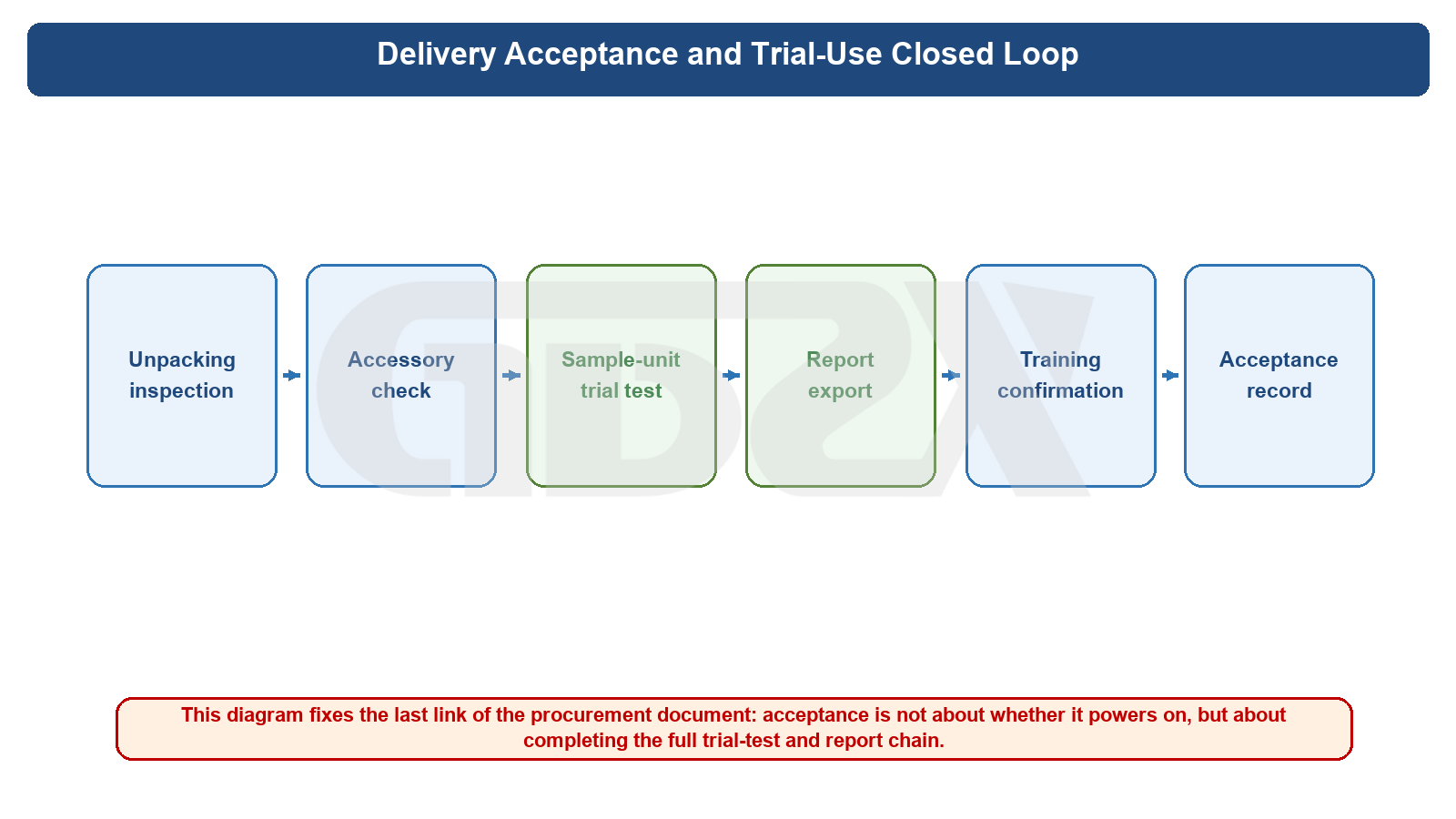
Diagram: Delivery Acceptance and Trial-Use Closed Loop
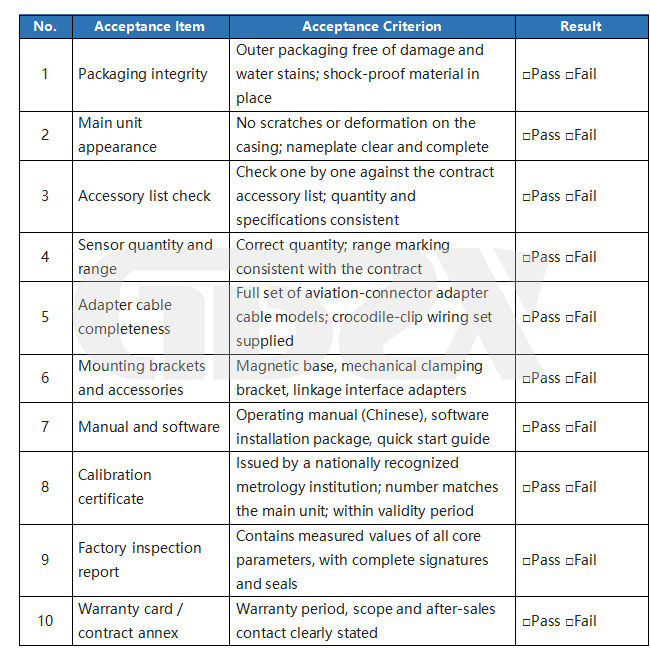
Delivery Acceptance Checklist
After the instrument arrives, check and accept it item by item against the following list:
I. Unpacking Check
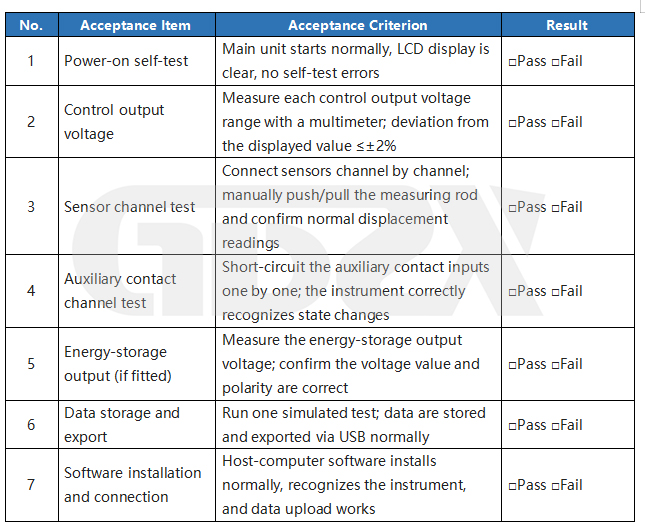
II. Power-On Check
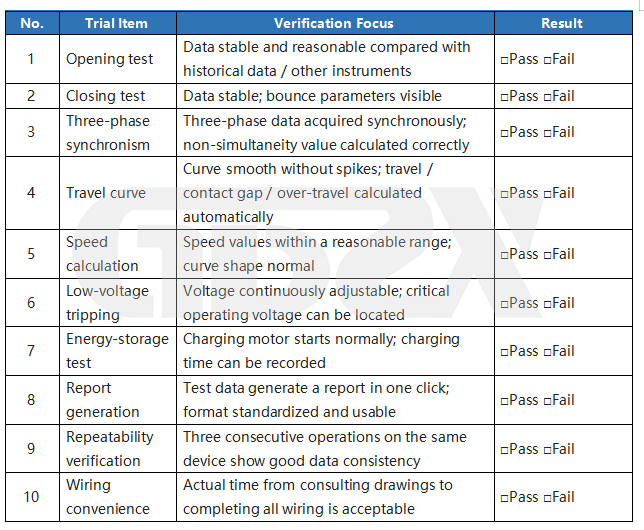
On-Site Trial Checklist
After the power-on check is passed, an on-site trial verification should be carried out on an actual circuit breaker. Choose your most frequently used circuit breaker model as the trial object:
Common Problems in Acceptance and Their Handling
One sensor channel shows no reading: first check that the signal cable is firmly connected, then cross-verify by swapping in another sensor. If an instrument channel fault is confirmed, record it immediately and contact the manufacturer.
Control output voltage deviation exceeds the limit: measure directly at the control output terminals with a calibrated multimeter and compare with the displayed value. A deviation exceeding ±3% should result in rejection of acceptance.
Instrument not recognized after software installation: confirm that the driver is correctly installed, that the USB cable is the original accessory, and that the computer port works normally.
Calibration certificate number does not match the main unit nameplate: reject acceptance and require the manufacturer to replace the certificate or the instrument with a matching one.
XII. Conclusion: How Procurement Staff Make the Right Decision
Back to the Core: Five Judgement Pillars of a Procurement Decision
After the systematic review in the preceding eleven chapters, the final procurement decision comes down to five core judgements:
First, define the boundary of your test tasks. Which equipment does your organization need to test (vacuum circuit breakers, SF₆ circuit breakers, GIS, disconnectors), which test items must be completed (time, travel, speed, synchronism, bounce, low-voltage operation, energy storage, blocking), and what level of report must be issued — the answers to these three questions lock in your configuration floor.
Second, let the equipment decide the break count and the tasks decide the functions. The break count is determined by the break structure of the most complex on-site equipment; the function configuration is determined by the test item list. Do not configure the highest grade for occasional needs, and do not cut necessary configuration to save budget.
Third, look at total cost, not only purchase price. Are sensors standard, is software reporting included, how is calibration service arranged, how long is the spare parts lead time — only the sum of these “hidden costs” is your true procurement cost.
Fourth, audit manufacturers on strength rather than quotation alone. Metrological traceability, industry application cases, technical training support, sample-unit field performance and the after-sales service system — a composite score across these five dimensions predicts real-world usability better than a simple price ranking.
Fifth, carry out acceptance rigorously. Check the accessory list on delivery, test every channel under power, run one complete test on real equipment, and confirm report generation — only when these steps are done properly can you be sure you have not bought a device with “a beautiful parameter sheet that cannot be used on site”.
Summary of Procurement Recommendations
Sensors are not an option; they are a necessity. A high-voltage switchgear characteristic tester without sensors can measure only time and synchronism — travel, speed and bounce, the parameters with the greatest diagnostic value, are all missing.
Wiring compatibility affects user experience more than parameter accuracy. Parameter accuracy is already highly homogeneous, but whether accessories are complete, whether adapter cables cover your equipment, and whether a crocodile-clip set is supplied directly determine whether the instrument works smoothly on site.
Reporting capability is often underestimated. The value of test data lies not in “being measured” but in “being usable” — written into acceptance reports, stored in technical archives, used as a basis for maintenance decisions. An instrument that cannot automatically generate standardized reports will keep consuming your labour cost.
Lock down calibration and after-sales support in advance. Specifying calibration service arrangements, spare parts lead times and technical support response in the contract are the clauses most easily omitted yet most far-reaching in a procurement contract.
Choosing a reliable manufacturer matters more than choosing a cheap price. A manufacturer with industry reputation, application cases and a complete service system is the underlying guarantee of the credibility of your test conclusions. In this field, professional manufacturers with long-standing specialization such as Guodian Zhongxing, drawing on extensive application within the power system and a mature technical service system, can provide purchasers with full-chain support from selection consulting to on-site training and from calibration service to spare parts supply — this is exactly what “quality credibility” means in a procurement decision.
A final word for procurement decision-makers: a high-voltage switchgear characteristic tester is not an instrument you “buy and forget” — it is the core tool with which your test team assesses the health of circuit breakers. The quality of the tool directly determines the credibility of your test conclusions, and that credibility ultimately bears on the safety of power grid operation. In this chain of logic, the weight of a procurement decision is far greater than the number on the price tag.
Disclaimer: this article is compiled from publicly available technical materials and current procurement application scenarios, and is for procurement decision reference only. The technical parameter ranges mentioned are illustrative references; specific acceptance criteria are subject to the technical conditions of the manufacturer of the device under test. Actual procurement plans should be formulated by considering the specific needs of your organization, budget constraints and industry norms. All standards cited should be used in their currently valid versions.


