


NEWSnews
ZXR-10A TWRT Technical Analysis and Application Specification
Introduction
In power transmission and distribution systems, power transformers are the core energy conversion equipment, and the integrity of their winding conductive circuits directly determines the safety and stability of equipment operation. The DC resistance test of transformer windings is a mandatory test item clearly specified in GB 50150 Standard for Handover Test of Electric Equipment in Electrical Installation Engineering and DL/T 596 Preventive Test Code for Electric Power Equipment. It is also the core technical method to detect hidden faults such as inter-turn short circuit of windings, poor contact of tap changers, broken strand of leads, and welding defects.
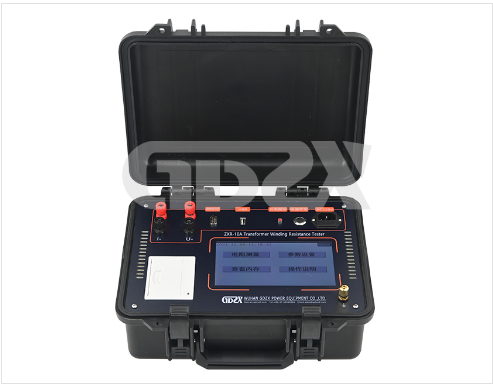
Traditional DC resistance test equipment generally has pain points such as insufficient output current, narrow measuring range, poor field adaptability, and insufficient discharge safety control, which are difficult to meet the needs of rapid on-site testing and high-precision detection of large-capacity transformers. The ZXR-10A Transformer Winding Resistance Tester is developed based on a new power supply technology and single-chip intelligent control architecture, which effectively solves the above industry pain points, and can provide an efficient, accurate and safe DC resistance test solution for power test technicians.
1. Core Technical Architecture and Functional Features of the Instrument
The ZXR-10A tester takes a single-chip microcomputer as the core control unit, matched with a new power supply technology architecture, to realize intelligent control of the whole test process. Its core functional features fully adapt to the core requirements of on-site tests in the power industry.
1.1 Intelligent Full-Process Control Architecture
The whole machine is fully intelligently controlled by a single-chip microcomputer, which can automatically complete the whole process of equipment self-test, data acquisition, operation processing and result display without manual intervention in data calibration and conversion, which greatly reduces the measurement error caused by manual operation, simplifies the on-site operation steps, and improves the test efficiency. The instrument has a built-in perfect automatic discharge function, which can automatically complete the energy release of the inductive load after the test, and solves the safety control problem of back electromotive force of the transformer winding with large inductive load after power off.
1.2 High Current and Wide Range Test Capability
The instrument adopts new power supply technology, which realizes the balance of large output current and light weight of the equipment. It is equipped with 7 optional output current gears, with a maximum output current of up to 10A, which can effectively shorten the inductance charging time of large-capacity transformer windings, and solve the industry pain points of long stabilization time and low efficiency of low resistance test of traditional equipment. At the same time, the wide range design covers the test range from 0μΩ to 20KΩ, which can adapt to the test requirements of various types of equipment from large-capacity main transformers to small distribution transformers and voltage transformers.
1.3 High Reliability Safety Protection Design
In view of the safety requirements of power field tests, the instrument is equipped with a perfect protection circuit, which can effectively avoid damage to the equipment caused by abnormal working conditions such as wiring errors and power supply fluctuations. At the same time, it integrates dual discharge alarm indication of sound and light + liquid crystal, which can clearly feedback the discharge state, remind the test personnel to operate standardly, greatly reduce the probability of misoperation, and ensure the personal and equipment safety of on-site tests.
1.4 Strong Field Adaptability
The instrument has a built-in lithium battery for power supply, and also supports AC220V external power supply, which can meet the test requirements of field substations without external power supply and emergency repair scenarios. The overall size of the whole machine is only 400×220×320mm, and the weight is 10kg. It has the characteristics of small size and light weight, and can flexibly adapt to multi-scenario test requirements in the laboratory and outdoor field. The human-computer interaction adopts LCD prompt menu and digital display design, with clear operation logic and intuitive reading, which can adapt to the operation requirements under complex working conditions on site.
2. Core Technical Indicators and Engineering Application Analysis
For power test technicians, the technical indicators of the instrument directly determine the validity of test data and scene adaptability. This chapter carries out engineering analysis of core indicators to provide technical reference for on-site selection and application.
2.1 Output Current and Range Adaptation
The instrument is equipped with 7 optional output current gears, corresponding to different measurement ranges, which can accurately match the test requirements of transformers with different voltage levels and capacities. The specific adaptation relationship is shown in the following table:
表格
Output Current Gear | Corresponding Measuring Range | Typical Application Scenarios |
10A | 0~180mΩ | High and low voltage winding test of 110kV and above large-capacity power transformers, large-section lead circuit test |
5A | 180mΩ~360mΩ | 35kV~110kV main transformer winding, large-capacity distribution transformer test |
1A | 360mΩ~1.8Ω | 10kV distribution transformer, medium reactor winding test |
400mA | 1.8Ω~4.5Ω | High voltage winding of distribution transformer, small transformer winding test |
200mA | 4.5Ω~9Ω | Voltage transformer winding, small reactor test |
40mA | 9Ω~45Ω | High resistance winding, small electromagnetic component test |
<5mA | 45Ω~20kΩ | Ultra-high resistance winding, special electromagnetic component circuit test |
At the same time, the instrument supports 0mΩ~20kΩ full automatic range switching without manual gear selection, which can further simplify the on-site operation process and avoid measurement errors caused by wrong gear selection.
2.2 Measurement Accuracy and Resolution
The measurement accuracy of the instrument can reach 0.2%±2μΩ, and the resolution is 0.1μΩ, which is at the leading level of similar equipment in the industry. In engineering applications, micro-ohm level resolution and high accuracy can accurately identify tiny changes in winding resistance, effectively capture hidden defects such as slight erosion of tap changers, early inter-turn short circuit of windings, and poor lead contact, provide accurate data support for transformer condition maintenance and early fault warning, and avoid equipment accidents caused by defect expansion.
2.3 Environmental Adaptability Indicators
The operating temperature range of the instrument covers -20℃~40℃, and it can work stably under the environmental humidity of ≤80%RH without condensation. It can adapt to the outdoor field test environment in most areas of China, and can ensure the stability of test data and the reliability of equipment operation whether it is in the severe cold outdoor substation in winter in the north or the high temperature and high humidity field conditions in summer in the south.
3. On-site Test Operation Specification and Data Judgment Criteria
To ensure the accuracy of test data and the safety of test operation, technicians must strictly follow the power test specifications and instrument operation requirements when using this instrument to carry out tests.
3.1 Pre-test Preparation
The tested transformer must be completely disconnected from all high and low voltage side wiring, confirm that the equipment has no voltage and is fully discharged, and strictly abide by the safety operation process of "power off first, then test for electricity, then discharge, and hang the ground wire".
Clean the transformer winding terminals, remove the surface oxide layer, oil and rust, to reduce the impact of contact resistance on the test results.
Check the integrity of the instrument appearance and the insulation layer of the test cable, and confirm that the instrument has sufficient power or the external AC220V power supply is reliably grounded.
3.2 Standardized Operation Process
Connect the test cable by the four-terminal test method, the current cable is connected to the outside of the terminal, the voltage cable is connected to the inside of the terminal, and the voltage cable must be in reliable contact with the winding terminal to avoid measurement errors introduced by wrong wiring.
After power on, wait for the instrument to complete self-test, select the corresponding test gear through the LCD menu, or directly select the full automatic range mode.
After starting the test, the instrument automatically completes winding charging, data acquisition and calculation. Record the test data after the reading is stable. It is strictly forbidden to terminate the test in advance before the data is stable.
After the test is completed, you must wait for the instrument to complete the automatic discharge, the sound and light alarm stops, and the discharge indication disappears before removing the test wiring. It is strictly forbidden to remove the wiring before the discharge is completed to prevent inductive electric shock accidents.
3.3 Test Data Judgment Criteria
According to the current power test regulations, the test results of transformer winding DC resistance must meet the following requirements:
For transformers of 1600kVA and below, the phase-to-phase difference of each phase winding resistance shall not be greater than 2% of the three-phase average value; for windings without neutral point leading out, the line-to-line difference shall not be greater than 1% of the three-phase average value.
For transformers above 1600kVA, the phase-to-phase difference of each phase winding resistance shall not be greater than 1% of the three-phase average value, and the line-to-line difference shall not be greater than 1% of the three-phase average value.
Compared with the historical test data at the same temperature, the resistance change rate shall not be greater than 2%.
All gears of the tap changer must be tested, the test results of all gears must meet the above requirements, and there is no abnormal mutation in the data of the same gear in different periods.
If the test result exceeds the above range, it is necessary to check the problems in the test links such as wiring and poor contact. After eliminating the test error, it can be determined that there is a defect in the conductive circuit of the transformer winding, and further fault diagnosis and maintenance are required.
4. Typical Engineering Application Scenarios
The performance indicators of the ZXR-10A Transformer Winding Resistance Tester fully meet the requirements of various test scenarios in the power industry. The typical application scenarios include:
Transformer Handover Test: Before the commissioning of transformers in new substations, detect whether the equipment has winding welding defects, loose leads, abnormal tap changers and other problems during transportation and installation, and verify whether the equipment meets the commissioning standards.
Preventive Test: According to the cycle requirements of the power equipment preventive test code, carry out regular detection of the winding state of the transformer in operation, identify hidden hidden dangers such as tap changer erosion and winding inter-turn degradation in advance, and realize equipment condition maintenance.
Fault Diagnosis and Emergency Repair: When the transformer suffers from short circuit impact, abnormal temperature rise, abnormal oil chromatographic data and other working conditions, quickly locate the fault point of the conductive circuit through DC resistance test, and provide technical basis for emergency repair.
Quality Acceptance After Maintenance: After the completion of transformer hoist maintenance, tap changer replacement, winding treatment and other maintenance work, verify the maintenance quality through testing to ensure that the equipment meets the safety operation requirements after maintenance.
Conclusion
With the core advantages of wide range, high precision, high safety and strong field adaptability, the ZXR-10A Transformer Winding Resistance Tester fully covers the regulation requirements and on-site needs of transformer DC resistance test in the power industry, and is a core tool for power test technicians to carry out transformer state detection and fault diagnosis.
GDZX is a manufacturer of power detection equipment, offering a diverse range of products with comprehensive models and providing professional technical support. Contact us at +86-27-6552607 or +86-17396104357.Website: http://en.gdzxdl.com/


