


NEWSnews
Distribution Transformer Winding Material Testing and ItsEngineeringSignificance
一、What Exactly Is a Distribution Transformer Winding Material Testing Device?
One-sentence answer: It is a specialized testing device used to identify, on site and without disassembling the transformer, whether the winding conductors of a distribution transformer are made of copper or aluminum.
Let us start with a real-world scenario. During the incoming inspection of a batch of 10 kV distribution transformers, a power supply utility suspected that some products had been manufactured with aluminum instead of copper, or with copper-clad aluminum conductors, while the nameplates indicated all-copper windings. Disassembling each transformer for core inspection was impractical, while sending samples to a laboratory for metallographic analysis was too time-consuming. What was needed was precisely a tool capable of providing a rapid indication of the winding material on site without disassembling the transformer.
A distribution transformer winding material testing device is designed to address this gap. It typically adopts a split structure consisting of a portable host unit and a testing unit: the host unit is responsible for excitation, data acquisition, calculation, and touchscreen display, while the testing unit is responsible for connection to or coupling with the winding under test.
Its positioning is screening rather than definitive determination. It provides an indication of the likely winding material together with supporting measurement parameters, helping determine which transformers require further disassembly or laboratory testing, rather than directly issuing a material composition certificate.
A common misconception should also be clarified: this type of device is not simply a resistance meter. Measuring only the resistance value cannot directly determine whether the conductor is copper or aluminum, because resistance is also affected by conductor cross-sectional area, turn length, temperature, and transformer capacity rating. Its value lies in incorporating these factors into a unified identification methodology.
二、Why Winding Material Identification Is Becoming Increasingly Important in Acceptance and Maintenance
Why specifically test the winding material? Because the price difference between copper and aluminum is significant, there is an incentive for substitution, and the material directly affects losses, temperature rise, and service life.
The market price difference between copper and aluminum is significant, and the amount of copper used in windings accounts for a considerable proportion of the cost of a distribution transformer. This creates an incentive to substitute aluminum for copper or use copper-clad aluminum to pass as all-copper windings. Material nonconformity is a concealed defect that is difficult to detect through appearance or the nameplate alone.
From the power grid side, the acceptance stage is the first line of defense. If transformers with nonconforming winding materials enter the grid, higher losses, greater temperature rise, and shortened service life during subsequent operation may result, with the associated costs ultimately borne by the operating utility.
From the perspective of in-service quality inspection, some old or unknown-source transformers may have material issues inherited from the past. Spot-checking the winding material can help assess the actual condition of the assets and provide a basis for replacement or operation at reduced capacity.
Case: During a special inspection in one region, this type of device was used to screen approximately 40 in-service distribution transformers. Several units with obvious mismatches between resistance and rated capacity/conductor cross-sectional area were identified. Subsequent disassembly confirmed copper-clad aluminum treatment at the winding ends. Without an on-site screening tool, such problems would have been difficult to detect.
The conclusion is clear: the significance of material identification is not merely to “identify a problem with one transformer,” but to use a low-cost method to safeguard the quality baseline of an entire batch of equipment.
三、Engineering Background of Copper Windings, Aluminum Windings, and Related Material Differences
What Are the Differences Between Copper and Aluminum? The Differences Lie in Resistivity, Mechanical Strength, and Connection Processes, and These Differences Ultimately Affect Losses, Temperature Rise, and Service Life.
The resistivity of copper is approximately 0.0172 Ω·mm²/m at 20°C, while that of aluminum is approximately 0.0283 Ω·mm²/m at 20°C. In other words, for the same cross-sectional area and length, the resistance of aluminum is approximately 1.6 times that of copper.
To achieve the same current-carrying capacity and loss targets, the cross-sectional area of an aluminum conductor generally needs to be larger than that of a copper conductor. This explains why transformers with aluminum windings often differ in physical dimensions or material configuration.
3.1 Specific Effects of Material Differences on Performance
For an aluminum winding with the same rated capacity, if the conductor cross-sectional area is insufficient, load losses (I²R losses) will be relatively high, directly increasing the operating temperature rise. As temperature rise increases, insulation aging accelerates, resulting in a corresponding reduction in service life.
In terms of mechanical strength, copper has higher tensile strength and better ductility than aluminum. Under the impact of short-circuit electromagnetic forces, aluminum windings have relatively weaker resistance to deformation, which affects their short-circuit withstand capability.
In terms of connection processes, the surface of aluminum is prone to oxidation. If copper-aluminum transition connections are improperly processed, contact resistance may increase during long-term operation, resulting in localized overheating. This is also why consistency of conductor materials at the winding ends deserves particular attention.
3.2 Special Risks of Copper-Clad Aluminum and End Conductors
Copper-clad aluminum conductors have a copper outer layer and an aluminum core. Their appearance and end connection points can easily be made to look like those of all-copper conductors. Their DC resistance falls between that of pure copper and pure aluminum, so measuring resistance at only a single point can easily lead to misjudgment.
Material differences in end conductors, such as leads and connecting pieces made of different materials, can create risks of localized contact resistance and overheating. This type of “localized material substitution” is more difficult to detect than replacing the material throughout the entire winding and therefore requires dedicated identification methods.
3.3 How Material Differences Ultimately Translate into Maintenance Risks
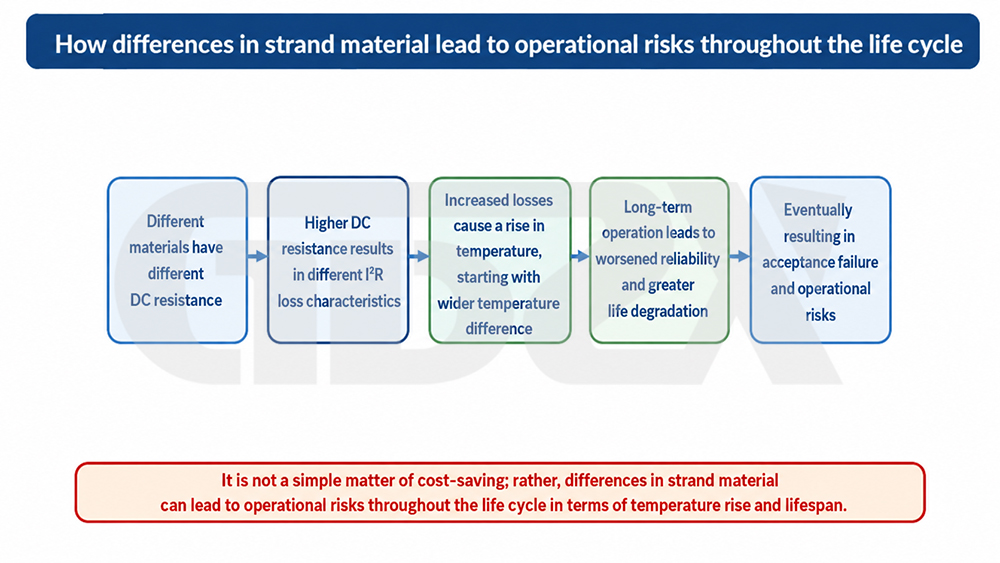
Figure: How Winding Material Differences Ultimately Translate into Operation and Maintenance Risks
Clarify the chain of causation: Nonconforming materials (such as aluminum conductors with insufficient cross-sectional area or copper-clad aluminum) will first manifest as increased DC resistance. This in turn increases I²R losses under load, and the resulting losses are converted into heat, raising the winding temperature rise. Persistently high temperature rise accelerates insulation aging over the long term and ultimately shortens the service life of the transformer. At the same time, under short-circuit conditions, aluminum windings have relatively weaker resistance to deformation caused by electromagnetic forces, reducing the short-circuit withstand margin.
A material-related issue is often not an isolated defect, but rather a chain of hidden risks spanning electrical, thermal, mechanical, and service-life aspects. More challenging is the fact that this chain is delayed and cumulative: a transformer using aluminum in place of copper may barely pass electrical tests during acceptance, yet fail prematurely after years of operation and several short-circuit events. If the problem is identified before commissioning, the cost is simply one screening test; if it emerges after years of operation, the consequences may include power outages, transformer replacement, or even an accident. This is precisely why such problems should be identified and stopped at the acceptance stage.


