


NEWSnews
Distribution TransformerWindingMaterialDetector: Methods, Types & Key Parameters
四、Which Scenarios Are Different Mainstream Detection Methods Suitable For?
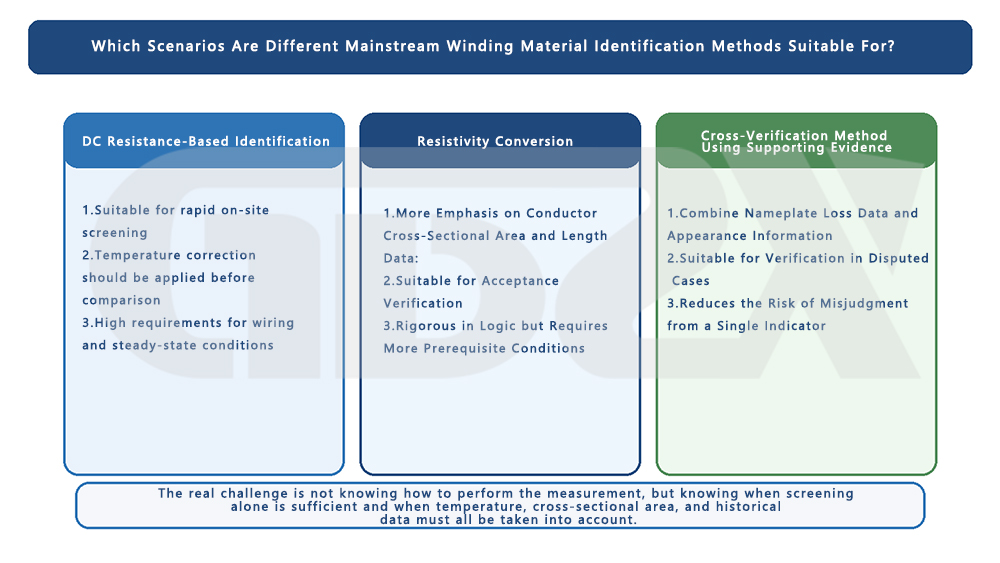
Figure: Which Scenarios Are Different Mainstream Winding Material Identification Methods Suitable For
What are the main ways to identify winding material? On-site screening, resistance measurement, loss testing, and disassembly and laboratory analysis each serve a different purpose.
The first is the subject of this article—the winding material detection device. It follows a non-destructive on-site screening approach, offering fast testing and suitability for batch inspections.
The second is the DC resistance tester. It accurately measures the winding DC resistance and provides an important indirect basis for determining the material. However, resistance itself does not directly indicate the material and must be evaluated together with conductor cross-sectional area and temperature correction.
The third is no-load/load loss testing. It reflects the overall energy consumption level of the transformer. Material discrepancies may indirectly appear as increased losses, but this method cannot identify which phase or which section has a material issue.
The fourth is disassembly verification and laboratory material analysis (such as spectroscopy and metallographic analysis). This is the “gold standard” for material identification, providing authoritative conclusions, but it is highly destructive, time-consuming, and costly.
A reasonable engineering approach is to use a tiered process: first use the material detection device and DC resistance testing for on-site screening, then use disassembly or laboratory methods to confirm identified suspected issues. The four approaches are not alternatives to one another; rather, they form a coordinated hierarchy of accuracy and cost.
五、What Types of These Devices Are Available, and How Do They Differ?
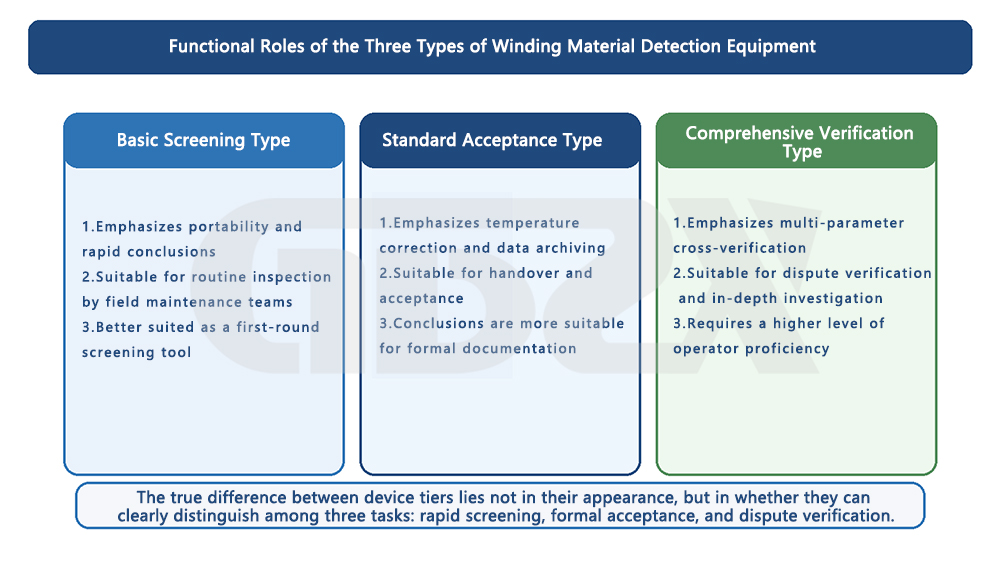
Figure: Functional Roles of the Three Types of Winding Material Detection Equipment
Why Do Devices That Are All Called Material Detection Devices Differ in Price by Several Times? The Difference Lies in Methodological Completeness and Verification Capability.
By form factor, they can be divided into portable devices, mainly intended for on-site screening, and benchtop devices, mainly intended for in-depth analysis in laboratories or quality inspection rooms. Portable devices emphasize mobility and on-site adaptability, while benchtop devices emphasize stability and comprehensive parameters.
By the depth of the detection method, they can be divided into screening-type and in-depth verification-type devices. Screening-type devices provide rapid identification of whether the winding is likely copper or aluminum; in-depth verification-type devices provide waveform, trend, and multi-parameter cross-validation functions, resulting in a lower risk of misjudgment.
By the basis for material identification, there are basic types that rely on a single electrical parameter and comprehensive types that combine non-contact excitation, multiple electrical parameters, and temperature correction. Comprehensive types offer stronger resistance to interference and greater capability to detect disguised or misleading conditions.
A common misjudgment scenario is using a basic device to test copper-clad aluminum conductors. Because it relies only on a single resistance range, it may incorrectly identify copper-clad aluminum as pure copper. Such borderline cases are precisely where the multidimensional criteria of a comprehensive device are needed.
The key to device selection is not simply “Can it distinguish copper from aluminum?”, but rather “Can it still make an accurate determination under borderline conditions and on-site interference?”
六、Using the Equipment Shown in the Figure as an Example, How Should Key Structures and Parameters Be Evaluated?
What Should You Look at First When Evaluating a Device? Focus on Its Structural Design, Power Supply and Environmental Adaptability, and Identification and Display Capabilities.
Taking a typical portable distribution transformer winding material detection device as an example (the parameters below represent typical configurations and should be verified against the actual technical documentation), it uses a split-type structure consisting of a main unit and a detection unit. The main unit integrates excitation, data acquisition, processing, and a touchscreen, while the detection unit is responsible for connection to or non-contact coupling with the winding terminals.
In terms of power supply, a typical configuration is three-phase 380 V ±10%, 50 Hz. The ±10% voltage tolerance means the device can continue to operate stably when the on-site power grid fluctuates, providing a basic guarantee of field adaptability.
In terms of environmental adaptability, typical specifications include an operating temperature of -10°C to 50°C, relative humidity of 5% to 90% RH (25°C), and an altitude of ≤2,000 m. These factors determine whether the device can be used in outdoor distribution transformer areas, as well as in hot and humid southern regions or cold northern environments.
In terms of the detection approach, the device uses non-contact detection and excitation, simultaneously acquiring electrical parameters for auxiliary identification. The touchscreen directly displays parameters, waveforms, and identification results. An industrial-grade operating system ensures stable operation in field conditions.
It should be noted that the device shown in the figure is only a typical example of this type of product, and its specifications are not the only standard configuration in the industry. When evaluating a device, the focus should be on its “combination of methods” and “basis for identification,” rather than on any single impressive specification.


