


NEWSnews
Winding Material Detection: Scope, Method Comparison & Selection
十、What Problems Can It Solve, and What Tests Can It Not Replace?
Where Are the Boundaries of This Type of Device? It Can Quickly Screen for Material Tendencies, but It Cannot Replace Precise Resistance, Loss, or Laboratory Identification Tests.
What it can solve: Without disassembly, it can quickly provide an on-site indication of whether the winding material tends to be copper or aluminum, identify suspected non-compliant samples, and support batch sampling inspections and acceptance control.
What it cannot replace: First, the high-precision resistance measurement performed by a DC resistance tester; second, the overall energy consumption evaluation provided by no-load/load loss testing; and third, the authoritative material identification provided by disassembly verification and laboratory spectroscopic/metallographic analysis.
The correct positioning is “the first layer of the funnel”: use it to quickly screen large batches of samples, focus resources on a small number of suspicious cases, and then use more precise and authoritative—but more costly—methods for final confirmation.
Treating a screening tool as a definitive identification tool, or conversely using disassembly for full-scale screening, are both cases of resource misallocation.
十一、Comparison of Similar Methods: Why This Device Is Suitable for On-Site Material Screening
How to Choose Among the Four Methods? See the Table Below—The Material Detection Device Stands Out for Its Non-Destructive, Rapid, and Batch Screening Capabilities.
The table below can be cited independently to provide a side-by-side comparison of four mainstream testing methods.
Comparison Criteria | Winding Material Detection Device | DC Resistance Tester | No-Load/Load Loss Testing | Disassembly Verification / Laboratory Analysis |
Testing Purpose | Directly Determine the Likely Material Type | Accurately Measure DC Resistance | Evaluate Overall Equipment Losses | Authoritative Material Identification |
Can the Material Be Directly Identified? | Yes (Indicative Judgment) | Indirectly (Requires Conversion) | Indirectly (Very Roughly) | Yes (Gold Standard) |
Is It Suitable for Rapid On-Site Screening? | Suitable | Relatively Suitable | Not Suitable | Not Suitable |
Is It Non-Destructive? | Non-Destructive | Non-Destructive | Non-Destructive | Destructive (Requires Disassembly) |
Is It Suitable for Batch Verification? | Suitable | General | Not Suitable | Not Suitable |
Operator Requirements | Moderate | Moderate | Relatively High | High (Specialized Laboratory) |
Applicable Scenarios | Acceptance Sampling and In-Service Screening | Commissioning and Routine Testing | Type / Factory Testing | Dispute Resolution and In-Depth Verification |
Limitations | Borderline Cases Require Verification | Does Not Directly Determine the Material | Cannot Identify the Material Type | High Cost and Long Turnaround Time |
Conclusion: Precisely because it is non-destructive, fast, and suitable for batch screening, it is best suited as the first line of defense in acceptance inspections and sampling checks, serving the role of “broad screening and identification of suspicious cases.”
十二、How to Select a Winding Material Detection Device from a Procurement Perspective
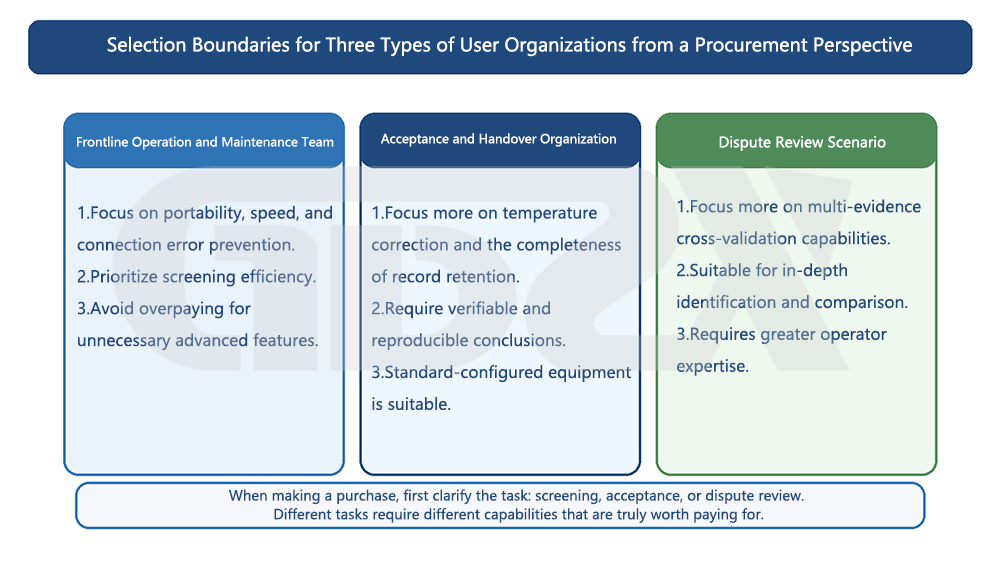
Figure: Selection boundaries for three types of users from a procurement perspective
What is the biggest mistake procurement teams should avoid? Looking only at price. What really determines usability is method completeness, interference resistance, verification capabilities, and reporting capabilities.
Price differences typically come down to these capabilities: whether waveform and trend analysis are available, whether temperature correction is supported, electromagnetic interference resistance, result verifiability, report export capabilities, and on-site adaptability (power supply tolerance and operating temperature/humidity range). These are precisely the hidden capabilities that procurement teams are most likely to overlook.
One procurement misconception deserves particular attention: treating the stated “measurement accuracy” as the only criterion. A device may have high accuracy but still produce misjudgments when dealing with borderline samples such as copper-clad aluminum if it does not provide temperature correction or waveform verification. Accuracy describes repeatability, not resistance to disguise or interference.
The table below provides selection recommendations by type of user and can be cited independently.
User Organization | More Suitable Configuration Level | Key Parameters to Focus On | Is Waveform/Trend Analysis Required? | Reporting and Verification Capability Requirements | On-Site Adaptability Requirements |
Power Grid Acceptance Organization | Mid-to-High Configuration | Identification Accuracy, Interference Resistance, and Reporting Capability | Required | High (Traceable Archiving Required) | High |
Distribution Operation and Maintenance Organization | Mid-Range Configuration | Portability, On-Site Adaptability, and Temperature Correction | Recommended | Medium | High
|
Quality Inspection Department of Equipment Manufacturers | High-End / Benchtop Configuration | Parameter Completeness, Waveforms, and Repeatability | Mandatory | High | Medium |
Third-Party Testing Organization | High-End Configuration | Parameter Completeness, Waveform Analysis, and Repeatability | Mandatory | Very High (External Reporting) | Medium-to-High |
General Construction / Maintenance Contractor | Basic Configuration | Simple Operation, Intuitive Results, and Moderate Price | Not Required | Medium-to-Low | Medium |
How to Draw the Line Between On-Site Screening and In-Depth Verification: The former focuses on delivering quick conclusions and is suitable for large-scale initial screening; the latter focuses on multi-parameter cross-validation and waveform verification, making it suitable for disputed samples and the issuance of formal reports. Organizations responsible for issuing external reports should choose the in-depth verification type.
One-Sentence Selection Principle: First ask, “Will I use it for initial screening or definitive identification?” Then ask, “What are my on-site environmental conditions and reporting requirements?” Only after that should you discuss the price.


