


NEWSnews
Relay Protection Tester Selection: Phase Knowledge & Type Differentiation
1. Get This Straight Before Purchasing: A Relay Test Set Is Not “The More Phases, the Better”
In the 2026 equipment procurement and field delivery context, the most common decision-making mistake is not paying too much, but “buying the wrong thing.” For the product category of protective relay test sets, many purchasers’ first instinct is to look at “how many phases” — assuming six-phase is better than three-phase, three-phase is better than single-phase, and the more phases, the safer. That logic may hold for most equipment, but for relay test sets it is a very costly misunderstanding.
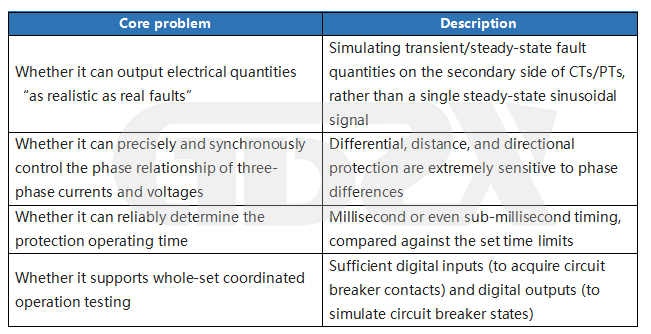
Why? Because the core value of a relay test set lies not in “how many signals it can output,” but in “whether it can accurately simulate the fault scenario you need to test.” As the well-known saying in the relay protection community goes:The essence of a relay test set is a fault quantity simulation system, not an ordinary power source or current source. The four core problems it must solve are:
For the scheduled maintenance test of line protection in a 35 kV substation, a three-phase unit is entirely sufficient, and many test items can even be done with a single phase. If you spend a six-phase budget only to find that 90% of the field tests can be done with three phases, the extra money is not “insurance” — it is waste.
Conversely, if you are responsible for 220 kV and above substations, involving dual-set differential protection testing, busbar protection coordination, or type testing of protection devices, a three-phase unit may simply be unable to do the job — not because it is “inferior,” but because the test scheme itself requires simultaneously outputting two groups of three-phase currents to simulate faults on both sides of a transformer. In that case, six phases is a rigid requirement, not a luxury.
Therefore, the first step in purchasing a relay test set is not to read product brochures, but to answer one question:In your test task list, how many phases of current and how many phases of voltage actually need to be output simultaneously? Once this question is answered accurately, most of the subsequent selection becomes clear.
2. What It Is and What It Solves in the Procurement Chain
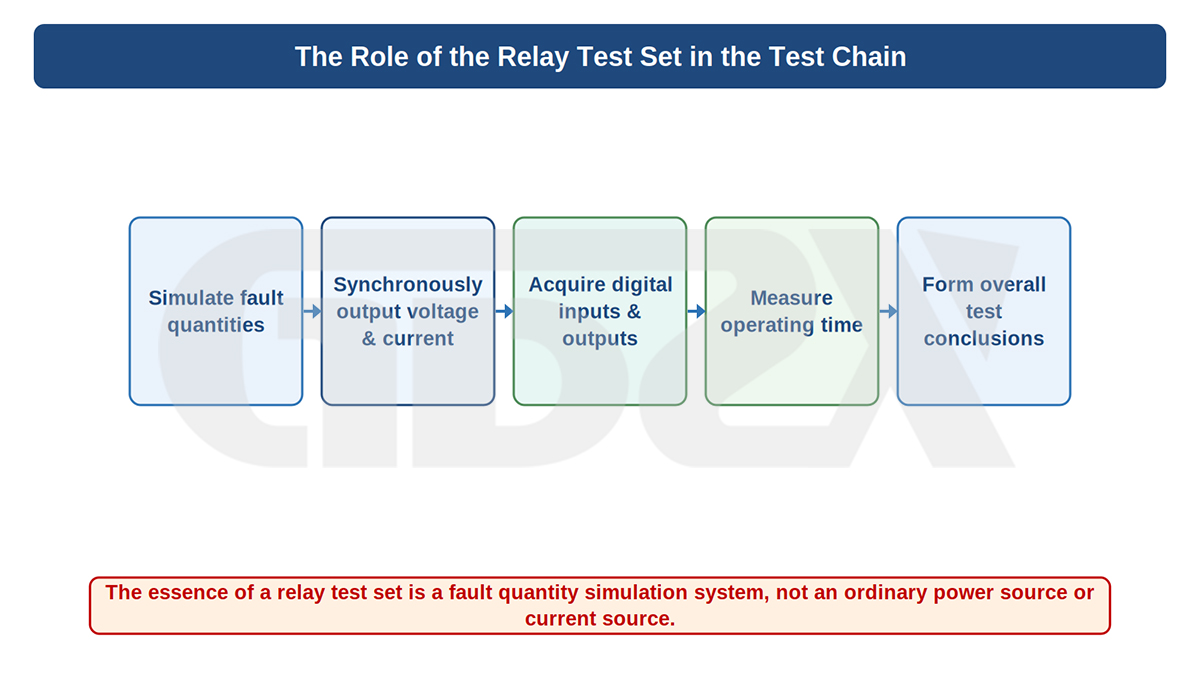
Figure: The role of the relay test set in the test chain
2.1 The Essential Functions of a Protective Relay Test Set
A protective relay test set (microcomputer-based relay protection test set, Microcomputer-based Relay Protection Test Set), also known in the industry as a “relay calibration tester” or “microcomputer relay protection test system,” has the following essential function:Synchronously output simulated current and voltage quantities with controlled precision, applied to the secondary input terminals of the protection device under test; simultaneously acquire the digital outputs of the protection device (trip contacts, signal relays, etc.) and measure operating times precisely; support complex whole-set coordinated test sequences, verifying the complete secondary circuit logic from protection operation to circuit breaker tripping.
Technically, it is built around an embedded computer with high-precision D/A conversion circuitry and power amplification units that output analog quantities precisely according to the configured parameters; it has built-in timing circuits and digital input acquisition modules to capture the protection device’s operating times and contact states. Most modern products come with a touchscreen or PC host interface and built-in automated test templates for various protection tests.
In plain terms, a power system cannot wait for a real short-circuit fault to see whether the protection holds up. The relay test set is the one who “sets the exam questions” — it gives the protection device one fault problem after another and checks whether the device’s “answers” (operating behavior) are correct.
2.2 Why Relay Protection Devices “Must” Be Tested Periodically
A protective relay device is normally in a “standby” state and only goes into action at the instant a fault occurs in the power system.The characteristic of “long periods of inactivity but mandatory operation at critical moments” means that its health state must be verified periodically. The consequences of failure have two extremes:
• Failure to trip: it should trip but does not; the fault current persists, which may cause equipment damage or even fire;
• Unwanted operation: it trips when it should not, causing unnecessary power outages and affecting supply reliability.
2.3 Which Stages of the Procurement Chain It Covers
From a procurement perspective, the relay test set covers the following key stages across the entire life cycle of power equipment:
Factory acceptance stage. Before a protection device leaves the manufacturer, a test set must be used to verify item by item that all of its protection functions meet the setting requirements. This is a prerequisite for equipment acceptance.
New-build/expansion commissioning stage. When a substation is newly commissioned or expanded, all protection circuits must be commissioned before energization. The relay test set is the core tool of commissioning — without it, setting verification, logic verification, and coordinated testing of protection devices cannot be completed.
Periodic maintenance stage. In accordance with regulations such as DL/T 995 (subject to the currently effective version), in-service protection devices must be tested periodically. This is the core scenario in which O&M units need a test set all year round.
Post-fault re-inspection stage. After an actual fault occurs in the power system, the protection devices involved must be re-inspected and confirmed to be fully functional before they can be returned to service.
R&D and type testing of protection devices. When a protection device manufacturer develops new products or applies for type inspection, it needs high-precision, multi-channel test sets to cover various extreme operating conditions.
Once you understand these stages, you will see: a relay test set is not an “optional accessory,” buta legally mandated, indispensable toolfor relay protection work. It is purchased not because you “want to,” but because “without it, the testing, commissioning, and acceptance of protection devices simply cannot be closed out.”
2.4 What It Is Not — A Comparison with Related Equipment
There are several common confusions that need to be clarified. The following comparison can help purchasers classify budget items correctly and avoid being questioned by the approval department about “whether alternatives exist”:
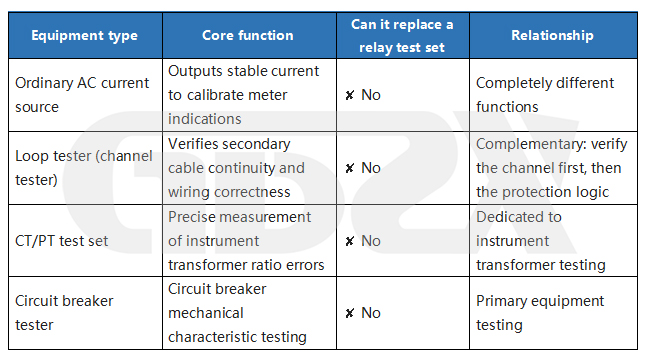
The irreplaceable value of the relay test set: complete fault quantity simulation + closed-loop verification of protection logic + precise operating time measurement + coordinated digital input/output testing — all four are indispensable, and no other single device can achieve them.
2.5 Regulatory Status and Reference Standards
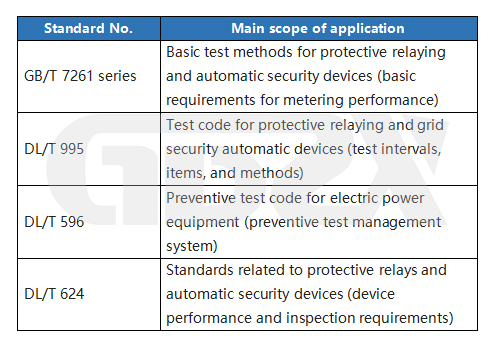
⚠️ The above standards may have newer versions; in actual engineering, please consult and confirm the currently effective versions.
3. Single-Phase, Three-Phase, Six-Phase — How to Tell Them Apart When Purchasing
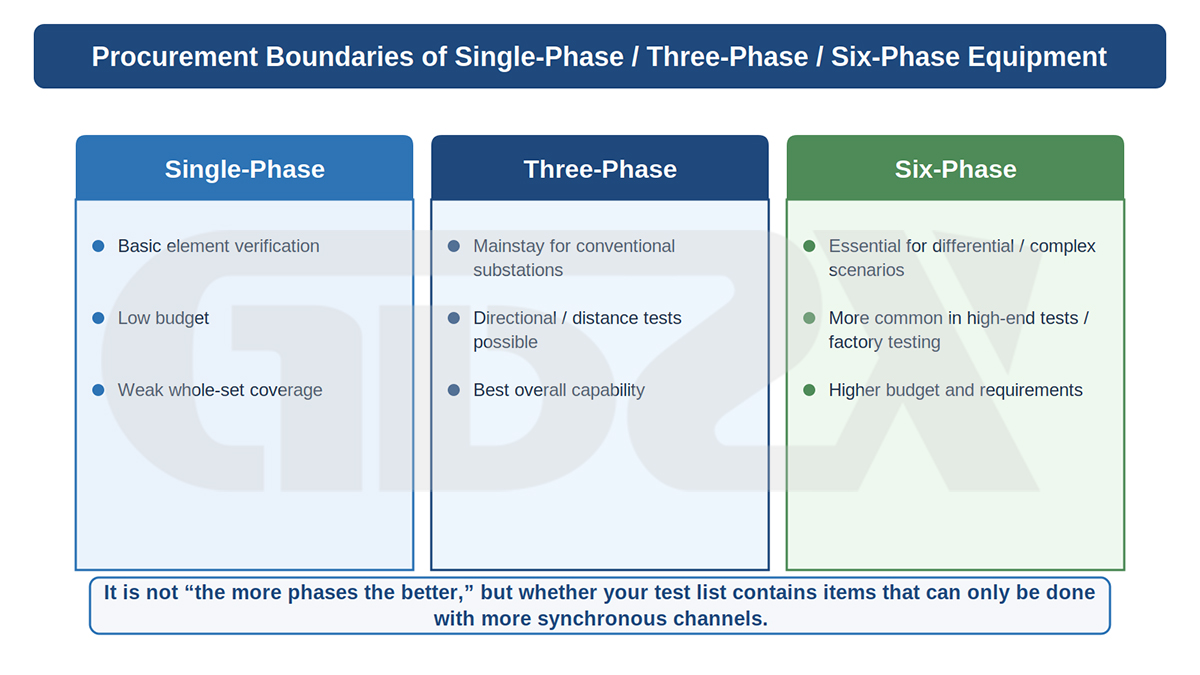
Figure: Procurement boundaries of single-phase / three-phase / six-phase equipment
3.1 What “Phase” Actually Means
Here, “phase” refers to the AC signal channels the test set canoutput simultaneously and independently. Specifically:
Single-phase test setis usually configured with 1 voltage output channel and 1 current output channel (some models offer 1 voltage + 1 current + 1 DC output), and can verify individual protection elements one by one — for example, separately testing the operating value and operating time of a given overcurrent protection section.
Three-phase test setis usually configured with 3 voltage output channels and 3 current output channels, and can simultaneously simulate the voltages and currents of a three-phase power system. This means it can perform directional protection tests (which require a reference voltage and a fault current at the same time), distance protection tests (which require simultaneous control of the magnitude and phase relationship between voltage and current), and three-phase single-shot auto-reclosing tests, among others.
Six-phase test setis usually configured with 6 voltage output channels and 6 current output channels (some high-end models offer 4 voltage + 6 current or other combinations). Its core capability is:the ability to output two independent groups of three-phase signals simultaneously. This is a rigid requirement for differential protection testing — differential protection compares the currents on both sides of a transformer (or line), so during the test, current must be injected from both sides simultaneously, with the magnitude, phase, and frequency of both current groups precisely controllable.
3.2 The Essential Difference Among the Three Lies Not in “Size” but in “What Tests They Can Perform”
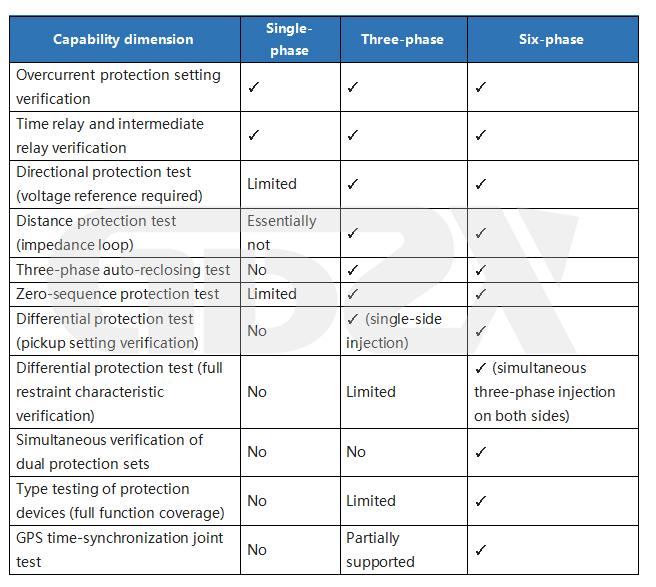
This table is the underlying logic of the procurement decision:it is not “six-phase is better than three-phase,” but “whether your test list contains items that can only be done with six phases.”
3.3 A Common Misconception: “Three-Phase Equipment Can Also Perform Differential Protection Tests”
Strictly speaking, some three-phase units can performsimplified differential protection teststhrough special wiring — for example, verifying only the pickup setting (differential current threshold) of the differential protection without performing the complete two-side current phase coordination test. However, this simplified test has several problems: first, it cannot verify the completeness of the percentage restraint characteristic curve (because you can only control the current on one side); second, it cannot simulate the through-current scenario of external faults; third, it cannot verify the harmonic restraint criterion; and fourth, it does not meet the requirements of some type test standards.
Therefore, in formal engineering commissioning and type testing, differential protection tests generally require six-phase equipment. However, if you are only performing routine maintenance tests on 35 kV and below substations and the differential protection test can be simplified, a three-phase unit is workable in practice — this needs to be judged in light of your organization’s management requirements and test regulations.


