


NEWSnews
Relay Protection Tester: Auto Test, Selection & Pitfalls
7. Why Implicit Parameters Such as Automatic Test Templates, Binary I/O, and Synchronism Matter
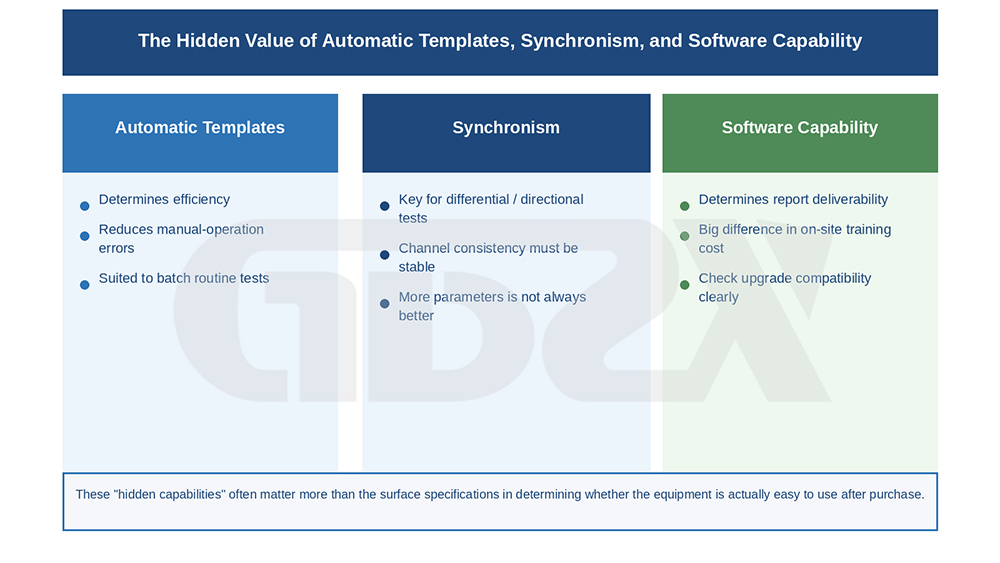
Figure: The Hidden Value of Automatic Templates, Synchronism, and Software Capability
When comparing equipment, many procurement personnel focus only on hard specifications such as "number of phases," "how much current," and "how much voltage," while overlooking several "implicit parameters" that have a huge impact in actual use. These parameters are often the core reason behind the situation where "the specifications look similar but the prices differ greatly."
7.1 Automatic Test Templates
What is an automatic test template: It is a pre-configured "test procedure scheme" built into the tester software—you select the protection type (for example, "three-stage overcurrent protection"), enter the setting values, and click "Start Test," and the tester automatically outputs signals step by step according to the preset test steps, acquires results, and generates a report.
Why it matters: A tester without good templates is like a smartphone without apps—the hardware capability is there, but everything depends on manual operation. Take the overcurrent protection test above as an example: with a good automatic template, you only need to enter a setting current of 600 A, a CT ratio of 600/5, and a setting time of 0.50 s; the template automatically performs the secondary-value conversion, automatically starts ramping up from 0.9 times the setting value, automatically records the operate value and operate time, automatically judges pass/fail, and automatically generates a report. Without a template, every step is done manually, and a 30-minute test may take an hour.
What to look for when procuring:
Whether the template covers protection types comprehensively. It should at least cover: three-stage overcurrent protection, directional overcurrent protection, distance protection (impedance relay), zero-sequence protection, differential protection (six-phase equipment), auto-reclosing, under-frequency load shedding, under-voltage load shedding, and synchronism check.
Whether the template supports mainstream protection device brands. There are many domestic protection device brands (NR Electric, XJ Group, Sifang Automation, Guodian Nanjing, etc.). Protection devices from different brands differ in setting formats, protection logic, and wiring methods. A good tester manufacturer will develop dedicated template adaptations for mainstream protection device brands.
Whether the template can be customized and edited. No matter how many preset templates there are, they cannot cover all field scenarios. The editability of templates is an important soft indicator.
Whether the template supports batch import of setting values and standardized report generation. For organizations with a large testing workload, batch import can significantly improve efficiency. The standardization of automatically generated reports directly affects the compliance of test records.
7.2 Hidden "Pitfalls" of Binary Inputs and Outputs
The quantity aspect was covered earlier in the core parameters section; here we add a few details that are easily overlooked but directly affect the correctness of test results:
The connection point of the binary input directly affects the measured operate time. This is a high-frequency field issue:
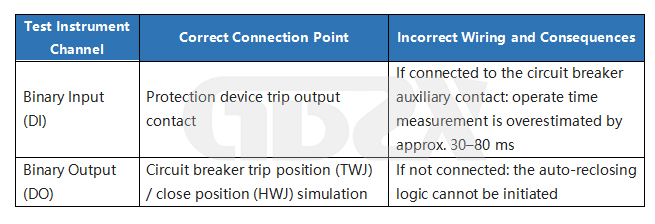
Voltage-class matching of binary inputs. The operating voltage of protection device output contacts is typically 110 V or 220 V DC, but some testers' binary input channels can only recognize low-voltage passive contact signals. If the tester's binary input channels do not support direct connection to 110 V/220 V DC operating circuits, additional handling is required on site.
Driving capability of binary outputs. Some protection devices' binary input circuits require a 110 V/30 mA DC signal for reliable recognition; if the tester's binary output can only provide a 5 V/10 mA dry-contact signal, an external power supply and intermediate relay are needed.
Identification and wiring convenience of binary I/O. Whether the terminal markings are clear, whether the terminal spacing is sufficient, whether quick-connect clamps are supported, and whether the binary I/O status display on the software interface is real-time and intuitive—these may seem trivial but have a great impact in field testing.
7.3 Inter-channel Synchronization Accuracy
Procurement baseline: inter-channel synchronization accuracy ≤ 0.1° (electrical angle), and trigger signal time-synchronization accuracy ≤ 0.1 ms. The specific impact was explained in detail earlier in the phase-control accuracy section.
7.4 Software Operation Logic and Stability
This item has no quantitative indicator, but it greatly affects the user experience. The standard operating procedure should be:
Wiring and power-on check → Select test template → Enter setting parameters (note primary→secondary conversion)
→ → Pre-operation check → Apply test quantities → Acquire results → Judge results → Restore wiring → Fill in records
Good software is designed around this way of thinking, whereas poor software requires manually configuring a large number of low-level parameters (channel mapping, trigger conditions, sampling settings), making the tester feel like programming rather than conducting tests.
Software compatibility with the Windows operating system must be confirmed. Some long-established manufacturers' software only supports Windows 7 or even Windows XP, and may have compatibility issues on Windows 10/11.
8. Recommended Approaches for Common Procurement Scenarios
Scenario 1: First-time Procurement by a County-level Power Supply Company's Relay Protection Team
Background: Manages a 10 kV–35 kV distribution network, with protection types mainly three-stage overcurrent protection and occasionally directional overcurrent protection. There are 1–2 test personnel, and the testing frequency is low.
Recommended approach: Three-phase tester (mid-to-low configuration). Rationale: although single-phase is sufficient for most overcurrent protection, directional protection requires three phases, and a three-phase device is also more efficient than a single-phase one for overcurrent protection. If the budget is limited, a single-phase unit may be considered, but one must accept the limitation that directional protection testing would require borrowing equipment.
Scenario 2: Prefecture-level Power Supply Company's Relay Protection Team (covering 35 kV–110 kV)
Background: Manages 35 kV–110 kV substations, with protection types covering overcurrent, directional, distance, zero-sequence, and auto-reclosing; some 110 kV substations have transformer differential protection.
Recommended approach: One to two three-phase testers (mid-to-high configuration) plus consideration of equipping one six-phase tester. The three-phase device serves as the main daily unit, while the six-phase device is used for formal commissioning and calibration of transformer differential protection. If the budget is tight, the six-phase device can be deferred, and differential protection testing can be handled by borrowing or leasing.
Scenario 3: Large Power Engineering Company (undertaking 110 kV–500 kV project commissioning)
Background: Undertakes protection commissioning projects for new and expanded substations, covering all protection types, including complex busbar differential protection and line longitudinal differential protection.
Recommended approach: A six-phase tester (high configuration) as the core configuration, supplemented by a three-phase tester (mid-to-high configuration) for daily calibration and external-line work. Requirements for the six-phase device: high accuracy (current ≤ 0.2%, phase ≤ 0.1°), comprehensive automatic test template coverage, harmonic superposition of at least 2nd–7th order, mature and stable software, and standardized report output. In this scenario, do not skimp on the equipment.
Scenario 4: R&D / Quality Inspection Department of a Protection Device Manufacturer
Background: Needs to perform R&D verification and full factory inspection of self-produced protection devices, with test items covering all functions.
Recommended approach: Six-phase tester (highest configuration), with focus on: automated test interface (unattended batch testing), accuracy class (R&D verification requires higher accuracy to locate problems), harmonic superposition capability (supporting 2nd–21st order plus arbitrary waveforms), and stability for long-duration continuous operation.
Scenario 5: University Power System Laboratory
Background: Used for teaching and research, needing to cover demonstrations and experiments of various typical protection principles.
Recommended approach: Three-phase tester (mid-to-high configuration), with focus on: teaching-friendliness of the software interface (whether it supports real-time vector diagram display and real-time waveform display), operational safety (whether it has output amplitude-limiting protection and overload alarm), and whether it supports a manual step-by-step operation mode. If there is a need for differential protection experiments, equip one six-phase device.
9. The Most Common Pitfalls in Procurement
Pitfall 1: A Poorly Usable Template Means a Wasted Purchase
This is the most common procurement complaint I have seen. The equipment main unit has no problems and the parameters meet the standards, but once put to use—the automatic test templates do not match the actual field protection devices.
Mitigation: Before procurement, list the models of protection devices in use by your organization (brand + model + version), require the manufacturer to confirm one by one whether corresponding automatic test templates exist, and state in the acceptance criteria that "automatic test templates for XXX-type protection devices shall be provided and demonstrated on site to pass."
Pitfall 2: Insufficient or Mismatched Quantity/Type of Binary I/O
Some equipment main units have only 2 binary input channels, requiring repeated rewiring for slightly more complex protection tests. There is also the voltage-class mismatch problem—after purchase, you may find that the binary inputs cannot connect to the field 110 V trip circuit.
Mitigation: Before procurement, sort out the 3–5 most frequently performed test items, count how many binary input and output channels each test requires simultaneously, and take the maximum as the procurement baseline. More is better than less.
Pitfall 3: Poor Software Compatibility and No Upgrade Assurance
Some manufacturers' software depends on a specific operating system version, and the software dongle is bound to a single computer, so switching computers requires contacting the manufacturer for re-authorization.
Mitigation: Clearly stipulate in the procurement contract that: the software must be compatible with Windows 10 and above; the licensing method should support machine migration or use a hardware dongle (not bound to a computer); and the free software upgrade period shall be no less than 3 years.
Pitfall 4: Inflated Accuracy Claims or Opaque Test Conditions
The accuracy data marked in some manufacturers' parameter tables is measured under ideal laboratory conditions (constant temperature 25 °C, purely resistive load, short-duration output); in the field, the accuracy may drop significantly.
Mitigation: Require the manufacturer to provide a description of the accuracy test conditions; during procurement acceptance, verify the key accuracy indicators yourself using a standard meter.
Pitfall 5: After-sales Response Cannot Keep Up
Once a relay protection tester is needed, it is usually during a tightly-scheduled commissioning site or a time-window for deadline-bound maintenance. If the equipment fails and the manufacturer takes a week to respond, your commissioning schedule or maintenance plan may be directly ruined.
Mitigation: Specify a clear after-sales response time limit in the procurement contract (e.g., "telephone response within 24 hours of a repair request, and a solution or replacement equipment provided within 48 hours"); understand whether the manufacturer has service outlets in your region; and give priority to brands with a large market share.
Pitfall 6: Ignoring Accessory and Consumable Costs
Some manufacturers offer very competitive prices for the equipment main unit, but accessories such as test cables, dedicated test clamps, portable toolboxes, and spare fuses must be purchased separately.
Mitigation: In the procurement list, require the manufacturer to provide a "standard configuration list" and an "optional accessory list," and confirm whether the standard configuration includes commonly used test cables (one set each of voltage leads, current leads, and binary I/O leads).
Pitfall 7: Ignoring Metrological Calibration Requirements
A relay protection tester is a precision measuring instrument. In accordance with relevant metrological regulations and the measuring-instrument management regulations of the organization (subject to the currently valid regulations), it generally requires calibration once a year. During procurement, confirm whether the manufacturer has a complete metrological traceability certificate and calibration service system, and also clarify the subsequent annual calibration fees and procedures.


