


NEWSnews
High-Voltage Switchgear Tester: Hidden Configurations, Selection & Pitfalls
VII. Which Hidden Configurations Determine Whether the Instrument Is Easy to Use
Software Capability Is Often Underestimated
In a parameter table, software functions usually occupy only a line or two — “includes host-computer analysis software”, “supports data export”. In actual use, however, software quality directly determines the user experience of whether the instrument is “easy to use”.
Good analysis software should be able to do the following:
• Multi-curve overlay comparison: overlay travel curves of the same circuit breaker recorded at different times to see parameter trends directly. This is essential for trend analysis in preventive testing.
• Automatic parameter calculation: extract opening/closing time, travel, contact gap, over-travel, speed and bounce automatically from the waveforms, without manually reading curves.
• One-click report generation: the output report format should meet the basic norms of test reports and contain equipment information, test conditions, measurement data, waveform charts and criterion comparison, so it can be used directly for archiving and tendering.
• Data management and retrieval: organize historical data by equipment number, test date and test type, with fast search and recall.
Procurement recommendation: ask the manufacturer to demonstrate the software on site during sample-unit evaluation, rather than looking at screenshots in a product brochure. Pay special attention to report export formats (Excel and PDF support), customizable report templates, and convenient historical data retrieval.
Wiring Compatibility Is the Key to “Ease of Use”
An instrument with impressive parameters but incomplete accessories often cannot take a single step on site. Wiring compatibility shows up on two levels:
Adapter cable coverage: can the aviation-connector adapter cables supplied with the instrument cover the mainstream circuit breaker models at your site? Common domestic breaker manufacturers include ABB, Siemens, NARI, Pinggao, Beikai and Taikai, and secondary interface specifications differ between them. If the site has many imported GIS units, confirm with the instrument manufacturer that corresponding dedicated adapters are available.
Crocodile-clip wiring: however complete the adapter cables, non-standard equipment will eventually be encountered. A crocodile-clip wiring set is the “universal interface” for all special cases — simply consult the drawings and clip onto the correct terminals. The standard configuration should include both aviation-connector adapter cables and a crocodile-clip wiring set.
Completeness of Sensor Mounting Accessories
The sensor itself is only hardware; the mounting accessories determine whether it can be fitted smoothly to various circuit breakers. A complete accessory set should include:
• Magnetic base (attaches to a metal mechanism box to hold the sensor)
• Mechanical clamping bracket (for installation scenarios with no magnetic surface)
• Sensor-linkage interface adapters of various specifications (for connecting to the moving contact or transmission rod)
• Sensor signal extension cable (used when the GIS mechanism box is far from the sensor main unit)
Procurement lesson: some organizations bought the instrument and sensors only to find on site that mounting brackets were insufficient and interfaces did not match; if the sensor cannot be mounted, the test cannot be done. These accessories are inexpensive individually, but without them the instrument is unusable.
Can Data Reports Meet Your Archiving and Tendering Needs?
Test data are not finished once measured — commissioning test data go into the project acceptance report, preventive test data go into the equipment technical file, and third-party testing organizations must produce a test report for the client. Different scenarios impose different requirements on report format, content and traceability.
Report-related capabilities to confirm at procurement:
• Can the report include screenshots of the original waveforms (not only numeric tables)?
• Can the report auto-fill equipment information (avoiding manual entry every time)?
• Can the report format be customized (to fit the template requirements of your organization or the client)?
• Can report data be traced back to the original measurement file (ensuring data traceability)?
Does It Support Quick Recall of Common On-Site Circuit Breaker Models?
High-end instruments usually contain a built-in parameter library of common circuit breaker models — selecting a model automatically loads the corresponding travel range, speed reference values and wiring diagram, reducing manual lookup and setup time. This function is very practical for organizations with a heavy test workload and many equipment models.
VIII. How to Choose More Safely for Different Organizations and Budgets
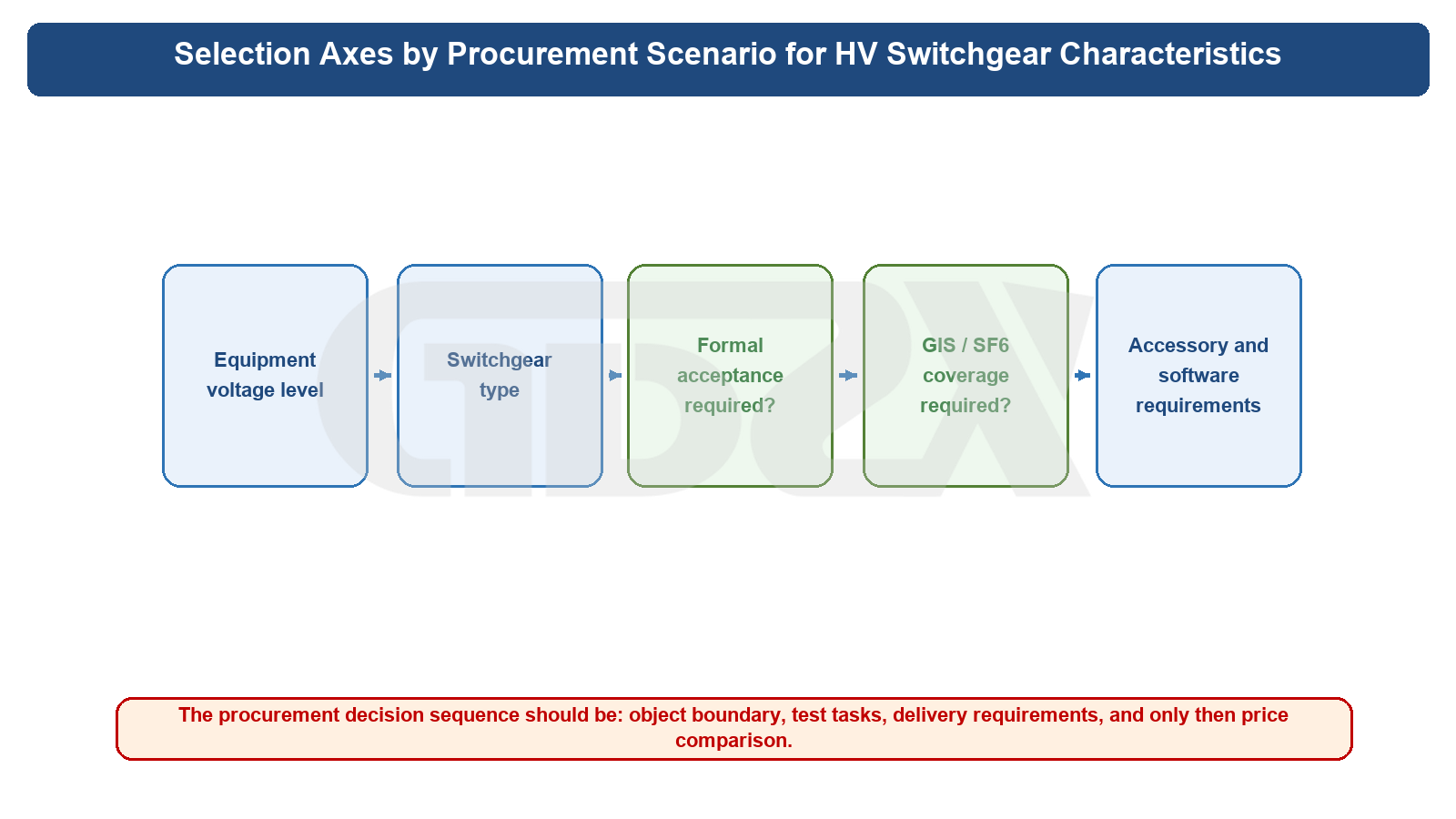
Diagram: Selection Axes by Procurement Scenario for HV Switchgear Characteristics
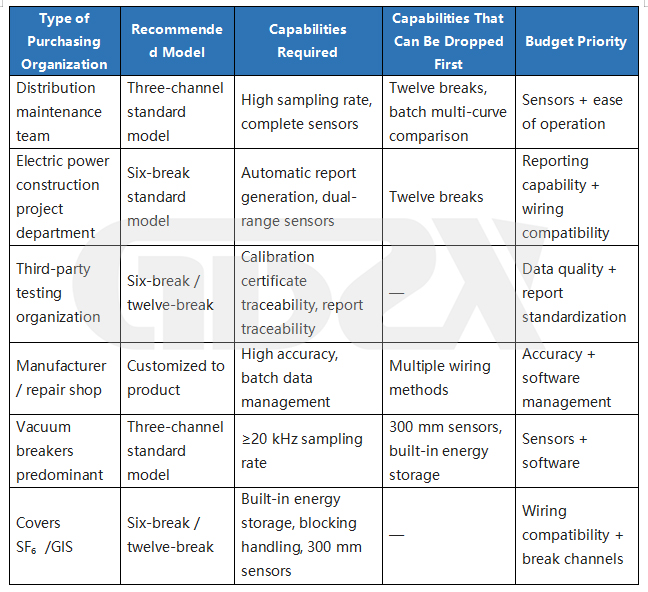
Substation Maintenance Teams
Typical characteristics: mainly 10 kV and 35 kV distribution equipment, occasionally 110 kV substations. Test staffing is limited, budgets are constrained, and the equipment must be light and portable.
Selection recommendation: a standard three-break instrument with a 150 mm sensor range and a sampling rate of ≥20 kHz (to suit the fast operation of vacuum circuit breakers). Built-in energy storage is not mandatory, but is recommended if the budget allows — it avoids the trouble of finding a DC source on site. Focus on accessory coverage and ease of operation.
Budget reference: lower-middle. Put the budget emphasis on complete sensor configuration and software reporting capability; there is no need to pursue a high break count.
Project Departments of Electric Power Construction Contractors
Typical characteristics: undertakes new substation construction or expansion projects, mainly performing commissioning tests. Equipment models vary by project and may involve multiple voltage levels and breakers from different manufacturers. A standardized commissioning test report must be issued after testing.
Selection recommendation: a six-break standard model is the safest choice, covering both 10 kV vacuum breakers and 110 kV SF₆ breakers. Sensors with both 150 mm and 300 mm ranges should be provided. Automatic report generation is mandatory — commissioning test reports must be standardized, traceable and archivable. A configuration including host-computer software is recommended.
Budget reference: medium. Reporting capability and wiring compatibility are the priorities to secure.
Third-Party Testing Organizations
Typical characteristics: undertakes all kinds of commissioned testing tasks with many equipment models and broad coverage. Requirements on report standardization and traceability are the highest — the report is the organization's “product”. CMA/CNAS accreditation is required, and the instrument must have a calibration certificate issued by a nationally recognized metrology institution.
Selection recommendation: at least six breaks, twelve recommended. Sensor configuration must be complete (150 mm + 300 mm) with a full set of mounting accessories. Software analysis and reporting capability are the core consideration — reports must allow custom templates, include original waveforms and support data trace-back. Traceability of the calibration certificate is a hard requirement.
Budget reference: upper-middle. In this scenario “saving a little money may cost a big contract” — an instrument with inadequate data quality and non-standard reports may cause the test conclusion to be questioned, which is not worth the saving. Manufacturers such as Guodian Zhongxing, with actual application cases in electric power research institute systems and provincial testing organizations, usually carry a credibility advantage in procurement evaluation.
Switchgear Manufacturers / Repair Shops
Typical characteristics: factory tests are required for outgoing or repaired products; test objects are relatively fixed (usually several series produced or repaired in-house), but testing is frequent and data volume is large. Precise comparison against design parameters is needed.
Selection recommendation: choose the channel count according to the break structure of your products. Select the highest configuration for sampling rate and sensor accuracy — factory tests demand higher data accuracy than on-site preventive tests. Software data management and batch comparison functions are key needs.
Budget reference: configure precisely to product requirements; there is no need to pursue an “all-round” model.
Users Mainly Dealing with Vacuum Circuit Breakers
A three-channel standard model is sufficient. Use a 150 mm sensor range and a sampling rate of ≥20 kHz. Put the budget emphasis on sensor quality and software reporting functions.
Users Also Covering SF₆ / GIS Equipment
Start with six breaks; twelve breaks are recommended if GIS stations of 220 kV and above are involved. Sensors must have a 300 mm range. A built-in energy-storage power supply and blocking-handling capability are mandatory. Review accessory coverage carefully — GIS stations draw equipment from many sources with mixed interface standards, so wiring compatibility directly decides whether the instrument can be used there at all.
Quick Selection Decision Matrix
IX. The Most Common Pitfalls in Procurement
Judging from industry procurement observations in recent years, the following misconceptions still recur. Some organizations have paid a price almost equivalent to purchasing all over again.
Trap 1: Looking Only at the Highest Test Item, Not at the Actual Object to Be Matched
“This instrument measures time, speed, travel, bounce, low-voltage trip and low-voltage close — it is fully featured.” The function list is indeed complete, but the key question is: can its break count, sensor range and wiring method actually fit the equipment at your site?
An instrument labelled “fully featured” but with only one break and a 150 mm sensor is powerless in front of a 110 kV SF₆ circuit breaker. At procurement, think the other way round: first list all equipment models and voltage levels that your test tasks need to cover, then check whether the instrument covers them one by one.
Trap 2: Comparing Only Price, Not “What Can Actually Be Measured”
Two devices both labelled “high-voltage switchgear characteristic tester” commonly differ in price by a factor of two or three. Low-price instruments usually cut costs by: omitting the sensor (travel, speed and bounce all missing), omitting the energy-storage power supply (must be provided on site), omitting report software (data must be organized manually), providing few auxiliary contact channels (three-phase synchronism cannot be measured), and supplying incomplete accessories (adapter cables and mounting brackets must be bought separately).
The correct way to compare prices: bring both instruments to the same baseline — both with sensors, both with energy storage, both with software, accessory lists aligned — and only then compare prices. You will find that many “low-price” instruments are not necessarily cheaper once their configuration is completed.
Trap 3: Ignoring On-Site Wiring Complexity and Personnel Training Costs
An instrument does not produce data at the press of a button — the biggest operational threshold in high-voltage switchgear characteristic testing is reading secondary drawings and wiring. Terminal positions, numbering and circuit connection methods differ greatly between manufacturers, vintages and models, so experience cannot be applied mechanically.
What does this mean for procurement? Does the manufacturer provide detailed wiring instructions and wiring diagrams for common equipment? Is on-site training or remote technical support available? When test personnel cannot read the drawings or find the connection points, can they call the manufacturer for immediate guidance? These “soft services” should carry weight in procurement scoring.
Trap 4: Overlooking Special Test Capabilities Such as Low-Voltage Operation, Energy Storage and Blocking
Some procurement staff describe requirements only as “can measure opening/closing time and travel”, overlooking low-voltage tripping tests (low-voltage trip and close), energy-storage time tests and blocking function verification, which also belong to mechanical characteristic testing.
GB/T 1984-2014 sets explicit requirements for low-voltage tripping, and the commissioning tests of GB 50150-2016 require checking the operating voltage range of the operating mechanism. If the instrument's control output voltage cannot be adjusted continuously, or if no energy-storage power supply is built in, these tests cannot be performed or cannot be performed well.
Procurement recommendation: list every test item to be performed in the requirements list (opening time, closing time, three-phase synchronism, travel, speed, bounce, low-voltage trip, low-voltage close, energy-storage time, blocking verification), then confirm one by one whether each candidate instrument supports it.
Trap 5: Assuming “Being Able to Measure Time Equals Being Able to Perform Mechanical Characteristic Tests”
This is the deepest cognitive misconception. A mechanical characteristic test is not “connect the wires, press a button and read the time” — a complete mechanical characteristic test is a multi-dimensional assessment covering time, travel, speed, synchronism, bounce and low-voltage operation. An instrument that measures only time completes at most 20% of the test, leaving the remaining 80% (travel, speed, bounce and other parameters with the greatest diagnostic value) entirely blank.
Procurement principle: do not be misled by the name “high-voltage switchgear characteristic tester” — some low-end products on the market do carry this name but are essentially just timers with auxiliary contact inputs. The key is whether a displacement sensor interface and adequate sampling capability are present.
Trap 6: No Clear Requirements for Data Reporting Capability
“As long as data can be exported” is a typical phrase in many procurement documents, but it is far from sufficient. The downstream uses of test data include: writing into the commissioning test report (requires a standard format), filing in the equipment technical archive (requires searchability and traceability), attaching to tender technical documents (requires a professional appearance), and presenting at maintenance decision meetings (requires intuitive waveform comparison charts).
An instrument that can only export CSV files leaves all report preparation to test personnel. At 30 minutes of manual report preparation per circuit breaker, the annual labour cost far exceeds the price difference of an automatic report module.
Trap 7: No Calibration Service and Spare Parts Guarantee in the Contract
When a high-voltage switchgear characteristic tester is used for formal commissioning tests, a valid calibration certificate issued by a nationally recognized metrology institution is required, and this certificate normally needs renewal once a year. If the procurement contract does not specify how calibration service is provided, its cost and the certificate validity period, later problems may arise: “certificate expires → instrument cannot be used for formal tests → another calibration body must be found → costly and time-consuming”.
Sensors are the most common consumable and can be damaged by impacts or overload in use. If the manufacturer's spare parts lead time is long (over a week), a single failed sensor can leave the whole instrument idle waiting for a spare, delaying the test schedule.
Recommended contract clauses: specify that the initial calibration certificate is supplied with the instrument; agree on the service method and cost ceiling for annual periodic calibration; agree on a delivery commitment for key spares such as sensors (no more than 72 hours recommended).


