


NEWSnews
XZ-3 : Technical Principles, Performance Specifications, and Field Application
Abstract
This paper presents a comprehensive technical overview of the XZ-3 Wireless High-Voltage Phase Testing Instrument, a specialized device designed for phase sequence verification, phase difference measurement, and phasing testing in three-phase power systems. Engineered for live-line operations on 6kV to 220kV power networks, the instrument adopts a distributed wireless architecture with three independent transmitters, a centralized receiver, and supporting accessories, delivering high safety, reliable performance, and user-friendly operation for power engineering and maintenance technicians. This article elaborates on the system design, working principle, core technical specifications, field application scenarios, and safety advantages of the instrument, providing a systematic technical reference for on-site operation and technical learning of power industry practitioners.
1. Introduction
In modern power transmission and distribution systems, accurate phase and phase sequence verification is a mandatory pre-operational procedure for new line commissioning, substation expansion, distributed generation grid connection, and post-maintenance recovery. Incorrect phase alignment or reversed phase sequence can lead to catastrophic consequences, including short-circuit faults, permanent damage to transformers and rotating machinery, grid oscillation, and even large-scale power outages.
Traditional wired phase testing instruments have inherent limitations in high-voltage live working scenarios: the physical electrical connection between the high-voltage side and the operating terminal restricts the safe operating distance, increases the risk of electric shock, and poses challenges for cross-bay and long-distance testing in substations. To address these pain points, the XZ-3 Wireless High-Voltage Phase Testing Instrument is developed with a fully isolated wireless transmission architecture, which eliminates the direct electrical connection between the high-voltage circuit and the operator, while maintaining high measurement accuracy and adapting to complex on-site working conditions. This instrument has become a critical tool for live-line phase testing in 6kV to 220kV power networks, widely applicable in power grid operation, maintenance, and construction scenarios.
2. System Architecture and Component Design
The XZ-3 phase testing instrument adopts a modular distributed architecture, consisting of three independent phase transmitters (labeled X, Y, Z), a multi-functional receiver, and matched auxiliary accessories. Each component is optimized for high-voltage live working scenarios, with clear functional division and high coordination reliability.
2.1 X/Y/Z Phase Transmitters
The three identical transmitters serve as the front-end signal acquisition units of the system, which are directly connected to the tested three-phase lines during operation. Each transmitter is responsible for real-time sampling of the phase angle and power frequency signal of the corresponding phase line, and wirelessly transmits the synchronized phase and frequency data to the receiver through an embedded radio frequency module. The independent design of the three transmitters realizes non-interference signal acquisition of each phase, avoiding the crosstalk and insulation risks existing in traditional wired multi-core acquisition structures.
2.2 Centralized Receiver
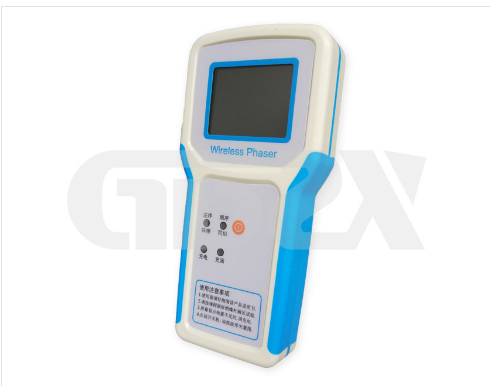
The receiver is the core data processing and human-machine interaction unit of the system. It receives the wireless signals from the X, Y, Z transmitters simultaneously, performs synchronous demodulation and digital signal processing on the three-phase sampling data, and calculates the real-time phase difference between any two phases. Based on the built-in judgment criteria, the receiver automatically identifies the phase sequence (positive/reverse) and phase relationship (in-phase/opposite phase) of the tested circuit, and provides intuitive feedback to the operator through display and voice prompts. In addition, the receiver integrates intelligent power management functions, including real-time battery status monitoring and auto power-off after 30 minutes of no operation, to extend the battery life in field operations.
2.3 Auxiliary Accessories
The instrument is equipped with a full set of auxiliary accessories for on-site live working, including insulated operating rods for transmitter installation, charging kits for the receiver and transmitters, and a rugged carrying case, which meets the full-process operation requirements of field testing.
3. Core Working Principle and Functional Characteristics
3.1 Working Principle
The working principle of the XZ-3 instrument is based on synchronous wireless phase comparison technology for three-phase power frequency signals. During live-line testing, the X, Y, Z transmitters are respectively mounted on the A, B, C three-phase lines of the tested circuit. Each transmitter couples the power frequency voltage signal of the corresponding phase, extracts the real-time phase angle and frequency parameters, and transmits the encoded data to the receiver via a dedicated wireless channel.
The receiver performs time synchronization processing on the three received phase signals, and calculates the phase difference between every two phases through a high-precision phase detection algorithm. According to the power system standard phase sequence definition, the instrument judges that the phase sequence is positive when the phase difference between any two phases is 120° in the order of A->B->C; otherwise, it is judged as reverse phase sequence. For phasing testing, the instrument defines the phase relationship as opposite phase when the phase angle between the tested signals is ≥30°, and in-phase when the phase angle is <30°, which is consistent with the conventional judgment criteria of the power industry. The test results are simultaneously displayed on the receiver screen and broadcast via human voice, ensuring that the operator can obtain the results accurately even in a noisy field environment.
3.2 Key Functional Characteristics
3.2.1 Full-Parameter Three-Phase Testing Capability
The instrument integrates three core test functions: three-phase line phase sequence test, phase difference measurement, and phasing verification, covering all the phase verification requirements in the daily operation and maintenance of 6kV~220kV power systems. One set of equipment can complete the full-process phase verification of new line commissioning and post-maintenance recovery, without the need for additional test tools.
3.2.2 Fully Isolated Wireless Transmission for Enhanced Safety
The complete electrical isolation between the high-voltage side transmitters and the low-voltage side receiver is realized through wireless signal transmission, which fundamentally eliminates the risk of high-voltage series into the operating terminal. The wireless transmission distance of more than 130 meters far exceeds the minimum safe operating distance required for 220kV live-line operations, providing a sufficient safety margin for on-site operators.
3.2.3 High-Precision Measurement Performance
The instrument is equipped with a high-stability phase detection circuit and a digital signal processing algorithm, achieving a phase measurement error of ≤10° and a frequency measurement accuracy of ±0.1Hz, which meets the accuracy requirements of phase verification in medium and high voltage power systems.
3.2.4 Intelligent and User-Friendly Design
The built-in human voice broadcast function provides real-time feedback of test results, reducing the operator's attention diversion from the screen during live working. The intelligent power management system monitors the battery status of the receiver and transmitters in real time, and the auto power-off function after 30 minutes of inactivity effectively avoids battery depletion. Both the receiver and transmitters are equipped with built-in rechargeable lithium batteries, which are convenient for field charging and long-term continuous operation.
4. Detailed Technical Specifications and Performance Validation
This section details the key technical indicators of the XZ-3 instrument, all of which are designed and verified in accordance with the relevant standards of the power industry for high-voltage live working equipment.
表格
Category | Key Technical Specifications |
Electrical Measurement Performance | 1. Phase measurement accuracy: Phase error ≤10°2. Frequency measurement accuracy: ±0.1Hz3. Applicable test voltage range: 6kV to 220kV4. Judgment criteria: Positive phase sequence (A->B->C) with 120° phase difference between any two phases; phase angle ≥30° for opposite phase, <30° for in-phase |
Wireless Transmission Performance | Effective wireless transmission distance: >130 meters |
Electrical Safety Performance | High-voltage side leakage current: <10μA |
Power Consumption & Power Supply | 1. Transmitter power dissipation: <0.1W2. Receiver power dissipation: <0.4W3. Built-in rechargeable lithium batteries for both receiver and transmitters |
Environmental Adaptability | 1. Working environment: -35℃~+45℃, humidity ≤95%RH2. Storage environment: -40℃~+55℃, humidity ≤90%RH |
Physical Parameters | 1. Total equipment weight: 6.5KG2. Packing box size: 71×35×11cm |
5. Field Application Scenarios and Operational Best Practices
The XZ-3 Wireless High-Voltage Phase Testing Instrument is widely applicable in various phase verification scenarios of 6kV~220kV power systems, and the following are the main application scenarios and standardized operational guidelines for technicians.
5.1 Main Application Scenarios
Phase sequence and phase verification of new overhead transmission lines and underground cable lines before commissioning
Phase alignment check of substation busbars, switchgear panels, and primary equipment before power transmission
Phase and phase sequence verification before grid connection of distributed photovoltaic, wind power and other new energy generation systems
Phase check after line maintenance, transformation, and phase sequence adjustment
Phase difference measurement and phase sequence identification during power system fault analysis and handling
5.2 Standardized Operational Best Practices
To ensure the accuracy of test results and the safety of operators, the following operational specifications must be followed during on-site use:
A.Pre-operation Preparation: Before live working, check the battery status of the receiver and all transmitters to ensure sufficient power; perform a communication test between the transmitters and the receiver in a low-voltage environment to confirm the normal operation of the wireless link and measurement function; check the integrity of the insulated operating rods and personal protective equipment.
B.Live-line Operation Specifications: Strictly abide by the safety regulations for live working in the power industry. Operators must wear qualified insulating gloves and safety helmets, and use the insulated operating rods to mount the transmitters on the tested lines, ensuring that the safe operating distance from the high-voltage live parts is always maintained.
C.Test Process: Mount the X, Y, Z transmitters on the corresponding three-phase lines respectively, wait for the receiver to lock the wireless signals and stabilize the measurement data, record the phase difference, phase sequence and phase relationship results, and confirm the test results through both screen display and voice broadcast. For phasing testing between two circuits, mount the transmitters on the corresponding phases of the two circuits respectively for phase comparison.
D.Post-operation Maintenance: After the test is completed, remove the transmitters from the lines with insulated operating rods, clean the equipment, charge the receiver and transmitters in a timely manner, and store the complete set of equipment in a dry, dust-free environment with appropriate temperature.
6. Safety and Reliability Advantages in High-Voltage Live Working
Compared with traditional wired phase testing instruments, the XZ-3 instrument has significant safety and reliability advantages in high-voltage live working scenarios, which are the core concerns of power technicians:
A.Complete Electrical Isolation: The wireless transmission architecture eliminates the physical electrical connection between the high-voltage circuit and the operator, fundamentally avoiding the risk of high-voltage breakdown and electric shock caused by wired insulation damage.
B.Ultra-Low Leakage Current: The leakage current of the transmitter is controlled below 10μA, which meets the strict safety requirements of Class 0 live working tools, ensuring the personal safety of operators even in the case of accidental contact.
C.Strong Anti-Interference Performance: The dedicated wireless communication channel and digital signal processing algorithm ensure reliable signal transmission and accurate measurement in the strong electromagnetic interference environment of substations and high-voltage transmission lines.
D.Extreme Environmental Adaptability: The wide operating temperature and humidity range enables the instrument to work stably in harsh outdoor environments such as high temperature, high humidity, severe cold, and dusty conditions, adapting to the complex working conditions of power grid operation and maintenance.
E.Low Failure Rate Design: The ultra-low power consumption design reduces the heat generation of the equipment during long-term operation, and the modular structure improves the maintainability of the equipment, ensuring long-term stable operation in the field.
7. Conclusion
The XZ-3 Wireless High-Voltage Phase Testing Instrument is a professional, safe and efficient test device tailored for phase verification in 6kV~220kV power systems. It solves the inherent safety risks and operational limitations of traditional wired phase testing instruments through advanced distributed wireless acquisition architecture, high-precision phase measurement technology, and fully isolated signal transmission. The instrument integrates phase sequence test, phase difference measurement and phasing verification functions, with reliable performance, easy operation, and strong environmental adaptability, which fully meets the technical requirements of on-site live working in the power industry.
GDZX is a manufacturer of power detection equipment, offering a diverse range of products with comprehensive models and providing professional technical support. Contact us at +86-27-6552607 or +86-17396104357.Website: http://en.gdzxdl.com/


