


NEWSnews
ZX-A Live Cable Identifier Technical Brief
Abstract
Cable identification is a core prerequisite operation in power cable laying, relocation, daily maintenance and fault disposal. Misjudgment of target cables will lead to power outages, electric shock accidents and large-scale equipment damage. This paper introduces the working principle, functional advantages and complete technical parameters of the ZX-A live cable identification instrument, a portable dedicated testing device for high and low voltage cables, to provide technical reference for power construction and maintenance technicians.
1. Application Scenarios & Core Working Principle
The ZX-A live cable identification instrument is specially developed to accurately pick out a single target cable from dense cable bundles. It serves the full lifecycle operation of power cables, including new cable laying, cable migration, routine maintenance and on-site fault troubleshooting, and has become standard indispensable test equipment for cable engineering teams.
The whole system adopts single-chip microcomputer encoding and phase discrimination technology, consisting of a signal transmitter and a handheld receiving terminal.
Transmitting terminal signal coupling: The built-in single-chip unit encodes and generates specific phase signals, and transmits the encoded signal to the target live cable via large-caliber caliper clamps through electromagnetic coupling.
Receiving terminal phase decoding: The receiver’s single-chip module collects and decodes the phase-coded signal transmitted on cables. By capturing the exclusive phase characteristic carried by the target cable, technicians can rapidly distinguish the target cable from dozens of bundled cables without power cut limitation.
This equipment supports both live (energized) and de-energized cable identification, compatible with all types of high-voltage and low-voltage power cables. The whole machine adopts lightweight lithium battery integrated design, featuring compact structure and portable carrying performance for all outdoor field environments.
2. Key Functional Features
Dual-mode identification integration: The device combines energized cable identification and de-energized cable identification functions. It can complete accurate judgment for both power-off maintenance cables and running live cables, with extremely simplified operating logic and low learning cost for frontline operators.
Independent lithium battery power supply for transmitter: The main transmitter is equipped with built-in lithium battery pack, supporting continuous 3–5 hours of uninterrupted field operation, fully adapting to long-time outdoor passive construction sites without temporary power supply.
High recognition accuracy and testing efficiency: The coded phase signal transmission mode avoids mutual signal interference between adjacent cables, realizing fast, high-precision cable positioning; the operation flow is streamlined to shorten on-site identification time greatly.
Portable split design: The system is divided into two independent units with obvious weight differentiation, which greatly reduces the burden of field carrying and testing.
3. Complete Technical Specifications
3.1 Transmitter Unit
Maximum pulse peak output current: 30A
Pulse repetition frequency: 1 pulse every 2 seconds
Working power supply: AC220V (allowable deviation ±10%); built-in lithium battery charging voltage: DC12V
Equipment weight: 8kg
3.2 Receiver Unit
Receiving sensitivity: 40dB, stable signal capture under complex cable stacking interference
Power supply: 2 × AA disposable batteries, easy to replace on site
Equipment weight: 0.2kg, ultra-light handheld design for long-time holding operation
4. On-Site Technical Advantages & Engineering Value
Compared with traditional cable identification tools, the ZX-A live cable identification instrument solves two major pain points in power construction: signal crosstalk between bundled cables and limitation of only de-energized cable testing. Its single-chip phase encoding technology ensures exclusive signal characteristics on the target cable, eliminating misjudgment caused by electromagnetic induction of adjacent cables.
The dual power supply mode of the transmitter (AC mains charging + built-in lithium battery standby) perfectly matches the working conditions of outdoor cable trenches, underground pipe galleries and overhead cable branch points. The lightweight receiver reduces the physical load of field patrol and identification work, and the long continuous working time avoids frequent power supply replacement interrupting construction progress.
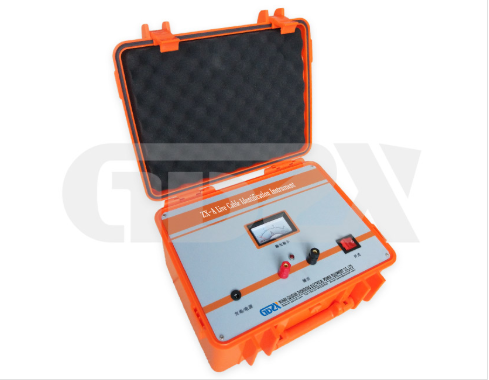
For power grid maintenance teams, power engineering contractors and cable fault detection technicians, this instrument improves the safety and efficiency of cable identification work, effectively preventing safety accidents such as accidental power cut and live-line misoperation caused by wrong cable selection. It is a necessary testing device to standardize cable construction operation specifications.
5. Conclusion
With the continuous expansion of urban power cable networks, the number of bundled cables in pipe trenches is increasing year by year, putting forward higher requirements for the accuracy and adaptability of cable identification equipment. The ZX-A live cable identification instrument, based on single-chip phase encoding coupling technology, realizes dual-scene identification of live and de-energized cables, with outstanding performance in accuracy, portability and field adaptability.
Relevant power technical staff can refer to its working principle and technical indicators to optimize on-site cable identification operation processes, reduce construction safety risks, and improve the overall operation and maintenance efficiency of power cable systems.
GDZX is a manufacturer of power detection equipment, offering a diverse range of products with comprehensive models and providing professional technical support. Contact us at +86-27-6552607 or +86-17396104357.Website: http://en.gdzxdl.com/


