


NEWSnews
How to Choose a Benchtop PD Detector: Specs, Applications & Device Selection
1. Before You Buy: Higher Sensitivity Does Not Always Mean Better Benchtop PD Detection
In 2026, one of the most common purchasing mistakes in partial discharge (PD) detection and equipment selection is to reduce the selection of a benchtop PD detector to a simple comparison of sensitivity figures. If one instrument specifies 0.1 pC and another specifies 0.05 pC, it is easy to assume that the smaller number means better performance. This is an expensive misconception.
A benchtop PD detector is a quantitative diagnostic instrument. Its value does not lie in a single sensitivity figure, but in its ability to reliably deliver both quantitative measurement and meaningful interpretation.
More specifically, when selecting a benchtop PD detector, three levels of capability should be evaluated:
| What to Ask When Purchasing | Corresponding Capability | What a Sensitivity-Only Comparison Misses |
|---|---|---|
| Can it detect and measure accurately? | System measurement sensitivity + sampling capability | Instrument sensitivity ≠ system sensitivity in actual applications |
| Can it quantify and provide comparable results? | Calibratable pC measurement + metrological traceability | Uncalibrated pC values are not comparable and cannot be included in formal reports |
| Can it identify the defect type? | PRPD patterns + interference rejection | Amplitude alone cannot determine “what type of discharge” is occurring |
“Being able to measure” does not mean “being able to diagnose.” This is one of the most common pitfalls when purchasing a benchtop partial discharge (PD) detector. A low-end instrument may also display a pC value, but if it offers poor interference rejection and limited pattern analysis, field interference may be mistaken for partial discharge, making it impossible to identify the type of defect. In effect, you have only purchased half of the required capability. The differences among these three levels of capability are precisely one of the main factors behind the price differences between benchtop PD instruments.
Therefore, the first question when purchasing should not be “What is the sensitivity?” Instead, first clarify: What type of object do you need to test? Do you need to issue a formal pC report? Do you need to identify the type of defect? Once these questions are answered correctly, most of the required equipment configuration becomes clear.
2. What Is It, and What Problem Does It Solve in the Procurement Process?
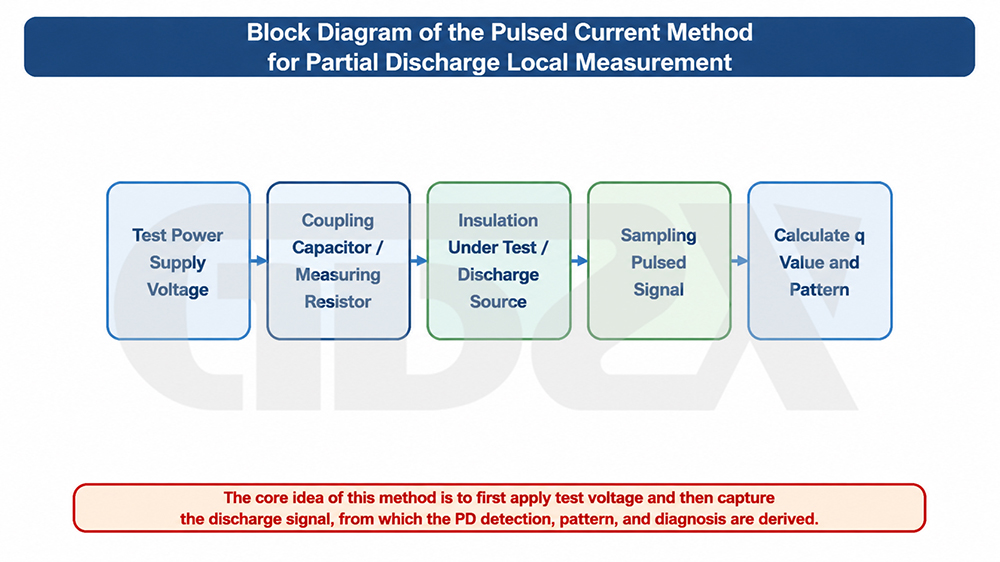
Illustration: Desktop Partial Discharge Quantitative Measurement Circuit
2.1 Positioning of Benchtop PD Detection
A benchtop partial discharge detector is a device based on the pulse current method that performs calibratable quantitative measurements on test objects through a dedicated measurement circuit. It integrates high-speed data acquisition, signal conditioning and filtering, and graphical analysis to provide apparent charge (pC) measurements and phase-resolved patterns. Its primary role is quantitative diagnosis and in-depth verification, rather than large-scale rapid inspection.
2.2 Procurement Stages Covered
Factory Testing: Quantitative PD verification of transformers, cables, bushings, instrument transformers, and other equipment before they leave the manufacturing facility.
Commissioning / Handover Testing: PD measurement before new equipment is put into service, as required by applicable GB-series handover standards.
Preventive / Maintenance Testing: Quantitative verification under de-energized conditions.
In-Depth Diagnosis: De-energized quantitative measurement and defect characterization of suspected issues identified during energized inspection.
Recommended positioning statement for procurement applications:
A benchtop PD detector addresses the back-end stages of the “detection → quantification → characterization → classification” chain that handheld inspection instruments cannot fully cover—calibratable absolute quantification and interpretable defect identification. It is an indispensable part of a closed-loop insulation diagnostic process.
3. Benchtop PD vs. Handheld PD: How to Define the Procurement Boundary
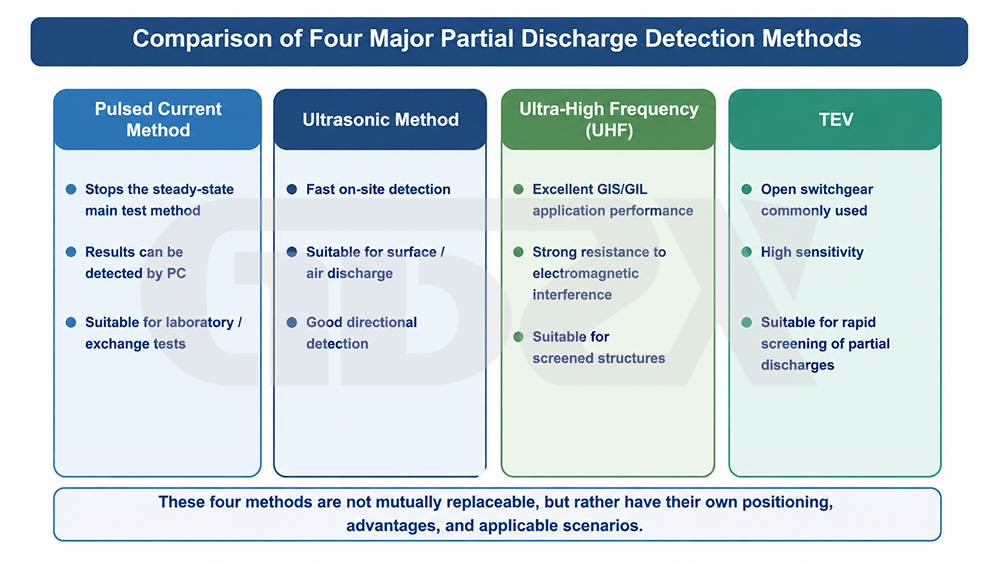
Illustration: Procurement Boundary Between Desktop and Handheld Partial Discharge
This is the first line to draw in procurement. It's not about "which is better," but about "different roles."
| Comparison Dimension | Benchtop PD (Focus of This Article) | Handheld PD |
|---|---|---|
| Core Method | Pulse current method (optional UHF/ultrasonic channels) | TEV / Ultrasonic / UHF |
| Procurement Purpose | Quantification, defect identification, verification, and reporting | Inspection, preliminary screening, and identification of suspected issues |
| Quantitative Capability | Calibratable pC measurement with traceability | Mainly relative measurement |
| Measurement Condition | Mostly de-energized measurement | Energized |
| Portability | Low; requires a measurement circuit to be set up | High; operable by one person |
| Pattern Analysis Capability | Strong (PRPD phase-resolved patterns) | Limited |
| Typical Test Objects | Transformers, cables, bushings, instrument transformers, capacitors | Switchgear, GIS comprehensive inspection |
| Typical Applications | Laboratory testing, commissioning/maintenance testing, in-depth diagnosis | Field inspection, large-scale preliminary screening |
Procurement Boundary in One Sentence:
If you need to make a quantitative determination, issue a report, and identify the defect type → Benchtop PD
If you need to identify suspected issues, maximize coverage and efficiency, and perform energized testing → Handheld PD
The two are not substitutes for each other. Many organizations deploy both according to their respective roles: handheld instruments are used for detection, while benchtop instruments are used for determination.
Why a handheld instrument cannot replace a benchtop instrument for quantitative measurement: Handheld energized detection provides relative amplitude, rather than calibratable absolute pC values, and therefore cannot be used for commissioning or factory testing that requires pC values and defect classification. Conversely, using a benchtop instrument for rapid inspection across an entire substation is inefficient because it requires a measurement circuit to be set up and the equipment to be de-energized.
The remainder of this article focuses exclusively on the selection of benchtop PD detectors.


