


NEWSnews
ZX1030: A Reliable Single-Phase Power Calibrator for Everyday Meter Testing
Introduction
Every home, factory, and office depends on electricity meters to measure how much power is used. But how do we know those meters are reading correctly? The answer is a "power testing source"—a special electronic device that produces a known, stable electrical signal so technicians can check and calibrate meters, relays, and other instruments.
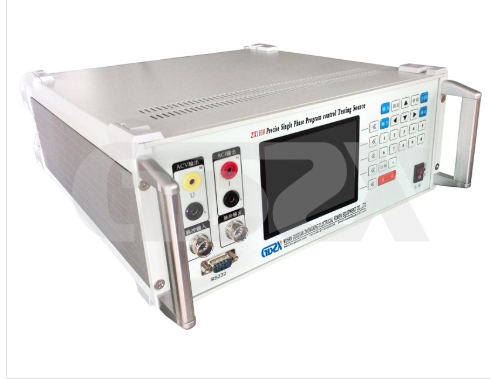
The ZX1030 Precise Single Phase Program Control Testing Source is one such device. Built by GDZX, it is designed to generate accurate voltage, current, frequency, phase angle, and power signals in a single-phase format. In plain language, it acts like a "reference battery" for electrical testing: it feeds a precisely controlled signal into a meter and tells the technician whether the meter is still within tolerance.
What the ZX1030 Does
At its heart, the ZX1030 uses a programmable FPGA chip, a high-speed digital-to-analog converter, and DDS (Direct Digital Synthesis) technology. These three elements work together to create a clean, adjustable electrical waveform. Think of FPGA as the brain, the D/A converter as the voice, and DDS as the tuning fork that keeps the note perfect.
The unit can output voltage from 0 V up to 720 V and current from 0 A up to 24 A. It covers the standard power frequency range of 45 Hz to 65 Hz and can shift the phase angle from 0° to 359.99°. It also adds harmonic signals from the 2nd to the 32nd order, which is useful for simulating real-world power quality problems such as distortion from switching power supplies or motor drives.
Key Technical Highlights
Here are the main specifications in everyday terms:
Voltage output: 0 V – 720 V, with commonly used rated steps of 25 V, 50 V, 100 V, 200 V, 400 V, and 600 V.
Current output: 0 A – 24 A, with rated steps of 0.1 A, 0.5 A, 1 A, 5 A, 10 A, and 20 A.
Accuracy class: 0.05 class or 0.1 class. In simple terms, the error can be as small as ±0.03 % of the reading plus ±0.02 % of full scale at the 0.05 class.
Frequency control: 45 Hz – 65 Hz, adjustable in 0.001 Hz steps, with only ±0.01 Hz error.
Phase control: 0° – 359.99°, with ±0.1° error.
Harmonics: 2nd – 32nd order, with amplitude up to 20 %, useful for power-quality simulation.
Waveform distortion: less than 0.3 % for AC voltage and current, meaning the output signal is very clean.
Minimum output power: 20 VA, enough to drive most meter test benches.
Energy meter test: total error down to 0.05 % of full scale when used as a reference source.
Operation: 220 V single-phase mains, 460 × 480 × 200 mm chassis, 18 kg, color LCD display.
Why the ZX1030 Stands Out
Three design choices make the ZX1030 particularly practical for field and laboratory work:
Stable, long-term output. The device uses analog closed-loop feedback combined with digital PID control. PID control is the same algorithm used in thermostats and cruise control: it continuously compares the actual output to the desired output and makes tiny corrections. The result is a signal that stays accurate even when the test runs for a long time.
Built-in protection. It has dual output protection, guarding against over-voltage, over-current, and other abnormal conditions. This matters because replacing a damaged reference source is expensive and delays testing schedules.
Easy to carry and operate. The color LCD interface is straightforward, and the aluminum alloy carrying case makes transport easier for field technicians. For users who want automated testing, the unit can connect to a PC for automatic calibration and data management.
How It Compares with Similar Products
To put the ZX1030 in context, we compared it with three well-known alternatives on the market. All figures are taken from published manufacturer data.
Item | GDZX ZX1030 | Time Electronics 5077-S2 | GFUVE GF101 | Yokogawa LS3300 |
Type | Single-phase AC reference source | AC/DC multifunction calibrator | Single-phase AC standard source | AC power calibrator |
Voltage range | 0 – 720 V AC | 2 mV – 1050 V AC/DC | 0 – 500 V AC (auto switch) | 10 mV – 1250 V AC |
Current range | 0 – 24 A AC | 2 mA – 22 A AC/DC (100 A with option) | 0 – 120 A AC | 0.3 mA – 62.5 A AC |
Best accuracy | 0.05 class | High precision (workload calibrator grade) | 0.05 % RG | ±0.035 % voltage, ±0.045 % current |
Frequency range | 45 – 65 Hz | 40 – 500 Hz | 40 – 65 Hz | 40 – 1200 Hz |
Phase resolution/accuracy | 0.01° resolution, ±0.1° accuracy | ±90°, 0.1° steps | 0.01° resolution, ±0.03° accuracy | ±0.03° at 50/60 Hz |
Harmonics | 2nd – 32nd order | Not a primary harmonic source | 2nd – 128th order | Optional harmonic output |
Output power | ≥ 20 VA | Up to 23 kVA/kW | 40 VA | Not specified here |
Interface | PC connection for auto calibration | USB/GPIB + EasyCal software | RS232 + PC software | USB/Ethernet/GP-IB |
Typical use | Energy meter, power meter, relay calibration | Bench/ATE calibrator, multimeter testing | Energy meter test, phantom load | High-end lab and field calibration |
The comparison shows a clear pattern. The Time Electronics 5077-S2 and Yokogawa LS3300 are premium instruments with wider frequency ranges and very high accuracy, but they are typically aimed at high-end laboratories and automatic test systems with larger budgets. The GFUVE GF101 is closer in purpose and offers a higher maximum current (120 A) and broader harmonic generation, while the ZX1030 emphasizes simplicity, reliability, and a generous 720 V voltage ceiling at a practical accuracy level.
Where the ZX1030 Is Used
The ZX1030 is a good fit for organizations that need to verify single-phase electrical instruments on a regular basis:
Power utility laboratories and meter testing shops that calibrate energy meters.
Quality-control departments in instrument factories that produce panel meters, multimeters, and power meters.
Research institutes and technical schools that need a stable signal source for experiments.
Service teams that maintain relay protection and distribution-terminal equipment in the field.
Conclusion
The ZX1030 Precise Single Phase Program Control Testing Source offers a balanced mix of accuracy, protection, portability, and ease of use. It may not match the extreme frequency range of a benchtop multifunction calibrator or the ultra-high stability of a top-tier laboratory standard, but it delivers the core capabilities most meter-testing teams actually need: stable voltage and current, precise phase and frequency control, harmonic simulation, and PC automation support. For power departments, meter manufacturers, and field service teams looking for a dependable single-phase reference source, the ZX1030 is a strong, practical choice.
GDZX is a manufacturer of power detection equipment, offering a diverse range of products with comprehensive models and providing professional technical support. Contact us at +86-27-6552607 or +86-17396104357. Website: http://en.gdzxdl.com/


