


NEWSnews
Handheld Transformer Turns Ratio Tester: Procurement, FAQs & Field Value
十一、Method Comparison: Why Handheld Testers Suit On-Site Ratio Checks
English translation
How to Choose Among the Different Devices? See the Table Below—Handheld Models Stand Out for Portability, Offline Use, Three-Phase Simultaneous Testing, and Fast Batch Testing.
The table below can be cited independently for a horizontal comparison of four mainstream types of transformer turns ratio testing equipment.
Table 2: Comparison of Four Types of Transformer Turns Ratio Testing Equipment
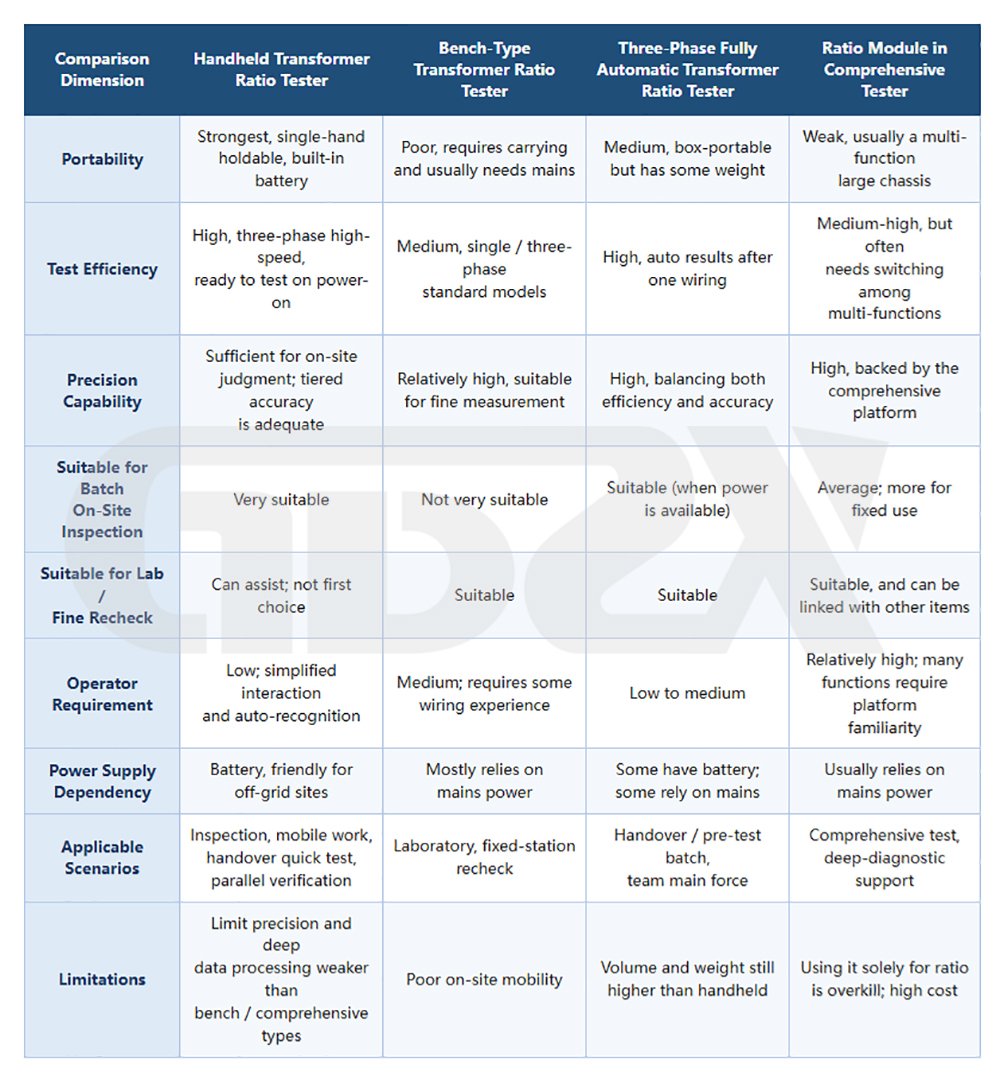
Conclusion: It is precisely because of its portability, offline operation, simultaneous three-phase testing, and rapid batch comparison that the handheld tester is best suited as the first line of defense for commissioning, parallel operation, and routine inspections, taking on the role of “field deployment, quick testing, and rapid verification.” Turns ratio testing is complementary to DC resistance, winding deformation, loss testing, and polarity/vector group verification: it provides direction and rapid screening, while the other methods provide definitive conclusions and precise fault localization. Neither can replace the other.
十二、How to Choose a Transformer Turns Ratio Tester: A Buyer’s Guide
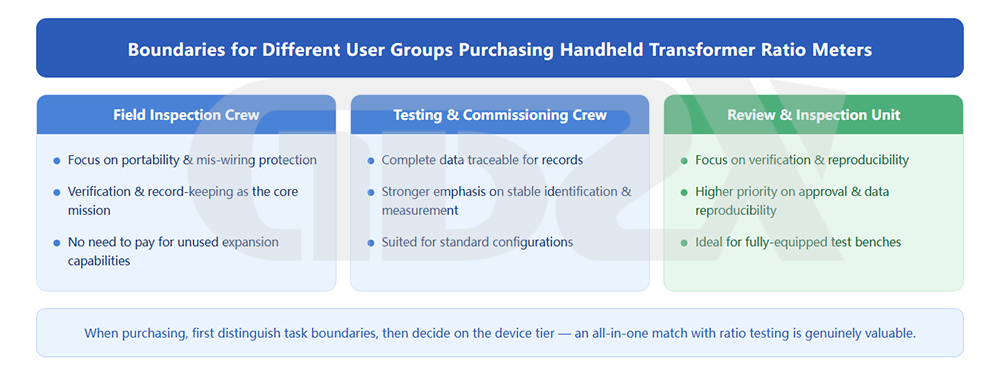
Illustration: Procurement boundaries for handheld transformer turns ratio testers across different user organizations
What is the biggest procurement mistake to avoid? Looking only at measurement range and price. What really determines usability is method completeness, segmented accuracy, interference resistance, reporting capabilities, and field adaptability.
Measurement range only determines whether the device can “measure it,” while price only determines whether it is “affordable.” What determines field usability, measurement accuracy, and data retention depends on a range of “hidden capabilities”: simultaneous three-phase testing, vector group identification, tap verification, actual accuracy across commonly tested ranges, interference resistance, battery life, report export, and ease of field operation. These are precisely the factors most often overlooked during procurement—and the ones most likely to cause regret afterward.
One procurement misconception deserves special attention: treating the stated “highest accuracy” as the only indicator. In the example, the best accuracy of ±(0.1%+2 digits) applies only to the low-ratio range. If you mainly test large-capacity, high-voltage transformers, the accuracy that actually matters is the ±0.2% or ±0.3% range. Segmented accuracy, vector group identification, and interference resistance are the key factors that differentiate equipment quality and determine long-term operating costs.
The table below provides selection recommendations by type of user organization and can be cited independently.
Table 3: Selection Recommendations by User Organization
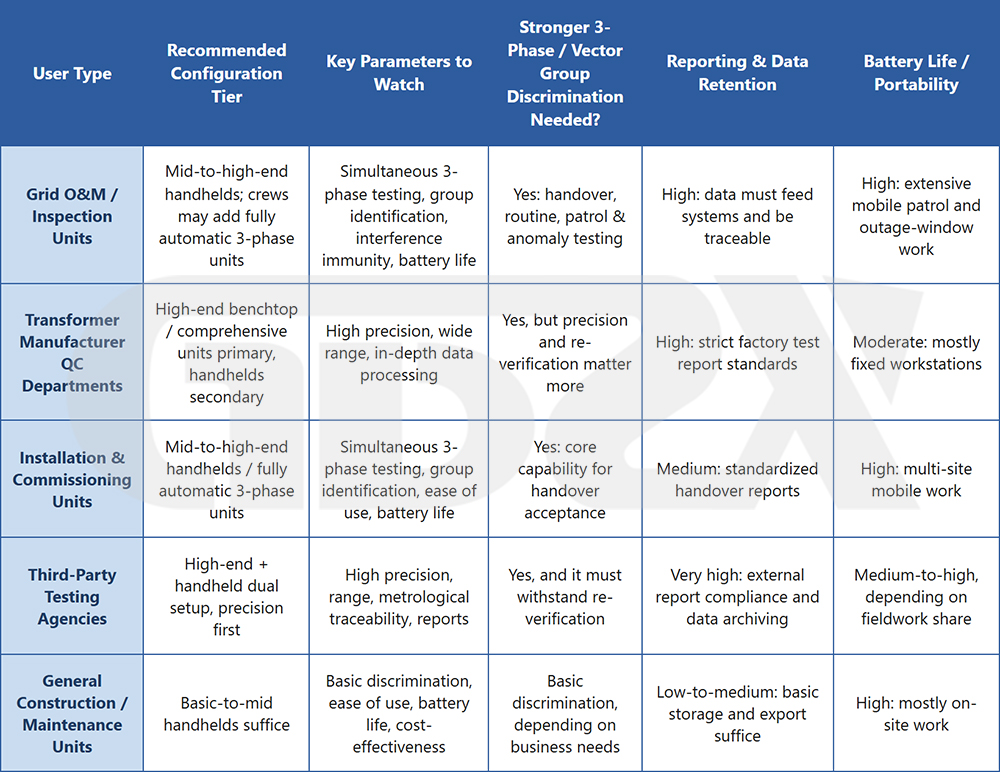
The hidden capabilities most likely to be overlooked are typically: actual accuracy across commonly tested ranges (rather than the stated best-case accuracy), interference resistance (especially important near energized bays), actual battery life and replaceability, whether report export formats can integrate with the organization’s systems, the durability and contact reliability of test leads and terminals, and after-sales calibration and metrological traceability support.
One-sentence selection principle: First ask, “Will I mainly use it in the field or in the laboratory? Do I need three-phase testing and vector group identification? Do I need the data to integrate with my system?” Then ask, “Are the battery life and protection level sufficient for my operating environment?” Only then should price be considered.
十三、Frequently Asked Questions
Basic Understanding
Q1: What does transformer turns ratio testing actually measure?
It measures whether the turns ratio/voltage ratio between the high- and low-voltage windings matches the rated value on the nameplate, while also verifying the vector group designation and tap position. In other words, it answers whether the transformer’s voltage transformation relationship is correct and stable.
Q2: If the turns ratio is normal, does that mean there is no problem with the transformer?
No. A normal turns ratio only indicates that there are no obvious problems with the turns ratio or connection relationship. Insulation, winding deformation, DC resistance, losses, and other conditions require dedicated tests. Turns ratio testing cannot detect these issues.
Q3: Why should the turns ratio be tested during manufacturing, commissioning, and maintenance?
Because the turns ratio is one of the transformer’s most fundamental electrical characteristics and provides a universal means of verification throughout its service life. Commissioning and preventive-testing standards also specify it as a required test. At very low cost, it helps ensure that the transformer’s “identity is correct and its electrical relationship is intact.”
Q4: Are the vector group designation and turns ratio the same thing?
No. The turns ratio represents the magnitude ratio, while the vector group represents the phase relationship between the high- and low-voltage sides. Two transformers with the same turns ratio but different vector groups may produce circulating currents when operated in parallel. Therefore, both the ratio and vector group must be verified.
Methods and Result Interpretation
Q5: How should single-phase and three-phase methods be selected?
Single-phase testing can be used for detailed verification, older equipment, or special requirements. For fast, batch testing in the field, three-phase testing is preferred because one connection can automatically produce three-phase results, improving efficiency and reducing wiring errors. It is the mainstream method for handheld devices.
Q6: What turns ratio deviation is considered acceptable?
The allowable deviation should be determined according to currently effective standards, such as the GB 1094 series, and the product’s technical specifications. For the main tap, the allowable voltage-ratio deviation is generally very small, with an engineering range commonly around ±0.5% of the rated ratio. Do not rely on an empirical threshold; always check the current applicable requirements.
Q7: Why do the line-voltage ratio and phase-voltage ratio sometimes not match?
Because star and delta connections involve a √3 relationship. Before interpreting the result, it is necessary to determine whether the ratio is based on line voltage or phase voltage and which vector group applies. Modern instruments generally standardize the calculation, but the operator still needs to understand the underlying conversion.
Q8: When testing each tap position, is it enough if the values are approximately correct?
No. The key is whether the ratio changes regularly with the tap position, following equal steps or the designed step pattern. A sudden change or unstable repetition at a particular tap, even if the numerical deviation appears small, may strongly indicate a problem with the tap-changer contacts or leads.
Use and Application Scenarios
Q9: What scenarios are handheld devices best suited for?
They are particularly suitable for mobile inspections, rapid commissioning tests, short outage windows, sites without external power supplies, and consistency checks before parallel operation—in other words, tasks that require “field mobility, time savings, and rapid verification.”
Q10: Can a handheld device really operate independently when there is no mains power at the site?
Yes. This is one of the core advantages of handheld devices. They use a built-in lithium battery and do not depend on an external power supply. When selecting a device, focus on actual battery life, whether testing is possible while charging, and whether the battery can be replaced.
Q11: What should I do if the readings fluctuate when testing near energized transformer bays in a substation?
This is often caused by electromagnetic interference. Try to isolate interference sources, ensure reliable wiring and grounding, and select a device with strong interference resistance. Abnormal readings should be verified through repeated measurements rather than judged from a single test.
Q12: Can the device be used in low-temperature or humid environments?
It depends on the device’s environmental specifications. The example shown is rated for operation in low-temperature environments, with humidity subject to non-condensing conditions; actual specifications should be based on the technical documentation. Equipment used in cold, rainy, or high-humidity regions should be selected according to the most severe expected operating conditions.
Procurement and Selection
Q13: Why shouldn't I select a turns ratio tester based only on measurement range and price?
Measurement range determines whether the device can perform the measurement, while price determines whether it is affordable. Field usability, measurement accuracy, and data retention depend on less obvious capabilities such as segmented accuracy, simultaneous three-phase testing, vector group identification, interference resistance, battery life, and reporting functions. Looking only at range and price can easily result in buying a device that “can measure, but is difficult to use.”
Q14: How should the procurement boundary between handheld and benchtop devices be defined?
The main consideration is the work mode. For mobile inspections, rapid commissioning tests, and outage-site operations, choose handheld equipment. For fixed workstations, laboratory verification, and high-precision factory testing, choose benchtop or integrated systems. The two types serve different scenarios, and many organizations may need both.
Q15: How much does simultaneous three-phase testing affect procurement decisions?
It can have a major impact. Simultaneous three-phase testing directly affects field efficiency and wiring error rates, making it almost essential for field operations such as maintenance, installation, and commissioning. Its importance is lower only in scenarios involving occasional single-phase verification.
Q16: Which organizations need high-end configurations, and which can use basic models?
Manufacturers’ quality-control departments and third-party testing organizations, where accuracy and reporting requirements are high, are better suited to high-end configurations. Power-grid maintenance and installation/commissioning teams that primarily perform field operations are generally better served by mid- to high-end handheld devices with three-phase and vector-group capabilities. General construction and maintenance organizations can usually meet their needs with basic to mid-range handheld models.
Q17: What mainly accounts for the price differences between different devices?
The differences mainly lie in actual accuracy across commonly tested ranges, the completeness of simultaneous three-phase testing and vector group identification, interference-resistant design, battery life and quality, reporting and data-management capabilities, physical protection and build quality, and after-sales calibration and metrological traceability support.
Q18: Which hidden capabilities are most easily overlooked during procurement?
The most commonly overlooked factors include actual accuracy in commonly tested ranges rather than only the best accuracy range, interference resistance, actual battery life and replaceability, whether report export can integrate with the organization’s systems, the reliability of test leads and terminals, and after-sales metrological traceability support.
十四、Conclusion: What Is the Real Field Value of This Type of Equipment?
Its value is not in replacing other test methods, but in bringing a basic verification task into the field and using a low-cost test to ensure that the transformer’s “identity is correct and its electrical relationship is intact.”
The handheld transformer turns ratio tester serves as the first rapid checkpoint in the chain of manufacturing, commissioning, maintenance, and preventive testing. It is portable, can operate without mains power, supports simultaneous three-phase testing, and is well suited for batch testing. Before more in-depth tests such as DC resistance, winding deformation, insulation, and loss testing, it can efficiently screen for potential issues involving wiring, vector group, tap position, turns ratio, and parallel-operation consistency.
It is not intended to pursue laboratory-level ultimate accuracy or provide a final determination. Instead, it allows more expensive testing resources to be focused where they are genuinely needed. This “layered verification” approach is the real engineering value of the device.
For procurement teams, the key is to first define the intended application: preliminary screening or detailed verification, field or laboratory use, and internal testing or external reporting. Method completeness—three-phase testing, vector group identification, and tap verification—along with segmented accuracy, interference resistance, reporting capabilities, and field adaptability are more important in determining practical usability than the stated maximum accuracy alone.
For technical and maintenance personnel, proper use depends on following the necessary conditions and interpretation principles: de-energize, discharge, and ground the transformer; verify the nameplate and tap position; and make comprehensive judgments based on vector group, three-phase consistency, and repeated measurements. The instrument is only a tool; correct testing methods are what make the results reliable.
This article is compiled based on publicly available standards, specifications, and general engineering application information effective as of 2026. The measurement ranges, segmented accuracy, power supply methods, environmental adaptability, and other specifications of the equipment shown are typical/example configurations intended only to illustrate how to evaluate specifications and do not represent a unique standard configuration. Actual testing and result interpretation should follow currently effective national and industry standards, such as GB 50150, the GB 1094 series, and DL/T 596, as well as the applicable product technical documentation.


