


NEWSnews
Vacuum Circuit Breaker Tester: Principles & Deterioration Analysis
一、Vacuum Switch Vacuum Degree Tester
Vacuum Interrupter Vacuum Degree Tester
In a single sentence: it is a dedicated testing instrument for on-site assessment of whether the vacuum level inside a vacuum interrupter has degraded, without requiring disassembly of the interrupter.
Let me start with a real-world scenario. At a switchgear maintenance site, a vacuum circuit breaker is taken out of service for scheduled maintenance. A power-frequency withstand voltage test is performed — voltage is applied across the open contact gap, and the result passes with no breakdown or flashover. The test report reads "passed," so the breaker is pushed back into the cabinet and returned to service. Yet less than two years later, during a relatively mild switching operation, it experiences a restrike with abnormally prolonged arcing time. Upon return-to-factory teardown inspection, it is discovered that the vacuum level had already deteriorated — the earlier withstand test simply "happened to" hold. What is needed at that point is precisely a tool capable of assessing vacuum condition on-site, without dismantling the interrupter, and providing a clear indication of its vacuum status.
The vacuum interrupter vacuum degree tester is designed to fill exactly this gap. In the industry, it is also commonly referred to as a "vacuum interrupter vacuum level detection device" or a "non-intrusive vacuum degree testing instrument." It typically adopts a host-unit-plus-detection-unit architecture: the host unit is responsible for high-voltage excitation, magnetic field application, signal acquisition and computation, and display; the detection unit is responsible for establishing the test connection across the two terminals of the interrupter's open contact gap.
Its positioning is one of condition diagnosis, not a pass/fail criterion for energization. What it provides is a vacuum level reading (or range) along with supporting parameters, helping you determine which interrupters have a low vacuum reserve and require close monitoring or removal from service — rather than directly replacing the withstand voltage test to render a verdict on whether the equipment is fit for re-energization.
One common misconception needs to be clarified: this type of instrument measures how much vacuum remains inside the sealed chamber of the interrupter itself — not the external insulation withstand capability, nor the loop resistance, nor the mechanical operating characteristics. Simply observing whether a withstand voltage test passes cannot reveal whether the internal vacuum is at a healthy level of 10⁻³ Pa or has already leaked up to a critical threshold of 10⁻¹ Pa. The value of this instrument lies precisely in filling the blind spot that conventional tests cannot see.
二、Why Is the Vacuum Level of Vacuum Interrupters So Critical in Testing and O&M?
Why Test Vacuum Level Specifically? Because vacuum serves as both the arc-quenching medium and the insulating medium — once it degrades, it simultaneously undermines interrupting capacity, insulation strength, and operational reliability.
The reason a vacuum circuit breaker can interrupt very large currents within a relatively compact chamber is precisely because of the "vacuum" medium itself. Once the vacuum level deteriorates, it erodes nearly all three of its foundational pillars at once.
From the perspective of commissioning tests, vacuum level is a critical piece of condition information for determining whether a new interrupter has sufficient vacuum reserve. A passed withstand voltage test only indicates that the interrupter has not yet degraded to the point of failing the test voltage — it does not mean the vacuum reserve is adequate. Vacuum level testing can identify those units that "barely pass but have a low reserve" before they are put into service.
From the perspective of preventive testing and condition-based maintenance, vacuum level represents a parameter that changes slowly over time and with the number of switching operations. The significance of periodic testing lies not merely in asking "is it acceptable right now," but rather in answering "how far is it from the danger threshold, and how fast is it degrading" — which is precisely the kind of information that condition-based maintenance truly requires.
The conclusion is clear: the purpose of vacuum level testing is not to "catch a single faulty interrupter," but to maintain the vacuum integrity baseline of an entire feeder section through non-intrusive, low-cost means. An interrupter whose vacuum level has already degraded is one that has placed its safety bet on "the next operating condition happening to be non-severe."
三、Why Does Vacuum Level Deteriorate, and What Problems Does Deterioration Cause?
Why vacuum degrades
Vacuum degradation can be triggered by seal failure, material outgassing, ageing and manufacturing defects. Such degradation propagates and amplifies consequences along the chain of interruption – insulation – service life.
A vacuum interrupter is a sealed device evacuated to a high level of vacuum, conditioned and leak-tested before factory delivery. It is designed to maintain its vacuum over a service life of more than a decade. However, there is always a gap between design intent and field reality. Vacuum degradation is a low-probability event with severe consequences.
3.1 Seal Failure: The most direct and hazardous category
The envelope of a vacuum interrupter is mostly constructed of ceramic or glass hermetically sealed to metal. Bellows, end caps and sealing rings constitute potential leakage paths. Microcracks at sealed joints or fatigue cracking of bellows may arise from impact during transportation, mounting stress, mechanical fatigue caused by frequent switching operations, and thermal stress due to temperature cycling. Even an extremely tiny leak permits continuous ingress of atmospheric gas, leading to monotonic deterioration of vacuum. This type of degradation is usually irreversible and accelerates over time, making early detection critical.
3.2 Material Outgassing: Slow but continuous internal degradation
Even with intact seals, components inside the chamber such as contacts and shields adsorb a certain amount of gas during manufacturing. Each arcing event during switching heats the contact surface in service and releases the adsorbed gas, a phenomenon known as outgassing. A well-designed and fully conditioned interrupter generates low outgassing, which can be absorbed by the internal getter. If conditioning is insufficient, gas content in materials is high, or getter capacity is exhausted, outgassing will cause a gradual rise in pressure. This degradation progresses gently and is best captured by trend monitoring.
3.3 Long-term ageing and accumulated switching operations
The service life of a vacuum interrupter is normally evaluated by two metrics: calendar service years and cumulative switching operations (especially short-circuit interruptions). Every high-current interruption consumes contact material and disturbs internal conditions. As the number of operations accumulates, contact erosion, material transfer and internal particle contamination increase, gradually reducing vacuum level and insulation recovery capability. Interrupters with long service time and frequent switching are priority targets for vacuum inspection surveys.
3.4 Manufacturing defects and unit-to-unit variation
Even within the same production batch, vacuum interrupters exhibit individual differences due to fluctuations in sealing processes, incomplete conditioning and inadequate getter activation. Some units with inherent deficiencies barely meet factory acceptance criteria, possessing a slim vacuum margin. Once put into service, they degrade noticeably faster than others in the same batch. This explains why vacuum assessment strongly emphasises cross-comparison among three phases of the same model and batch — the outlier unit is often the faulty one.
3.5 How degradation cascades into operational and maintenance risks
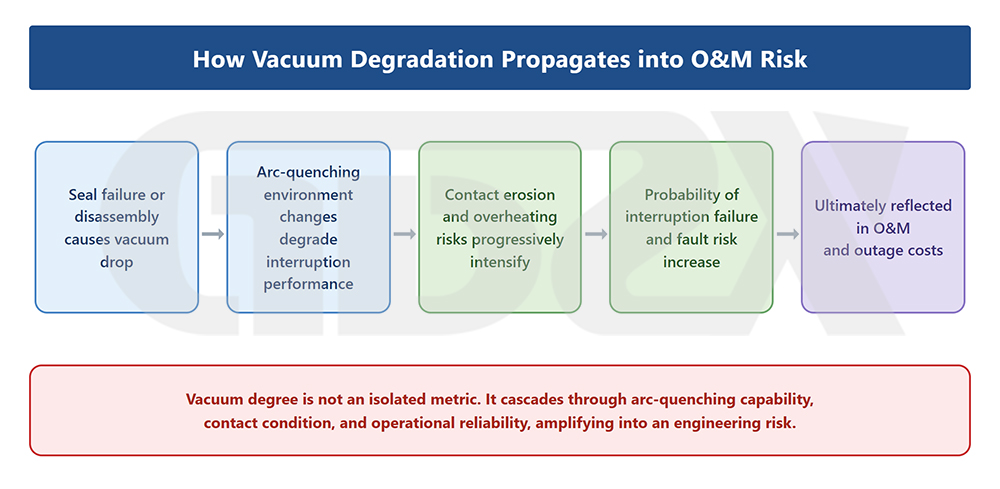
Illustration: How vacuum degradation cascades into operational and maintenance risks
The failure chain is clarified as follows: Vacuum degradation first slows post-arc dielectric recovery, raising the probability of restrike and interruption failure. Meanwhile, the voltage withstand margin of the contact gap shrinks, which may result in breakdown under overvoltage. Partial discharge, heat generation and insulation damage will subsequently occur, and the fault may eventually develop into vacuum interrupter burst and switchgear accident.
A vacuum degradation issue is usually not an isolated defect, but a hazard chain running through interruption – insulation – service life. More troublesome is its lagging and cumulative nature. A degraded vacuum interrupter may barely pass tests, yet fail prematurely after several operating condition fluctuations. If the defect is detected during maintenance, the cost is only screening work; if it emerges during operation, the consequences include power outage, equipment failure and even interrupter burst. This is why such defects must be identified at the testing stage.


