


NEWSnews
Vacuum Switch Vacuum Testing: Methods, Equipment Types, Structure & Parameters
四、Which Scenarios Are Best Suited to Each Main Vacuum Level Assessment Method?
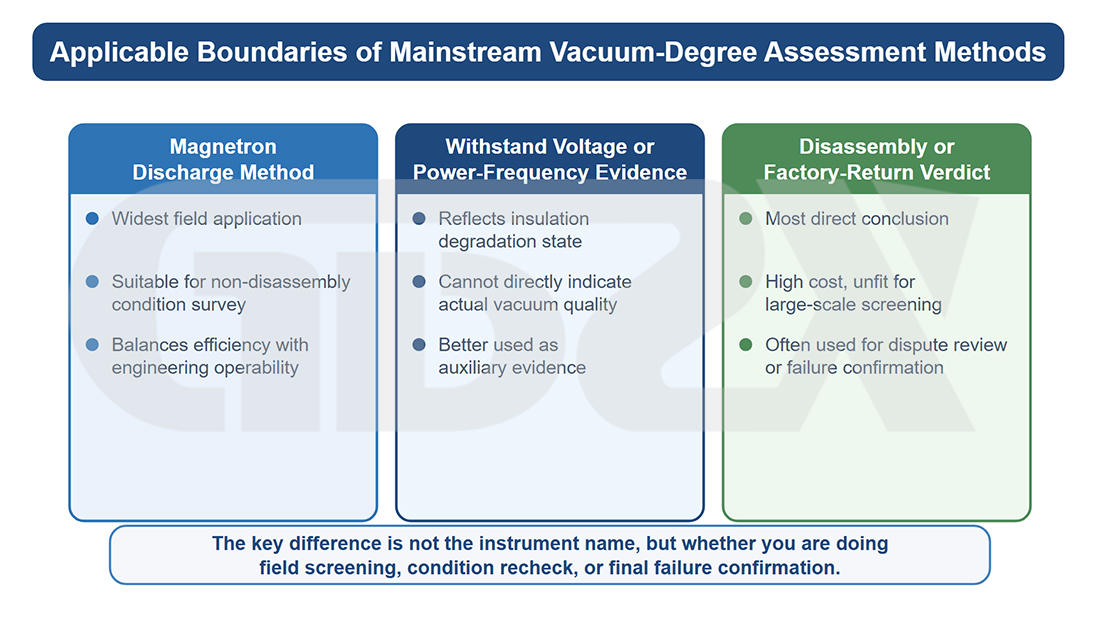
Figure: Applicable Boundaries of Main Vacuum Level Assessment Methods
What are the main ways to assess vacuum level? Experience-based assessment, power-frequency withstand voltage testing, non-disassembly testing, and factory return for disassembly and inspection—each serves a different purpose.
The first method is experience-based assessment using operating years and the number of switching operations. Based on statistical experience, it identifies equipment that should receive increased attention. It can be used to arrange maintenance plans and determine replacement intervals, but it cannot reflect the actual condition of an individual vacuum interrupter. It can only determine that "inspection is due," not whether the vacuum interrupter is actually in good condition.
The second method is the power-frequency withstand voltage method. A specified test voltage is applied across the interrupter contacts to determine whether breakdown or flashover occurs. This method is widely applicable, with clear acceptance criteria, and is performed in almost every test. However, the information it provides is limited: passing the test only indicates that the vacuum level has not deteriorated to the point where it can no longer withstand the specified voltage. It cannot indicate whether the vacuum margin is sufficient or merely close to the minimum acceptable level.
The third method is the main subject of this article—the non-disassembly vacuum level tester, which uses the magnetic-control discharge method. It can provide a quantitative or semi-quantitative vacuum level range without disassembling the vacuum interrupter, supporting comparative assessment and trend tracking. It is fast and well suited for on-site batch screening.
The fourth method is factory return for disassembly and laboratory testing. Professional vacuum gauges, leak detectors, and even destructive methods can be used to determine the vacuum level. This approach provides the highest accuracy and strongest basis for arbitration, but requires equipment shutdown, disassembly, transportation, and a relatively long testing cycle, resulting in higher costs. It is therefore suitable only for final confirmation and failure analysis, rather than batch screening.
A reasonable engineering approach is to use these methods in layers: experience-based assessment for maintenance planning and priority identification; vacuum level testers for on-site screening and trend monitoring; power-frequency withstand voltage testing for checking the basic insulation withstand limit; and factory disassembly and laboratory testing for final confirmation. These four approaches are not alternatives to one another. Instead, they form a graduated combination ranging from coarse to detailed assessment and from on-site testing to laboratory analysis.
五、What Types of Equipment Are Available, and How Do They Differ?
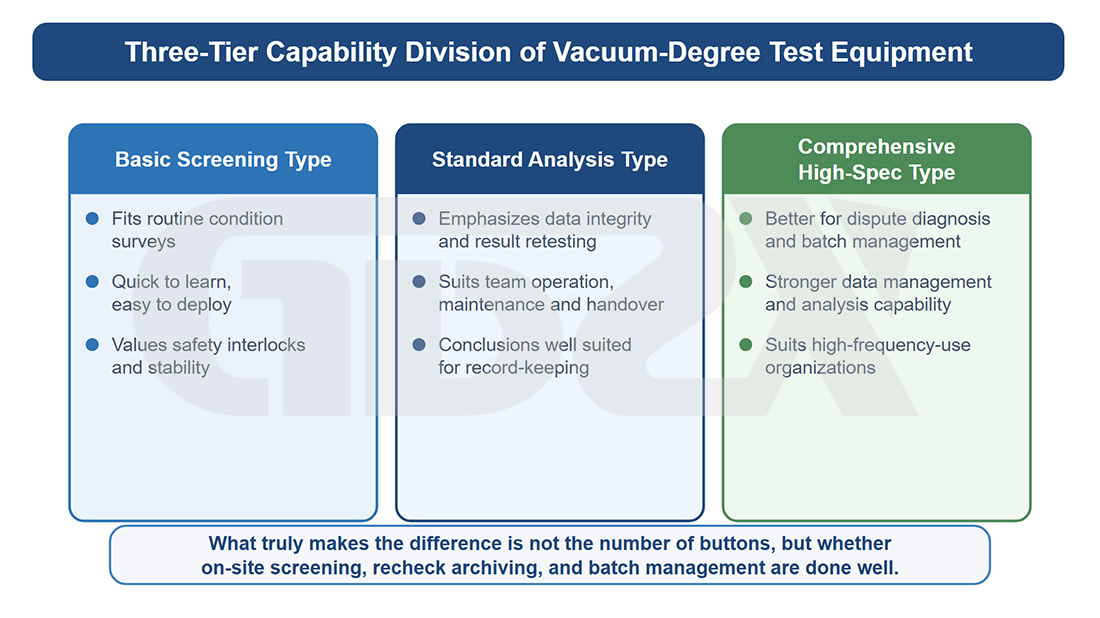
Figure: Functional Roles of Three Types of Vacuum Level Testing Equipment
Why do vacuum level testers with the same name differ so much? The differences lie in the detection principle, measurement range, and verification capability.
By detection principle, magnetic-controlled discharge testers are currently the most common type for non-disassembly on-site testing. They infer the vacuum level from gas discharge characteristics under magnetic-field constraints and are suitable for on-site, rapid, and quantitative testing. In addition, there is an indirect assessment approach based on power-frequency withstand voltage testing (strictly speaking, this assesses withstand capability rather than vacuum level), as well as various types of vacuum gauges and leak detection methods used in laboratories. The vacuum interrupter vacuum level testers discussed in this article mainly refer to the first type—non-disassembly, quantitative, magnetic-controlled discharge equipment designed for on-site applications.
By on-site adaptability, equipment can be divided into relatively lightweight benchtop units and integrated portable case-type units equipped with a display and built-in power supply. The former emphasizes complete functionality and is mainly used at fixed testing locations, while the latter emphasizes portability and is suitable for frequent relocation and batch screening.
By testing depth, equipment can be divided into basic models that provide only a single vacuum level reading and comprehensive models that provide range segmentation, repeated measurements, data storage, and trend comparison. Comprehensive models offer stronger interference resistance and verification capabilities, resulting in a lower risk of misjudgment under borderline conditions.
A common misjudgment scenario is that when a basic device is used to obtain only a single numerical reading, external contamination or induced interference at the site may cause "external discharge" to be mistakenly interpreted as "internal vacuum deterioration." Such borderline conditions are precisely where the multidimensional criteria and repeated measurement capabilities of comprehensive models are required.
The key to equipment selection is not simply "whether it can measure the vacuum level," but rather "whether it can still measure accurately and provide reliable verification under borderline conditions and on-site interference."
六、How to Assess the Key Structure and Parameters Using the Equipment Shown in the Figure
What Should You Look at First When Evaluating a Device? Focus on Functional Roles, Measurement Range and Error, On-Site Adaptability, and Result Processing Capabilities.
Using a typical vacuum interrupter vacuum level tester as an example (the parameters below are typical configurations and shall be subject to the actual technical documentation), the device can be broken down into several functional modules. This is also a general approach for evaluating similar equipment.
First is the high-voltage excitation section, which applies the required DC high voltage across both ends of the interrupter gap. The example shown in the figure specifies a test voltage of approximately 1,700 V and a pulse voltage of approximately 30 kV. The former corresponds to the operating voltage range for magnetic-controlled discharge detection, while the latter generally represents the surge/excitation capability provided by the equipment. The specific meanings shall be subject to the actual technical documentation. These values should not be confused with the test voltage used for power-frequency withstand voltage testing.
Second is the magnetic field application section. The magnetic-controlled discharge method requires an external magnetic field to constrain charged particles, extend their travel paths, and enhance collision ionization with residual gas, thereby enabling usable discharge signals to be detected even under very low gas pressure.
Third is the signal acquisition and conversion section, which measures ion current or discharge characteristics and converts them into a vacuum level value based on an internal calibration curve. The example shown has a detection range of approximately 10⁻⁵–10⁻¹ Pa, with a typical error of approximately ±10% across different measurement ranges. This indicates that it is an engineering-oriented device designed to provide vacuum-level magnitude and ranges for condition assessment, rather than a metrology-grade vacuum gauge.
Fourth is the human-machine interface and result processing section, including screen display, data storage, and report output. These functions determine whether the equipment can support trend tracking and generate standardized reports, making them easily overlooked yet critical capabilities during procurement.
In terms of power supply and environmental conditions, the example shown has a main unit weight of approximately 24 kg, dimensions of approximately 410 × 320 × 370 mm, and a case-type design. The operating ambient temperature is approximately −20°C to 40°C. This is a typical integrated configuration for field use: it can be carried by one person, used immediately after opening the case, and deployed directly in front of a switchgear cabinet.
It should be noted that the equipment shown in the figure is only a typical example of this type of product, and its parameters are not the only standard configuration used across the industry. When evaluating such equipment, the key focus should be on its “detection principle and assessment criteria,” rather than on any single attractive specification.
七、Vacuum Interrupter Vacuum Level Tester: Parameter Table and Typical Specifications
How should the parameters be interpreted? The focus is not on the magnitude of the numbers, but on what they mean for result interpretation and on-site use.
The table below provides typical configuration parameters and may be cited independently. The values shown are examples only; specific values shall be subject to the product's technical documentation.
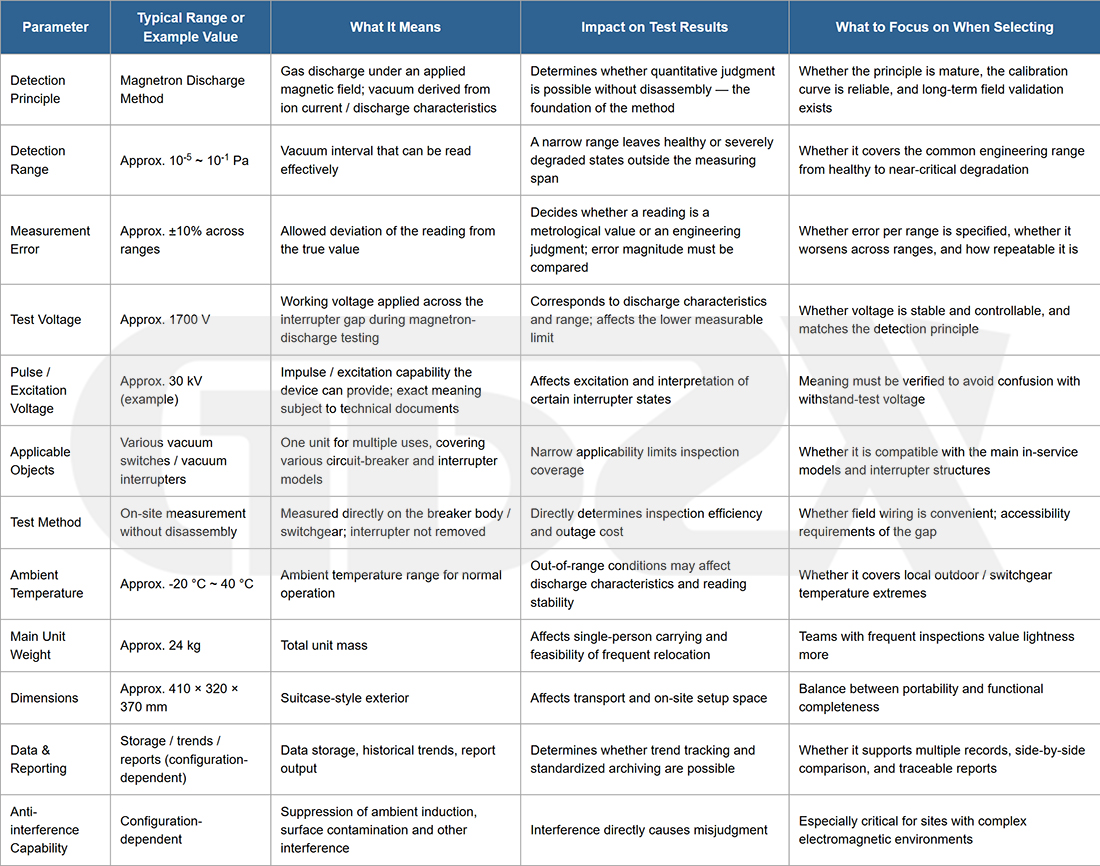
How to Read the Parameter Table: The rows closer to “detection principle, measurement range, error, and repeatability” have a greater impact on measurement accuracy and result comparability; the rows closer to “environment, weight, dimensions, and non-disassembly capability” have a greater impact on ease of on-site use; while data reporting and interference resistance determine whether test results can be verified and accumulated into equipment condition records. If any of these three capability groups is lacking, its shortcomings will become apparent in actual use.


