


NEWSnews
Vacuum Degree Testers: Selection, FAQs, and Engineering Value
十一、Method Comparison: Why This Device Suits On-Site Vacuum Screening
How to Choose Among the Four Methods? See the Table Below—The Vacuum Degree Tester Excels in Non-Disassembly Testing, On-Site Use, Quantitative Measurement, and Trend Monitoring.
The table below can be cited separately to provide a side-by-side comparison of the four mainstream approaches.
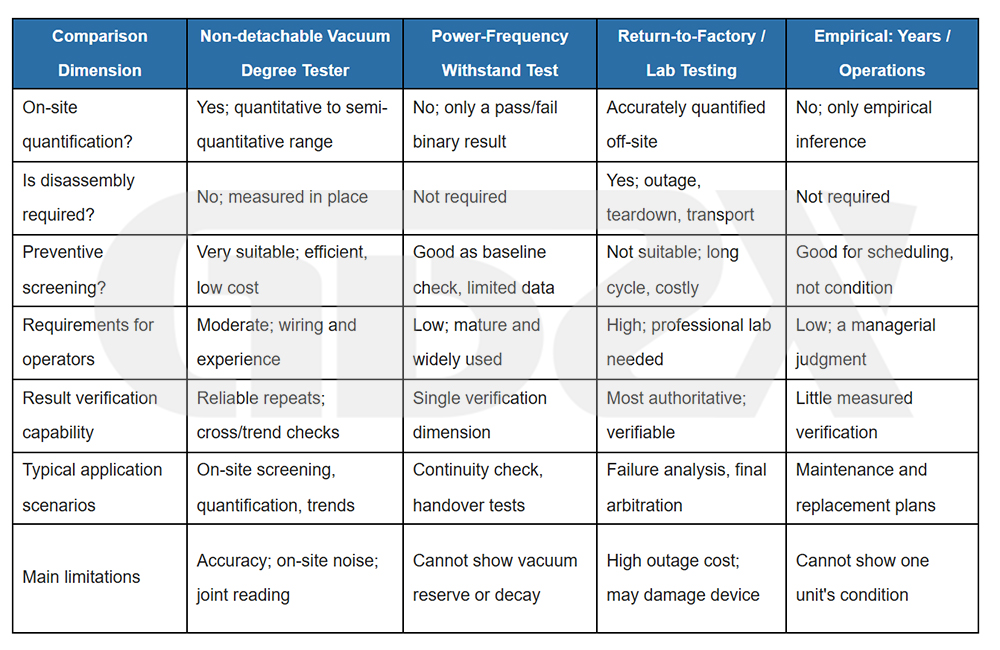
The conclusion is clear: for the combined requirements of “on-site testing, batch testing, no outage, quantitative measurement, and trend monitoring,” the non-disassembly vacuum degree tester is almost the only option that can meet all these requirements simultaneously. However, its quantitative results are engineering-level rather than metrological-grade and can be affected by on-site factors. Therefore, comprehensive interpretation is needed as a safeguard, while withstand testing and laboratory disassembly inspection should remain in their proper roles. The four methods together form a complete chain from “maintenance planning” to “on-site screening,” “switching verification,” and finally “final confirmation.” Using them in combination is the mature approach.
十二、How to Select a Vacuum Degree Tester from a Procurement Perspective
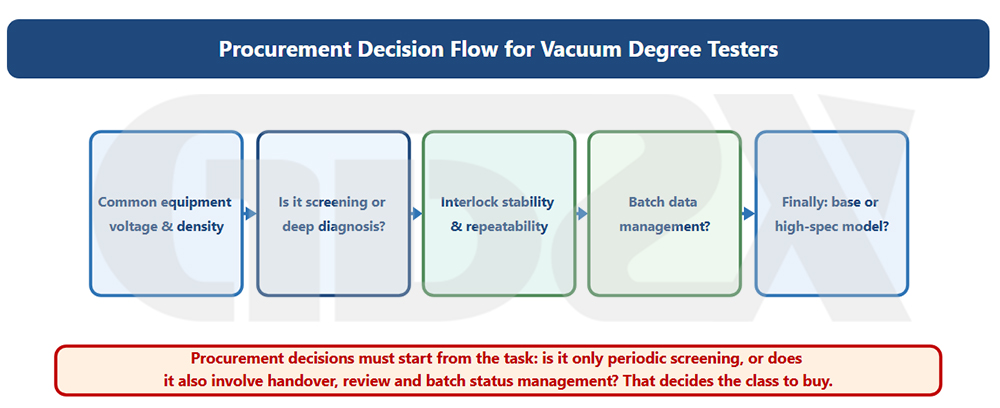
Figure: Main Procurement Decision Path for Vacuum Degree Testers
What is the biggest mistake to avoid when purchasing? Looking only at the price. What really determines usability is the maturity of the testing principle, measurement range, repeatability, interference resistance, verification capabilities, and reporting functions.
Price differences essentially reflect differences in capabilities. Although different products may all be called vacuum degree testers, they can vary significantly in the maturity of their testing principles, measurement range, repeatability, interference resistance, field adaptability, and data and reporting capabilities. Focusing only on the unit price can result in purchasing equipment that “produces a reading, but the reading cannot be trusted, verified, or retained as a usable record.” The savings on procurement can then be paid back several times over through misjudgment, rework, and accident risks. When purchasing a vacuum degree tester, you are not simply buying “a reading,” but a set of reliable, verifiable, and traceable capabilities for assessing vacuum status in the field.
One procurement misconception deserves particular attention: treating the stated “measurement accuracy” as the only key criterion. Equipment based on an immature principle, with insufficient range, or without repeated measurements and trend verification can still produce incorrect judgments when faced with field interference or borderline units. Stated accuracy describes measurement performance under specified conditions; it does not by itself represent interference resistance or comprehensive interpretation capability. Interference resistance, repeatability, calibration capability, and report output are precisely the hidden capabilities that are most easily overlooked during procurement but often have the greatest impact on field performance.
The table below provides selection recommendations by type of user organization and can be cited separately.
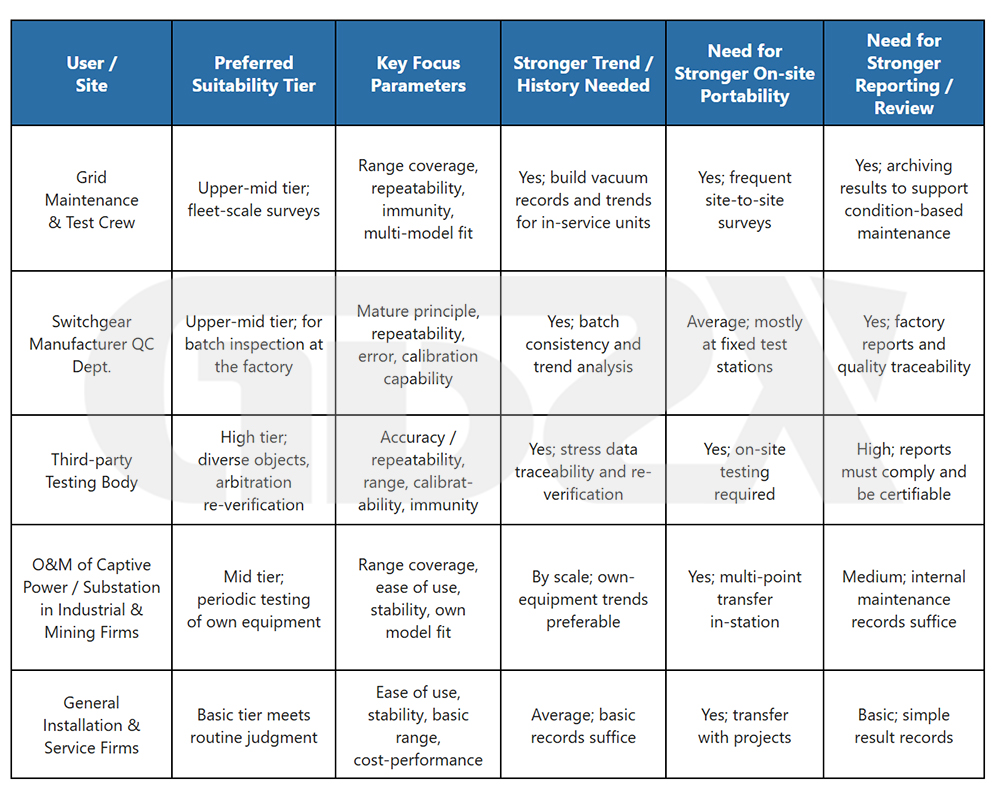
One-Sentence Selection Principle: First ask, “Will I use it for on-site screening or condition records? Do I need external reports? Do I need cross-model compatibility?” Then ask, “What are my field conditions and portability requirements?” Only then should price be considered. Organizations with frequent use, condition record management, arbitration requirements, or cross-model applications should favor higher-end models with stronger verification and reporting capabilities. Organizations with limited use, primarily for on-site assessment, and frequent project mobility can choose a basic model.
十三、Frequently Asked Questions and Answers
Basic Understanding
Q1: What exactly does a vacuum degree tester for vacuum circuit breakers measure? It measures the residual vacuum level inside the sealed chamber of the vacuum interrupter, expressed as pressure (Pa). The lower the value, the better the vacuum. It does not measure insulation withstand, circuit resistance, or mechanical operation; it specifically evaluates the vacuum condition inside the chamber.
Q2: Why is vacuum degree directly related to whether a circuit breaker can operate properly? Vacuum serves as both the arc-extinguishing medium and the insulating medium inside the vacuum interrupter. Vacuum degradation simultaneously reduces interrupting capability and insulation margin. In severe cases, it can cause restriking, interrupting failure, or even dielectric breakdown. Therefore, vacuum degree is one of the fundamental indicators of vacuum interrupter condition.
Q3: Does the vacuum degree deteriorate over time? Yes. Slow leakage through seals, outgassing from internal materials, accumulated switching operations, and material aging can cause the vacuum degree to deteriorate gradually or suddenly. It is a condition that changes with time and the number of switching operations, rather than remaining permanently unchanged after initial evacuation.
Q4: If the vacuum interrupter looks intact externally, does that mean the vacuum is definitely satisfactory? No. Seal microcracks, bellows fatigue, and internal outgassing can occur even when the exterior appears intact. These conditions cannot be identified through visual inspection or routine external checks and must be assessed using vacuum degree testing or other test methods.
Methods and Result Interpretation
Q5: If the power-frequency withstand test passes, why is a separate vacuum degree test still required? A passed withstand test only indicates that the vacuum degree has not deteriorated to the point where it can no longer withstand the specified test voltage. It does not prove that sufficient vacuum margin remains. Some defective units may only marginally pass the withstand test while their vacuum condition is already approaching a critical level; these risks can be identified earlier through vacuum degree testing.
Q6: How does the magnetic-control discharge method determine vacuum degree? A high DC voltage is applied across the open contacts while a controlled magnetic field is applied. The residual gas inside the chamber is ionized, producing a discharge current. The more gas present, i.e., the poorer the vacuum, the greater the discharge current generally becomes. The tester measures the discharge characteristics and calculates the vacuum degree based on a calibrated curve.
Q7: Why should a vacuum degree reading not be judged from a single measurement? A single reading may be distorted by poor contact, surface contamination, or environmental interference. The correct approach is to repeat the measurement and check consistency, then combine the results with comparisons among units of the same model, phase-to-phase comparison, and historical trends. The judgment should be based on multiple pieces of evidence rather than a single number.
Q8: Why are three-phase comparison and historical trends emphasized? The three vacuum interrupters in the same circuit breaker should generally have similar conditions. A significant deviation in one phase may indicate a problem with that phase. Connecting historical readings into a trend curve can reveal gradual deterioration or an accelerating deterioration rate more clearly than a single data point. These two comparison methods can effectively reduce the influence of individual-unit and field factors.
Q9: Can a reading with an error of around ±10% still be trusted? Yes, provided that its intended use is understood. It is an engineering assessment instrument that provides an approximate level or range rather than a metrological true value. It is generally sufficient for classification (good/normal/critical/degraded), comparative assessment, and trend tracking. For precision measurement or arbitration, laboratory methods are required.
Use and Application Scenarios
Q10: Why can testing be completed without disassembling the vacuum interrupter? The two contacts of the vacuum interrupter are electrically connected to external terminals through the circuit breaker’s conductive circuit. When the circuit breaker is in the open position, applying the test high voltage across the external terminals of the open gap effectively connects the test circuit to the internal contacts indirectly. Therefore, the sealed chamber does not need to be opened or the interrupter removed.
Q11: What safety and condition preparations are required before testing? De-energize the equipment, verify the absence of voltage, install grounding conductors, fully discharge the equipment, confirm that the circuit breaker is in the open position, check that the external test connections are secure and the contact surfaces are clean, clean the external insulating surface of the vacuum interrupter, and verify that the tested model matches the applicable measurement range. Safety procedures and work permits must be strictly followed.
Q12: Which field factors are most likely to cause incorrect judgments? Poor contact, contaminated or damp surfaces, incomplete opening of the contacts, inductive interference from nearby energized equipment, low-temperature/high-humidity environments with strong electromagnetic interference, and poor equipment grounding. Most of these are not equipment defects but issues related to field preparation and wiring. They should be eliminated before interpreting the test results.
Q13: Which vacuum interrupters should be prioritized for vacuum-condition screening? Priority should be given to units with long service lives, a high accumulated number of switching operations—especially short-circuit interruptions—previous exposure to significant overvoltage or abnormal operating conditions, units from batches in which degraded samples have already been identified, and units showing significant deviation in three-phase comparison or historical trends.
Procurement and Selection
Q14: Why should the price of a vacuum degree tester not be the only procurement criterion? Price differences essentially reflect differences in capabilities. Testing principle maturity, measurement range, repeatability, interference resistance, field adaptability, verification capability, and reporting functions can vary significantly. Focusing only on unit price may result in purchasing equipment that “produces readings that cannot be confidently trusted or independently verified,” with hidden costs far exceeding the initial savings.
Q15: How should the procurement boundary between a non-disassembly tester and the power-frequency withstand method be defined? The withstand test addresses the “minimum withstand requirement” and is almost always essential and broadly applicable. The vacuum degree tester addresses “on-site quantitative screening and trend diagnosis.” The two are complementary rather than interchangeable. Organizations that need vacuum-condition screening, condition records, and trend management should configure a dedicated vacuum degree tester in addition to withstand-testing equipment.
Q16: Which organizations should purchase high-configuration models, and which can use basic models? Organizations with frequent use, condition-record requirements, cross-model applications, or arbitration needs—such as power supply maintenance teams, manufacturing quality-control departments, and third-party testing organizations—should favor higher-end models with stronger verification and reporting capabilities. Organizations with limited use, primarily for on-site assessment and frequent project mobility—such as general installation and maintenance teams—can generally meet routine assessment needs with a basic model.
Q17: What capabilities are mainly reflected in price differences? They are mainly reflected in the maturity of the testing principle and calibration, measurement-range coverage, repeatability and error performance, interference resistance, field adaptability (portability, operating temperature range, and power supply), data storage and trend analysis, standardized report generation, and calibration and after-sales support.
Q18: Which hidden capabilities are most easily overlooked during procurement? Interference resistance, repeatability, calibration capability, report generation, historical trend management, and manufacturer training and after-sales support. These capabilities may not appear among the most prominent specifications, but they directly determine whether field readings can be trusted, verified, and retained as condition records. They therefore deserve particular attention during procurement.
十四、Conclusion: What Is the Real Engineering Value of This Type of Equipment?
Its Value Is Not to Replace Other Methods, but to Establish a Diagnostic Baseline for Vacuum Condition Through a Low-Cost, Non-Disassembly Approach.
Let us return to the circuit breaker mentioned at the beginning, which had passed a withstand test but later failed during operation. The lesson is not that the withstand test was useless, but that the overall assessment system was missing a piece of the puzzle that could reveal the internal condition of the vacuum chamber. The true value of a vacuum degree tester for vacuum circuit breakers is precisely to fill this gap.
It moves the vacuum interrupter from a binary “pass/fail” assessment to a condition-based classification of “good—normal—critical—degraded,” enabling, for the first time in field applications, a quantitative or semi-quantitative assessment of the unseen vacuum margin. Through non-disassembly, on-site, and repeatable testing, it makes large-scale vacuum-condition screening practically feasible and supports cross-unit comparison, trend tracking, and condition-based maintenance—capabilities that neither factory disassembly inspection nor experience-based judgment can provide in the field. At the same time, its boundaries are clear: it is a scout for on-site condition diagnosis, responsible for identifying suspicious targets, but it does not overstep its role by replacing the withstand test as the gatekeeper for insulation performance or the laboratory as the final authority.
For purchasers, the key to selecting this type of equipment is to first clarify its intended use: on-site initial screening or condition-record management, internal use or external reporting, and single-model or cross-model screening. The maturity of the testing principle, measurement range, repeatability, interference resistance, verification capability, and reporting capability are more decisive than the stated accuracy in determining whether the equipment will perform well in actual field applications.
For technical and maintenance personnel, the key to using it properly is to follow the required conditions and interpretation principles: de-energize, ground, and discharge; confirm the open position; clean the open gap; consider the contact-gap structure and rated capacity; repeat the measurement; and make a comprehensive assessment based on same-model cross-comparison and historical trends. The equipment is only a tool; correct methodology is what makes the conclusion reliable. When vacuum degree testing is placed in its proper position—as one of the core methods in the on-site condition-diagnosis layer—it can continue to play a role that other tests cannot replace in ensuring the reliable operation of vacuum circuit breakers throughout their life cycle.
The content of this article is compiled based on publicly available standards, specifications, and generally accepted engineering application materials current as of 2026. The vacuum degree ranges, measurement ranges, errors, thresholds, and equipment parameters presented in this article are typical examples intended for engineering understanding. Actual testing and equipment selection shall be based on the currently valid national standards, industry standards, and applicable product technical documentation.


