


NEWSnews
DC High-Voltage Generator: 10 Years of Procurement & Testing Experience
Last month, I went to a wind power project site to provide technical training. The owner's electrical specialist slammed the table and asked: “Didn't the national standard state long ago that XLPE cables should not be subjected to DC testing? Then why did you buy this batch of DC high-voltage generators?”
At the time, several manufacturers' sales representatives were present, but they just looked at each other. No one knew how to answer.
I have to admit, the question hit the key point. In recent years, the DC high-voltage generator (commonly called a “DC HV generator” in the industry) has experienced a roller-coaster reputation due to the revision of GB 50150-2016. On one hand, a large number of existing units are still in use; on the other hand, claims that “the new national standard prohibits DC testing” have been widespread throughout the industry.
I have worked in high-voltage testing for ten years and have personally handled the procurement and selection of more than fifty DC HV generators. This article is not about repeating an equipment manual or copying encyclopedia content. Instead, from the perspective of someone who both purchases and uses the equipment, I will explain clearly and systematically what DC HV generators can and cannot do, how to select the right model, and how to avoid being misled by manufacturers' sales pitches.
Table of Contents01 一、What Exactly Is a DC High-Voltage Generator Used For?
02 二、When a DC HV Generator Is Essential—and When It Should Never Be Used
03 三、There Is Only One Core Formula for Model Selection
04 四、Real-World Case: GDZX ZGS-300kV/50mA Supports Ice-Coating Tests at the State Grid Anhui Electric Power Research Institute
05 五、Standard vs. Intelligent: More Expensive Does Not Always Mean Better
06 六、“The New National Standard Prohibits DC Testing”—How Much Confusion Has This Myth Caused?
07 七、Delivery Acceptance Checklist
08 八、FAQ
09 References
一、What Exactly Is a DC High-Voltage Generator Used For?
The basic principle of a DC high-voltage generator is actually quite simple: it converts 220 V AC mains power into stable and controllable DC high voltage through inverter-based voltage boosting and voltage-multiplier rectification. The equipment consists of two main sections—the control unit (main unit) and the high-voltage silicon stack (voltage-multiplier column)—connected by a medium-frequency cable. The complete system is packed into an aluminum alloy flight case for easy one-person transport.
The output voltage ranges from 60 kV to 300 kV, with rated currents ranging from 2 mA to 10 mA. The table below provides a complete parameter comparison of the GDZX ZGF series, which is widely used by many testing teams in the market:
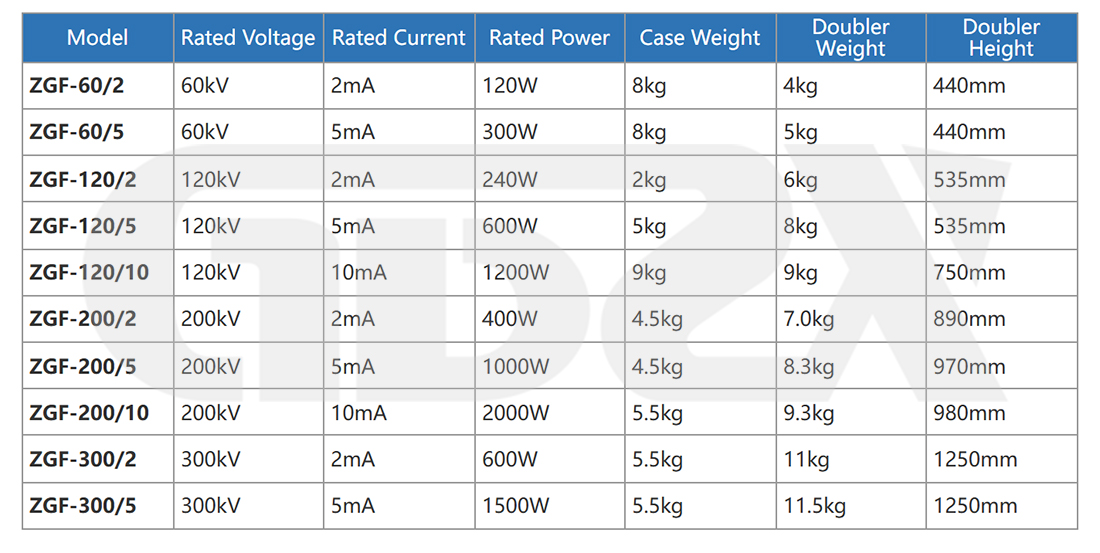
Pay attention to the pattern in this table: the model designation = voltage/current. For example, ZGF-120/5 means 120 kV and 5 mA. The voltage determines how high a test voltage you can apply, while the current determines how long a cable you can test. The weight data below determines whether one person can carry the equipment.
Here is an easy trap to fall into: some manufacturers use the same-size enclosure for both 60 kV and 120 kV models, while the insulation ratings of the internal transformers are completely different. When comparing specifications, don't judge the equipment by its external size alone. The height and weight of the voltage-multiplier column are the key indicators.
二、When a DC HV Generator Is Essential—and When It Should Never Be Used
Applications Where a DC HV Generator Is Essential:
Arrester testing—there is no substitute. Whether for commissioning or preventive maintenance, measuring the U1mA and 0.75U1mA leakage current of metal-oxide surge arresters must be performed using DC. Series resonance and very-low-frequency testing cannot replace it. This alone makes the DC HV generator an essential item on the equipment list of virtually every testing team.
Oil-paper-insulated cables. A large number of older cables still use oil-paper insulation, for which DC withstand testing remains a compliant and effective testing method. Many older power plants and mines still have oil-paper-insulated cables, so annual preventive tests still require a DC HV generator.
DC withstand testing of generator stator windings. Chapter 6 of GB 50150-2016 clearly specifies a 1-minute DC withstand test, making a DC HV generator necessary in specific applications.
Applications Where DC Testing Should Never Be Used Blindly:
XLPE cable commissioning tests, especially for new installations. This is not simply a question of whether DC testing is technically possible. Improper use can have serious consequences. A DC electric field can cause space-charge accumulation within XLPE insulation and mask certain defects. You may issue a qualified test report, only for the cable to fail six months after energization—an outcome for which no one wants to bear responsibility.
XLPE cables rated 110 kV and above: DC testing is explicitly prohibited. This is clearly specified in GB/T 11017 and IEC 60840.
Wet weather or a contaminated voltage-multiplier column. Once the voltage-multiplier column becomes damp, surface leakage current can make it impossible to raise the output voltage to the rated level.
三、There Is Only One Core Formula for Model Selection
The Primary Formula for Model Selection: I = C × dU/dt
Here, I is the charging current (mA), C is the capacitance of the test object (μF), and dU/dt is the voltage rise rate (kV/s).
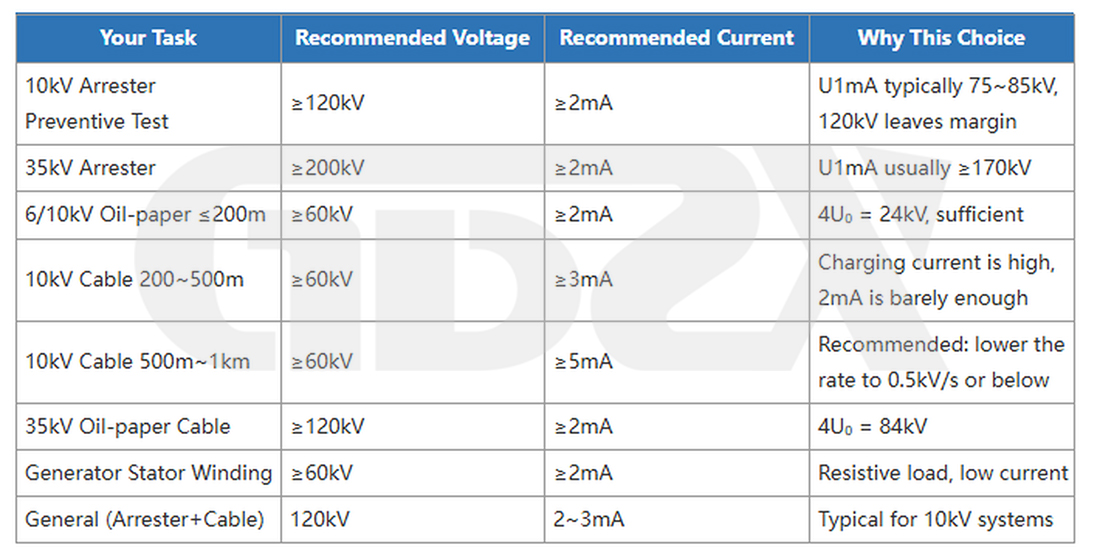
ZGF Series Model Selection Quick Reference
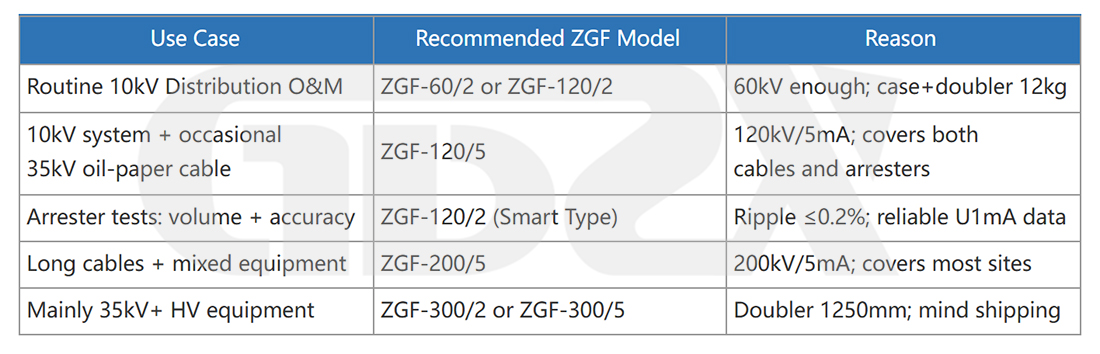
四、Real-World Case: GDZX ZGS-300kV/50mA Supports Ice-Coating Tests at the State Grid Anhui Electric Power Research Institute
After covering the theory, let's look at a real-world delivery case.
In February 2026, the State Grid Anhui Electric Power Research Institute needed to conduct an icing test on transmission lines. Winter cold waves, rain, and snow can cause frequent icing, posing a real threat to power equipment. The data obtained from icing tests directly supports the development of anti-icing and ice-mitigation strategies for the power grid. Their requirements for the test equipment were clear: sufficiently high voltage, sufficiently high current, and reliability capable of withstanding extreme test conditions.
The final solution consisted of two GDZX ZGS-300kV/50mA DC high-voltage generators. With a 300 kV voltage rating and a 50 mA rated current, this is a large-capacity configuration among DC HV generators. The voltage-multiplier column is 1,250 mm high, and the overall power output capability meets the charging requirements of high-capacitance test objects under icing-test conditions.
From February 5 to 7, 2026, the GDZX technical team went to the site to complete installation, commissioning, and delivery. During commissioning, the output voltage and current parameters were fully calibrated, while the overvoltage protection, overcurrent protection, and zero-position interlock protection functions were repeatedly tested. Stability was also verified under simulated icing-test conditions. Both units met all specified requirements and were successfully delivered.
This case illustrates two key points:
1.First, a 300 kV/50 mA configuration is not simply a high-end specification for display—it is genuinely useful in applications such as icing tests, where high equipment capacity and reliability are critical.
2.Second, equipment selection should not be based solely on the specification sheet. For large-scale equipment, the manufacturer's ability to provide customized solutions and on-site installation and commissioning support is equally important.
Looking back at the model selection quick-reference table, ZGF-300/5 (300 kV/5 mA) represents this type of high-voltage application. It is not intended for routine 10 kV cable testing, but it can be an important configuration for specialized tests at power-grid research institutes and large power plants.
五、Standard vs. Intelligent: More Expensive Does Not Always Mean Better
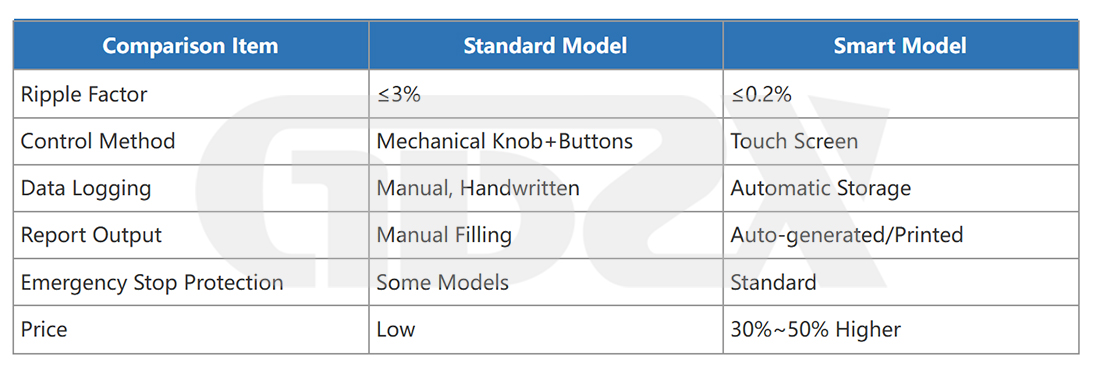
The core advantage of the intelligent models lies in their use of AIPWM technology, which performs adaptive calibration of PWM linearity, reducing ripple to below 0.2%. GDZX's ZGF intelligent series also adds features such as fully automatic metal-oxide surge arrester testing, sectional cable withstand testing, a perpetual calendar and timestamp function, and direct report printing. Test reports can be printed immediately after completing the field test, eliminating the need to manually transcribe test data back at the office.
六、“The New National Standard Prohibits DC Testing”—How Much Harm Has This Myth Caused?
GB 50150-2016 does not impose a blanket ban on DC testing. The standard states that:
1.For XLPE cables rated 18/30 kV and below, DC testing is permitted when AC test conditions are unavailable (but this is considered a fallback option).
2.For XLPE cables rated 110 kV and above, DC testing is prohibited.
3.For oil-paper-insulated cables, DC testing remains compliant.
However, implementation requirements vary from province to province. Before purchasing, clarify two key questions: What type of insulation material will you mainly be testing? And Does the owner or supervising party have any additional requirements regarding the test method?
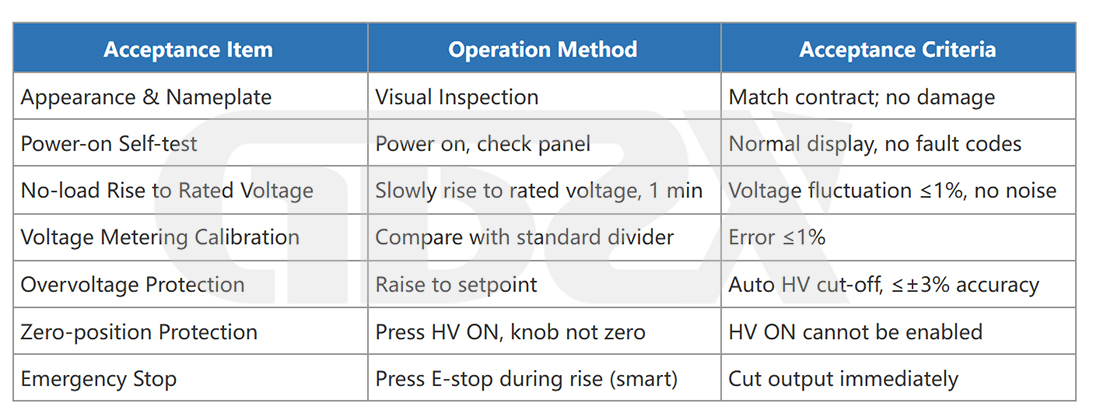
七、Delivery Acceptance Checklist
八、FAQ
Q: What DC test voltage should be applied to a 10 kV cable?
A: It depends on the cable nameplate rating. For a 6/10 kV cable (U₀ = 6 kV), apply 24 kV; for an 8.7/15 kV cable (U₀ = 8.7 kV), apply 34–35 kV.
Q: Should the test duration be 1 minute, 5 minutes, or 15 minutes?
A: Under GB 50150-2016, the duration for commissioning tests is 5 minutes. Some railway industry requirements specify 15 minutes. The 1-minute duration applies only to specific test items, such as DC withstand testing of generator stator windings.
Q: What leakage current is considered acceptable?
A: DL/T 596 specifies ≤50 μA, but year-on-year changes and the overall trend should also be given close attention.
Q: Can a DC HV generator be used for a 500 m cable?
A: Technically, yes. A 3 mA or 5 mA model is recommended, with the voltage rise rate controlled below 0.5 kV/s.
Q: Can a DC HV generator actually detect cable faults?
A: Yes, for oil-paper-insulated cables and severely damaged XLPE cables. However, its ability to detect early-stage minor defects in XLPE cables is significantly weaker than that of AC testing methods.
References
1.GB 50150-2016, Standard for Handover Test of Electrical Equipment in Electrical Equipment Installation Engineering
2.DL/T 596-2021, Code for Preventive Tests of Electric Power Equipment
3.GB/T 11032-2020, AC Gapless Metal Oxide Surge Arresters
4.GDZX ZGF Series DC High-Voltage Generator Product Specifications


