


NEWSnews
Power-Frequency Withstand Test Equipment: Procurement Guide
一、Before Purchasing: Understand That Higher Power-Frequency Withstand Voltage Is Not Always Better
There is no doubt about it. While this logic may hold true in other industries, in test equipment procurement it can directly lead to wasted budget and even idle equipment.
The core principle of a power-frequency withstand voltage test system is matching, not simply choosing the highest rating. The equipment must be matched to the voltage level of the test object, capacity requirements, and application scenario. Using a 200 kV system to test a 10 kV switchgear is technically feasible, but it means higher costs, greater transportation weight, and unnecessary complexity. Conversely, using a system with only 5 kVA to test several hundred meters of cable may cause the system to trip during voltage boosting, making the test impossible to complete. In this case, what is wasted is on-site labor time and the project schedule.
The first step in procurement is not to ask, “How large should the equipment be?” Instead, answer three questions first: What is the test object? What is the required test voltage? How large is the capacitive load? The answers to these three questions directly determine the equipment specifications.
二、What It Is and What Problem It Solves in the Procurement Process
工A power-frequency withstand voltage test system is specialized test equipment used to apply power-frequency high voltage to electrical equipment under test and verify its insulation withstand capability. Essentially, it is a step-up system: 220 V/380 V power-frequency mains is fed through a voltage regulator and test transformer, stepped up to tens or hundreds of kilovolts, and then applied to the test object to determine whether insulation breakdown occurs.
A typical system consists of three main components: a voltage regulator (for smoothly increasing the voltage from zero), a test transformer (for stepping up the low voltage to high voltage), and a control unit (control console or control box responsible for protection, timing, measurement, and recording).
2.2 What Problem Does It Solve in the Procurement Process
From a procurement perspective, this type of equipment addresses the compliance requirements for electrical equipment commissioning acceptance and preventive testing:
1.Commissioning withstand voltage tests after new equipment is delivered (in accordance with GB 50150-2016)
2.Insulation re-testing after major equipment overhauls
3.Periodic preventive tests (in accordance with DL/T 596-2021)
4.Type tests before delivery from the manufacturer (in accordance with applicable product standards)
These tests are subject to mandatory standards. Failure to perform them, or performing them in a non-compliant manner, may result in acceptance reports being rejected, preventing project completion or equipment commissioning. In essence, purchasing this type of equipment means purchasing a compliance tool.
2.3 Why Power-Frequency AC Instead of DC
Power-frequency AC (50 Hz) is consistent with the actual operating frequency of the power system. AC voltage produces periodic polarization stress in insulation materials and can reveal local defects that may be difficult to detect under DC voltage, particularly defects such as air-gap defects, interfacial delamination, and mechanical damage. GB 50150-2016 explicitly requires power-frequency withstand voltage testing for most equipment during commissioning acceptance. As a specified test method under the applicable standard, its test results can be directly used in engineering acceptance and other relevant compliance processes.
三、Power-Frequency AC, VLF, and Series Resonance: How to Choose
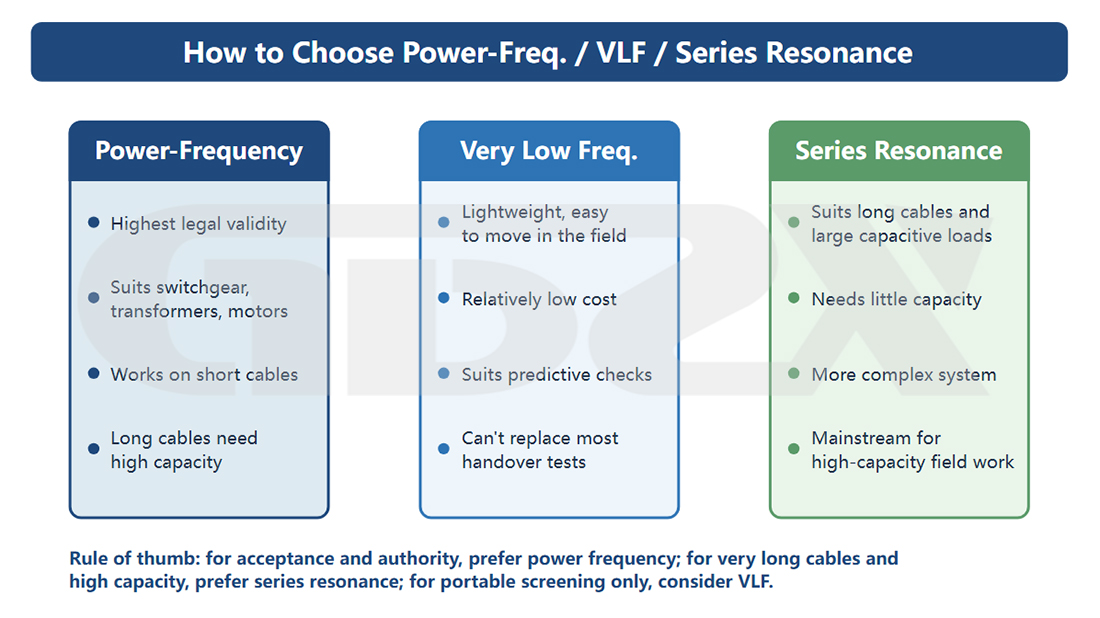
Figure: A quick guide to the procurement decision logic in this section
3.1 Core Comparison of the Three Methods
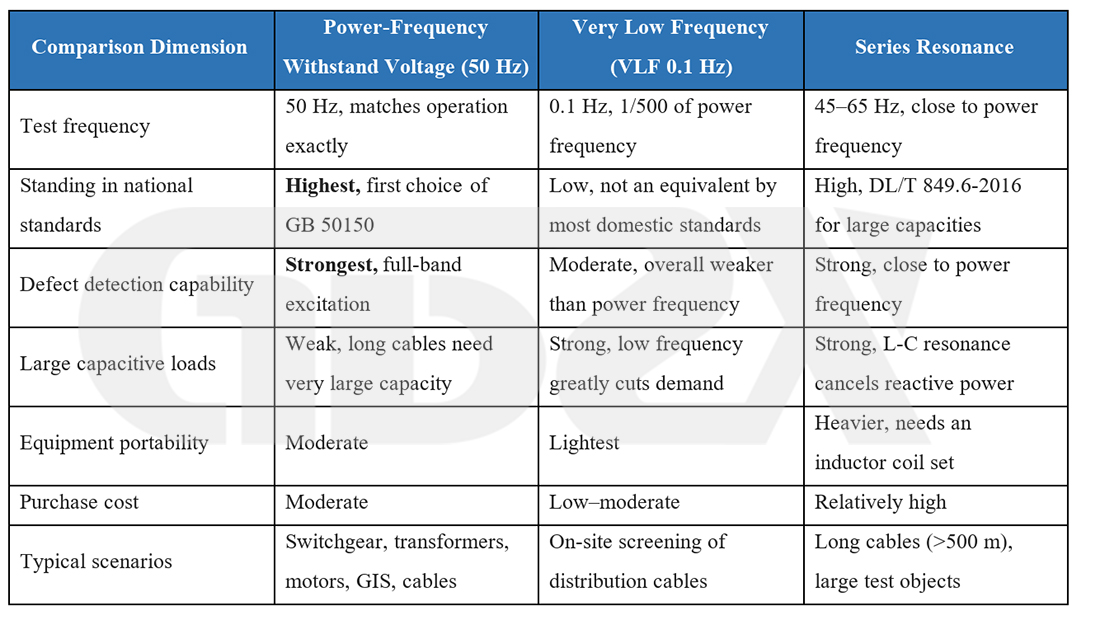
3.2 Procurement Decision Criteria
Conditions for Prioritizing Power-Frequency Withstand Voltage Testing:
1.The test object is a switchgear, circuit breaker, transformer, motor, GIS, insulating rod, or other equipment with relatively low capacitance.
2.The test requires an official commissioning acceptance report with legal validity.
3.The test cable is relatively short (typically within 500 m; the required capacity must be calculated based on the actual test conditions).
Conditions for Selecting Series Resonance:
1.The test object is a long cable (generally over 500 m), and the power capacity required for power-frequency testing exceeds the available equipment capacity.
2.The site has limited power supply capacity and cannot support a high-power power-frequency test transformer.
Conditions for Selecting VLF:
1.Outoor or mobile testing where strict weight restrictions apply.
2.Predictive maintenance and preliminary condition assessment, rather than final acceptance testing.
3.The budget is extremely limited and the user accepts restricted functionality.
⚠️ GB 50150-2016 does not recognize VLF testing as an equivalent alternative for the commissioning acceptance of most electrical equipment. Where a project specifies power-frequency withstand voltage testing as a commissioning requirement, VLF testing cannot replace power-frequency testing for issuing an acceptance report.


