


NEWSnews
Power-Frequency Withstand Test: Control Selection & Procurement Guide
七、Control Box vs. Control Console: It’s More Than Just Size—and How to Determine the Test Transformer
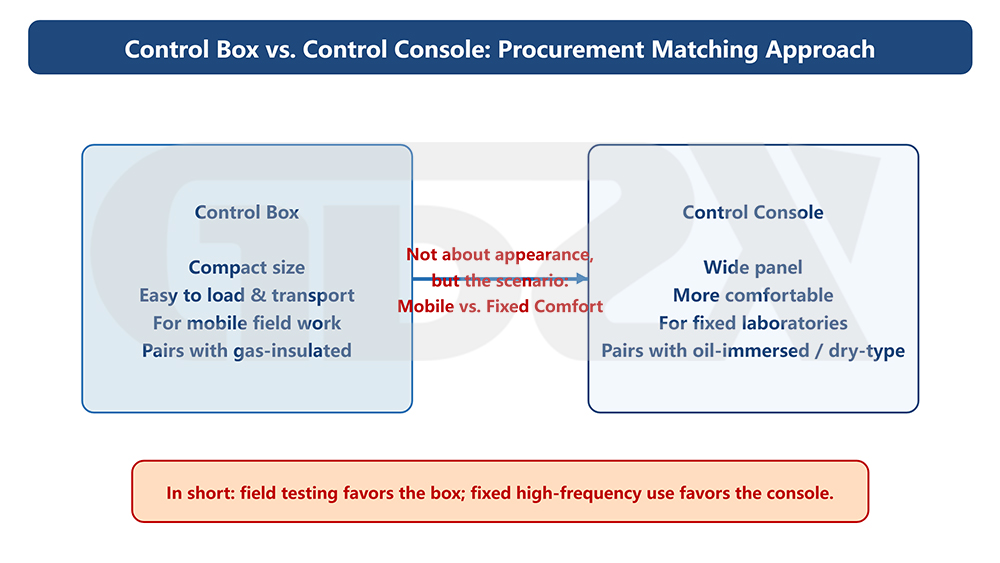
Figure: Control Box vs. Control Console — Procurement Matching Approach
Choosing a control console or a control box depends on the application scenario, not personal preference.
Control Console: Floor-standing or desktop design, with a wider panel and ample space for knobs, meters, and buttons, providing a clear operating view. Suitable for fixed installations and locations requiring frequent, long-term use. Less convenient to move, but more comfortable to operate.
Control Box: Integrated box-type design with a compact size and carrying handle, making the complete set convenient for transportation. Suitable for field operations requiring frequent relocation. The compact design limits panel space, but does not reduce functionality.
The control mode (manual/automatic) and enclosure type (console/box) are independent dimensions and can be freely combined:
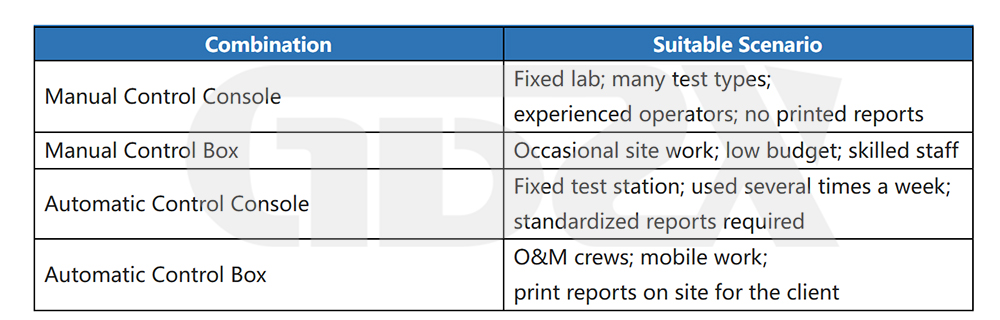
7.1 Determine the Test Transformer Configuration from the Control Unit
If Chapter 7 starts by selecting between a “control box” and a “control console,” the selection can also be approached in reverse: first determine the control unit, then identify the most suitable type of test transformer to pair with it. This approach is particularly useful when preparing technical specifications for tenders, because many projects initially determine whether a portable box-type or fixed console-type configuration is required.
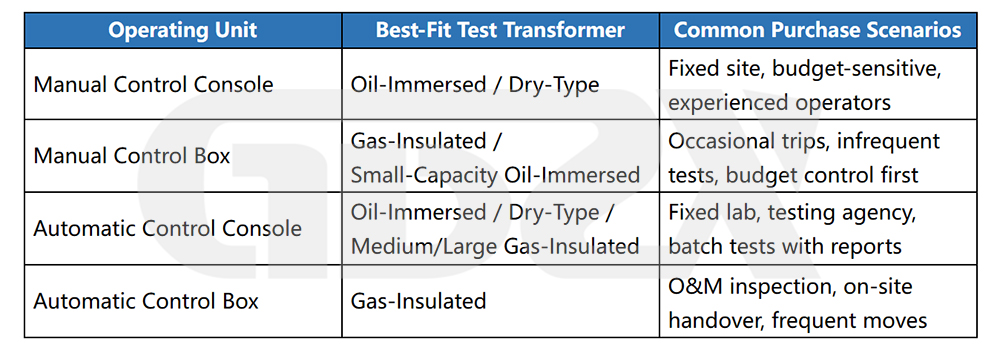
In procurement terms, the selection can be summarized in four points:
1.For fixed use, with an emphasis on operating comfort and long-term stability, prioritize a control console paired with an oil-immersed or dry-type test transformer.
2.For frequent relocation, with an emphasis on field efficiency and ease of transportation, prioritize a control box paired with a gas-insulated test transformer.
3.For frequent testing, where consistent records and report output are required, prioritize the automatic type.
4.When budget control is a priority and the testing tasks are relatively simple, the manual type or fixed oil-immersed configuration is often more economical.
Where does the practical value of the automatic type lie? It is not just about convenience, but about reducing human error. Automatic control of the voltage rise rate, timing, and voltage reduction throughout the test helps meet the operational requirements of GB/T 16927.1. The resulting report format and recorded items can also meet the requirements of GB 50150. If the client requires standardized test reports for acceptance, manually compiled reports may sometimes be subject to questions or additional verification.
Who is the manual type suitable for? It is suitable for users with experienced operators, applications where written reports do not need to be submitted to the client, or training and teaching purposes. The manual type has a lower acquisition cost and is sufficient for such applications.
Regardless of the control mode selected, overcurrent protection, overvoltage protection, and zero-position interlocking must all be provided and verifiable on site. These are not merely manufacturer marketing claims; they are basic requirements of GB/T 16927.1 and should also be explicitly included as acceptance criteria in the contract.
八、Recommended Selection Strategies for Three Procurement Scenarios
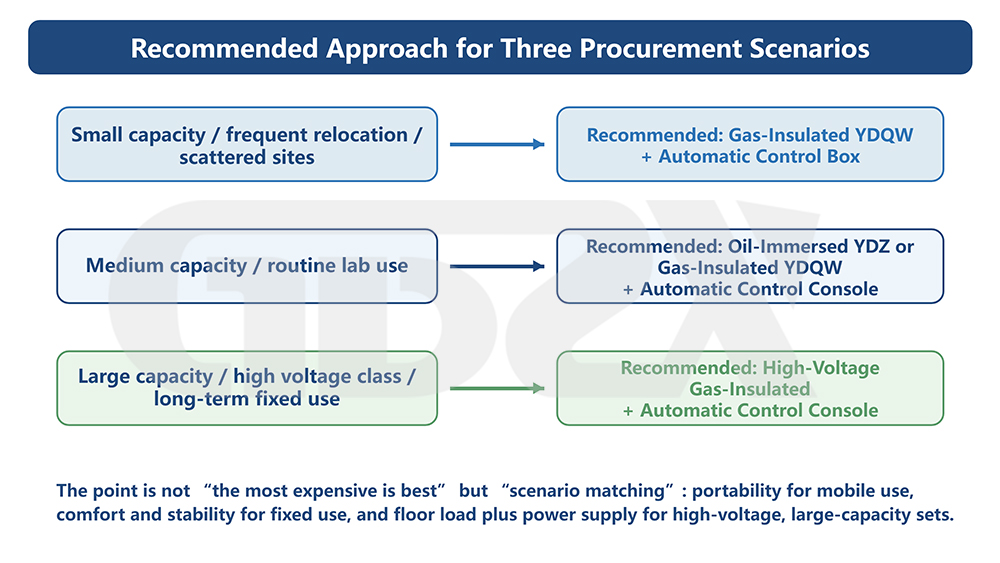
Figure: Recommended Procurement Strategies for Three Procurement Scenarios
Scenario 1: Small Capacity / Frequent Relocation / Dispersed Field Operations
Typical buyers in this category include power supply utility maintenance teams, equipment installation companies, and third-party mobile testing service providers. Their concern is not simply whether the equipment can perform the test, but which configuration is most suitable to take to each site.
Recommended configuration: Gas-Insulated YDQW + Automatic Control Box
1.The gas-insulated design is lightweight, fully enclosed, and less susceptible to moisture and vibration during transportation.
2.The control box is convenient for vehicle loading, reducing transportation costs when multiple work sites are involved.
3.The automatic type can print test reports on site, eliminating the need for manual report preparation afterward.
4.High-voltage ratings are typically 50 kV or 100 kV, covering test objects in 10 kV and 35 kV systems.
5.A capacity of 3–10 kVA covers conventional equipment such as switchgear, transformers, and motors.
If the primary application is cable testing and the cables are generally long, the required capacity should be calculated first. If the capacity is insufficient, series resonance testing should be considered.
Scenario 2: Medium Capacity / Routine Use in a Fixed Laboratory
This category includes quality inspection departments of manufacturers, testing laboratories of power construction companies, and dedicated testing teams at substations. These users have fixed facilities, frequent testing requirements, and relatively fixed types of test objects.
Recommended configuration: Oil-Immersed YDZ or Gas-Insulated YDQW + Automatic Control Console
1.For fixed installations, weight is less critical, making the oil-immersed type more cost-effective.
2.If the test objects include GIS or partial-discharge-free testing is required, the gas-insulated type should be selected.
3.The control console provides greater operating comfort and is suitable for frequent testing.
4.Typical specifications are 50 kV or 100 kV, with a capacity of 10–30 kVA.
5.The automatic type reduces manual recording workload and improves testing efficiency.
Scenario 3: Large Capacity / High Voltage Level / Long-Term Fixed Installation
This category includes provincial-level power testing institutes, factory test laboratories of high-voltage equipment manufacturers, and large infrastructure projects. Test objects include equipment rated 110 kV and above, with frequent testing and high requirements for stability and accuracy.
Recommended configuration: High-Voltage Gas-Insulated YDQW (100 kV / 150 kV / 200 kV) + Automatic Control Console
1.High-voltage configurations require the insulation strength provided by the gas-insulated design; a single unit can reach 300 kV.
2.A capacity of 20–50 kVA or above is recommended as a starting point and should be calculated based on the maximum test-object capacity.
3.Equipment rated above 100 kV becomes significantly heavier and larger. Before procurement, the installation site's load-bearing capacity and access route must be confirmed.
4.The utomatic control console meets the requirements for batch testing and standardized test report generation.
九、The Most Common Procurement Pitfalls
Pitfall 1: Looking Only at Voltage Without Calculating Capacity
This is one of the most common mistakes. A 100 kV unit may trip during cable testing because its capacity is only 5 kVA while the test object requires more than 20 kVA. A sufficiently high voltage rating does not mean sufficient capacity. These are two independent specifications, and both must be considered.
Pitfall 2: Using the Factory Test Voltage Directly as the Procurement Basis
GB 50150-2016 generally specifies that the withstand test voltage for handover tests is 80% of the factory test value. However, the applicable ratio varies depending on the equipment and specific clause, so it should not be applied as a blanket “80% rule.” Selecting equipment directly based on the factory test voltage may result in an unnecessarily high voltage rating, wasted budget, and limited practical use of the high-voltage range when the same equipment is later used for handover testing.
Pitfall 3: Assuming Protection Functions Are Reliable Just Because They Are Listed
A quotation may state that the equipment “has three protection functions,” but during on-site acceptance, it is not uncommon to find that a protection trigger condition is incorrectly configured or that a protection function fails to operate. The contract should explicitly require that all three protection functions be individually verified on site before delivery acceptance, with final payment conditional on successful verification.
Pitfall 4: Selecting a Gas-Insulated Type Without Assessing SF₆ Maintenance Capability
Routine maintenance of gas-insulated equipment requires regular pressure and leak checks using an SF₆ leak detector, while leak handling and disposal may require qualified personnel or services. If the user does not have the necessary maintenance capability, every inspection may need to be outsourced and every leakage incident may require manufacturer support. Some users only discover after purchase that they cannot handle these tasks themselves, resulting in unplanned operating costs.
Pitfall 5: Having a Calibration Certificate Without Verifying Its Validity
Test transformers are subject to mandatory metrological verification, and the verification interval is generally no longer than 2 years. After receiving the equipment, verify that the model on the certificate exactly matches the equipment nameplate and that the certificate remains within its validity period. Some equipment may have passed factory verification but already have an expired certificate by the time it reaches the user, or the certificate model may not match the actual equipment. An expired certificate or model mismatch may cause the test report to be questioned or rejected by supervisory authorities.
Pitfall 6: Comparing Only the Purchase Price Without Calculating Maintenance Costs
Low-cost equipment suppliers may not guarantee long-term spare-parts availability. If the equipment fails and replacement parts have been discontinued or the manufacturer is unable to provide support, the entire unit may remain out of service. During procurement, confirm the guaranteed supply period for critical wear parts, fault-response time, and whether annual verification services are supported.
Pitfall 7: Discovering Only After Delivery That the Equipment Cannot Be Moved into the Installation Area
For gas-insulated transformers rated above 100 kV, the main unit may exceed 1.5 m in height. With the control console included, the overall footprint can be substantial, and the total weight may exceed 100 kg. There have been cases where equipment arrived on site but could not pass through the elevator or doorway. Before procurement, confirm the clear height and width of the transportation route, floor load-bearing capacity, and whether the available power supply capacity meets the equipment's operating requirements.


