NEWSnews
Insulation Resistance Testing: Principles, Metrics & Limits
1. What Is Insulation Resistance Testing? The Physics Behind It
Insulation is the first line of defense for the safe operation of electrical equipment. In every transformer, motor, cable, and switchgear, insulation materials provide the electrical isolation between conductors and between conductors and enclosures. The health of the insulation material directly determines whether the equipment can operate stably at its rated voltage over the long term.
Insulation resistance testing is, in essence, a quantitative assessment of the resistive characteristics that insulating materials exhibit under DC high-voltage excitation. A DC high voltage (typically ranging from 250 V to 5000 V) is applied across the insulation under test, the small current passing through the insulation is measured, and the insulation resistance value is calculated according to Ohm's law. The unit is usually megohms (MΩ), gigaohms (GΩ), or even teraohms (TΩ). The basic calculation relationship is:
Insulation resistance R = Test voltage U ÷ Leakage current I
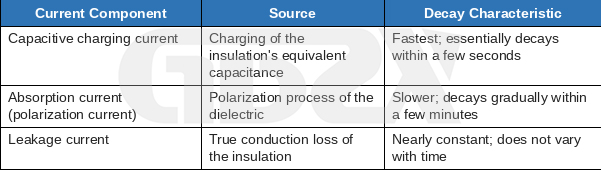
After DC high voltage is applied, the current flowing through the insulation is not a fixed value but the superposition of three current components, decaying dynamically over time:
2. Key Measurement Metrics: Time-Point Readings, Absorption Ratio, and Polarization Index
Meaning of Each Time Point
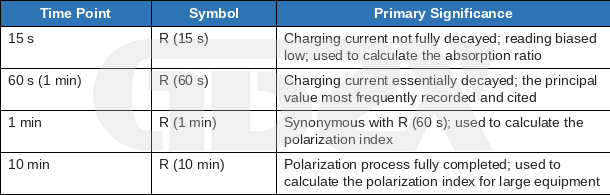
After DC high voltage is applied, readings at different time points reflect different physical states:
Absorption Ratio
Absorption ratio K = R(60 s) ÷ R(15 s)
When the insulation is dry and in good condition, the 60 s value is significantly higher than the 15 s value, giving a large absorption ratio; when the insulation is damp or deteriorated, the leakage current dominates, the two values converge, and the absorption ratio approaches 1.0. DL/T 596-2021 gives a reference requirement for oil-immersed transformers (10 °C to 30 °C) that the absorption ratio should generally be no less than 1.3; the specific values are subject to the corresponding current standard clauses.
Polarization Index
Polarization index PI = R(10 min) ÷ R(1 min)
This index applies to large equipment with long polarization processes, such as large transformers and high-voltage generators, for which the absorption ratio alone cannot adequately reflect the insulation condition. The higher the value, the drier the insulation; a value close to 1.0 indicates that the insulation may be damp or severely aged (the specific acceptance values are subject to the corresponding current standard).
Temperature Correction
Insulation resistance exhibits significant temperature dependence: for every increase of approximately 10 °C, the insulation resistance roughly halves:
R(Standard temperature) = R(Test temperature) × KT
KT is the temperature conversion coefficient, which varies with the insulation material and should be taken from the corresponding standard or manufacturer's data. The temperature must be recorded for each test; readings taken at different temperatures must not be compared directly.
3. Why Is Insulation Resistance Testing Mandatory for Power Equipment?
Insulation resistance testing has become a mandatory test item for almost all power equipment for the following reasons: insulation deterioration is the root cause of most electrical faults, and a continuous decline in insulation resistance from the GΩ level is a precursor of breakdown and ground faults; compared with methods such as dielectric loss and partial discharge testing, insulation resistance testing equipment is compact, cost-controllable, and standardized in operation, making it suitable as a basic item for on-site inspection, acceptance testing, and preventive testing; both GB 50150-2016 and DL/T 596-2021 explicitly list it as a mandatory test item for equipment such as transformers, motors, cables, and switchgear.
More importantly, the value of insulation resistance testing lies not only in a single absolute value but also in the longitudinal trend of historical data. Many preventive test regulations place special emphasis in their acceptance clauses on being "no lower than a certain percentage of the previous test result," precisely because a sustained downward trend reflects the direction of insulation condition evolution better than any single reading. If the insulation resistance of a main transformer continues to decline significantly across successive tests, further in-depth evaluation must be arranged even if the absolute limit has not yet been reached.
4. What Can Insulation Resistance Testing Detect, and What Can It Not Replace?
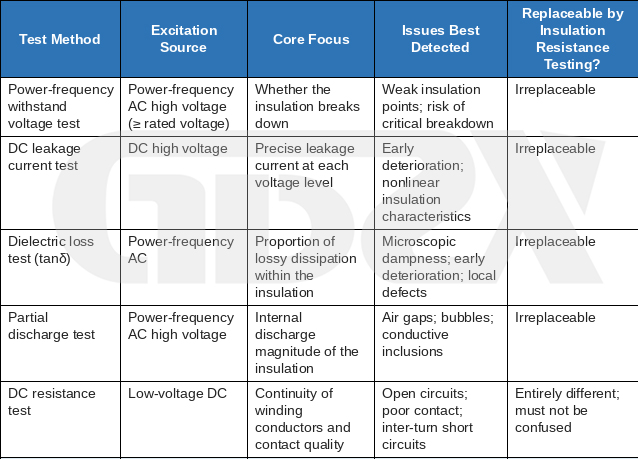
Insulation resistance testing is good at detecting overall dampness or contamination, severe insulation aging, and through-type defects, and at making a preliminary assessment of the effectiveness of drying treatment when combined with the absorption ratio. However, it is a "first screening" rather than everything — the following scenarios cannot be replaced by it: